Parmar Vinod, Orabi Esam A, English Ann M, Peslherbe Gilles H
Department of Chemistry and Biochemistry, Centre for Research in Molecular Modeling (CERMM), Concordia University, 7141 Sherbrooke Street West, Montréal, QC, H4B 1R6, Canada.
Quebec Network for Research on Protein Function, Structure, and Engineering (PROTEO), Montréal, Canada.
Sci Rep. 2024 Dec 30;14(1):31552. doi: 10.1038/s41598-024-80230-7.
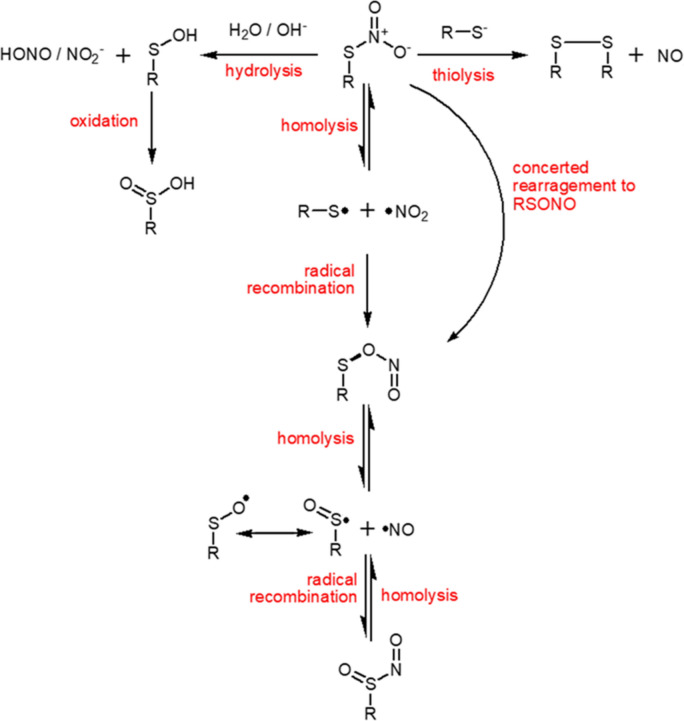
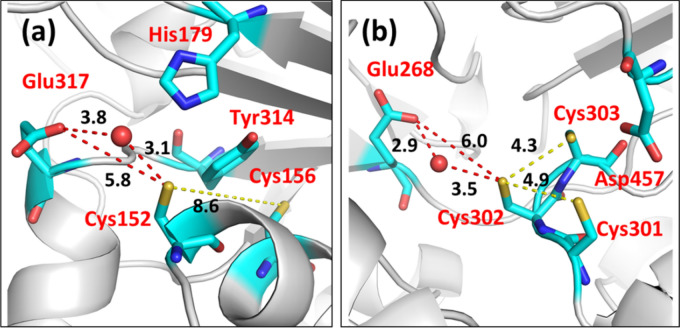
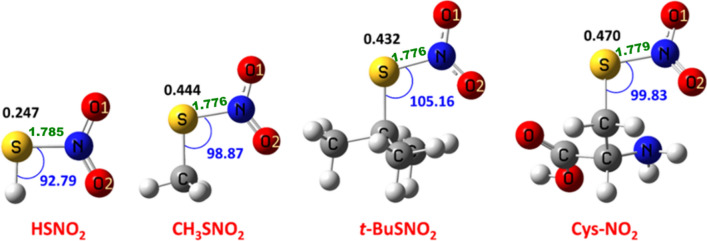
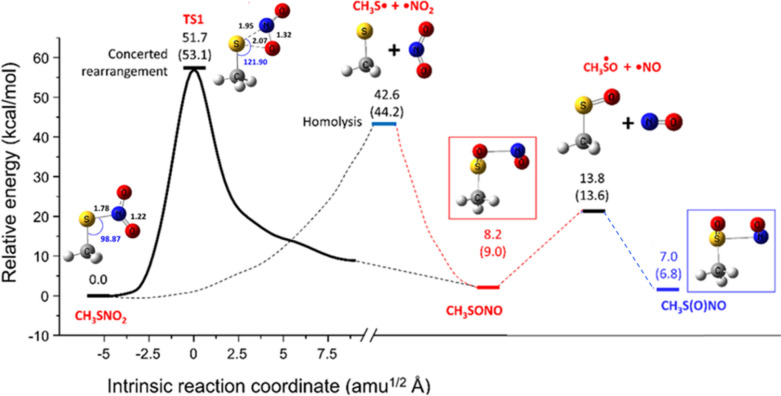
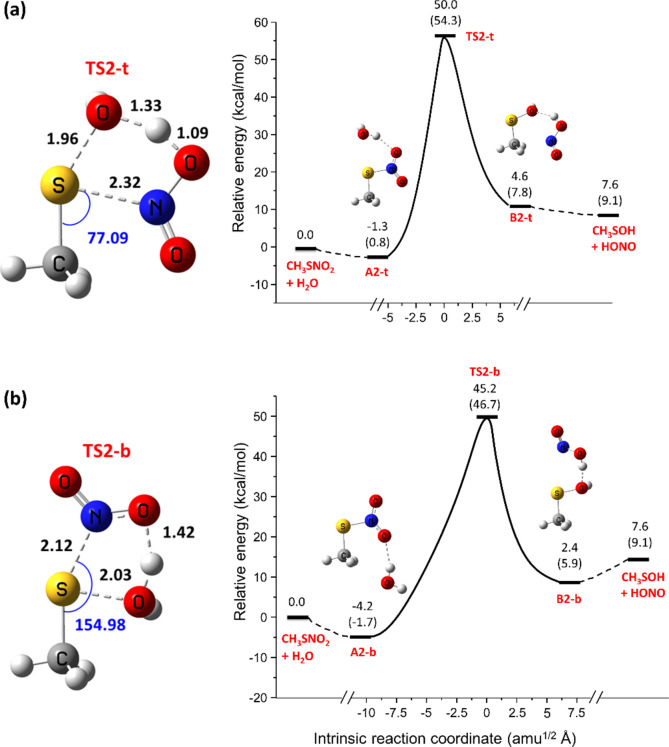
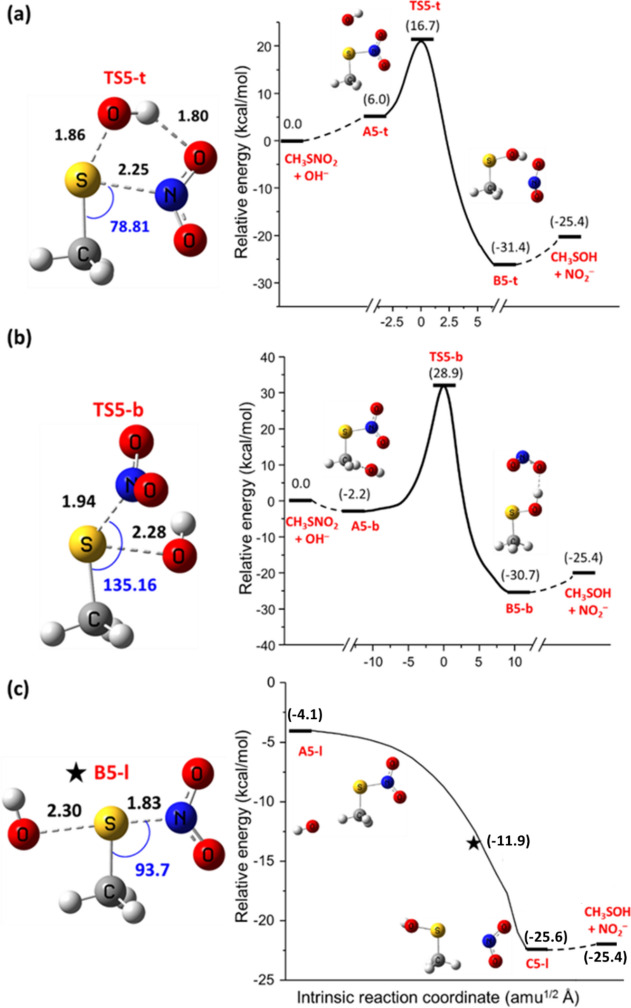
Nitroglycerin is a potent vasodilator in clinical use since the late 1800s. It functions as a prodrug that is bioactivated by formation of an enzyme-based thionitrate, E-Cys-NO. This intermediate reportedly decomposes to release NO and NO but their relative yields remain controversial. Hence, we determined barriers for NO and NO production from the model thionitrate, CHSNO, using comprehensive high-level quantum chemistry calculations [CCSD(T)//MP2/aug-cc-pVTZ]. We find that the sulfenyl nitrite, CHSONO, readily releases NO on (S)O-N bond homolysis but CHSONO formation from CHSNO either by S-NO bond homolysis or concerted rearrangement faces prohibitively high barriers (ΔH/ΔH > 42 kcal/mol). Dramatically lower barriers (ΔH ~ 17-21 kcal/mol) control NO release from CHSNO by gas-phase hydrolysis or nucleophilic attack by OH or CHS on the sulfur atom within the C-S-NO molecular plane. Moreover, attack by either anion along the S-NO bond results in barrierless NO release (ΔH ~ 0 kcal/mol) since a σ-hole (i.e., area of positive electrostatic potential) extends from this bond. Consistent with our high-level calculations, ALDH2 and GAPDH, enzymes implicated in nitroglycerin bioactivation via an E-Cys-NO intermediate, catalyze mainly or exclusively NO release from the prodrug.
自19世纪后期以来,硝酸甘油一直是临床使用的强效血管扩张剂。它作为一种前药,通过形成基于酶的硫代硝酸盐E-Cys-NO进行生物活化。据报道,这种中间体分解会释放NO和NO,但它们的相对产率仍存在争议。因此,我们使用全面的高水平量子化学计算[CCSD(T)//MP2/aug-cc-pVTZ]确定了模型硫代硝酸盐CHSNO产生NO和NO的障碍。我们发现,亚磺酰基亚硝酸盐CHSONO在(S)O-N键均裂时很容易释放NO,但CHSNO通过S-NO键均裂或协同重排形成CHSONO面临极高的障碍(ΔH/ΔH > 42 kcal/mol)。气相水解或OH或CHS对C-S-NO分子平面内硫原子的亲核攻击控制CHSNO释放NO的障碍显著降低(ΔH ~ 17-21 kcal/mol)。此外,由于一个σ-空穴(即正静电势区域)从该键延伸,任何一种阴离子沿S-NO键的攻击都会导致无障碍的NO释放(ΔH ~ 0 kcal/mol)。与我们的高水平计算一致,通过E-Cys-NO中间体参与硝酸甘油生物活化的酶ALDH2和GAPDH主要或专门催化前药释放NO。