Bisen Divya, Chouhan Ashish Pratap Singh, Sarma Anil Kumar, Rajamohan Sakthivel, Elumalai P V, Balasubramanian Dhinesh, Cherie Aschalew
Department of Physics, School of Chemical Engineering and Physical Sciences, Lovely Professional University, Phagwara, Punjab, India.
Sardar Swaran Singh National Institute of Bio-Energy, Kapurthala, Punjab, India.
Sci Rep. 2024 Dec 30;14(1):31798. doi: 10.1038/s41598-024-82830-9.
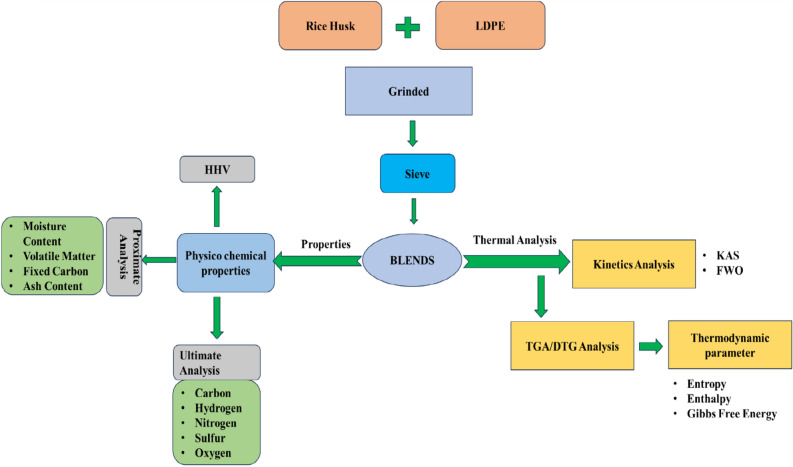
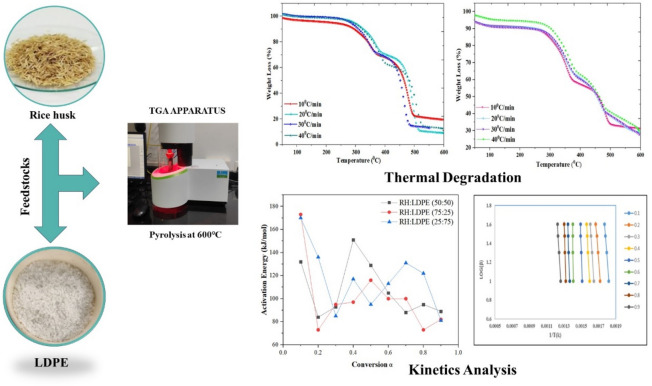
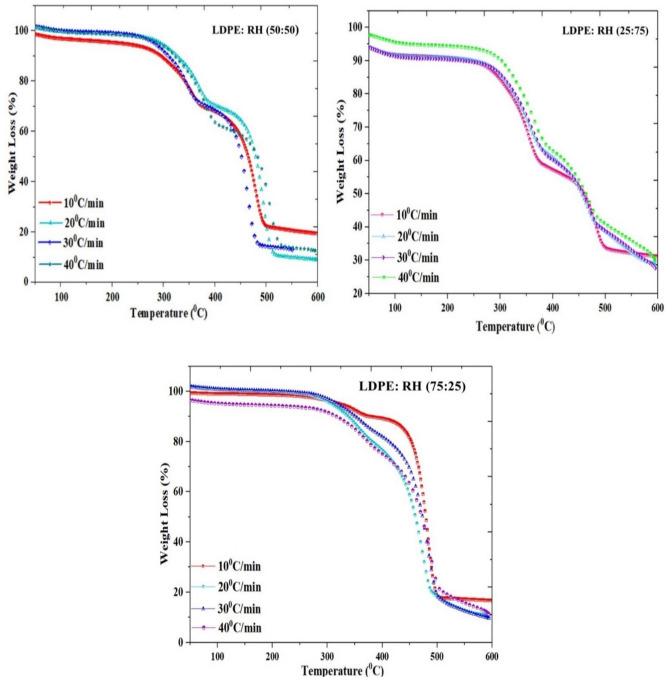
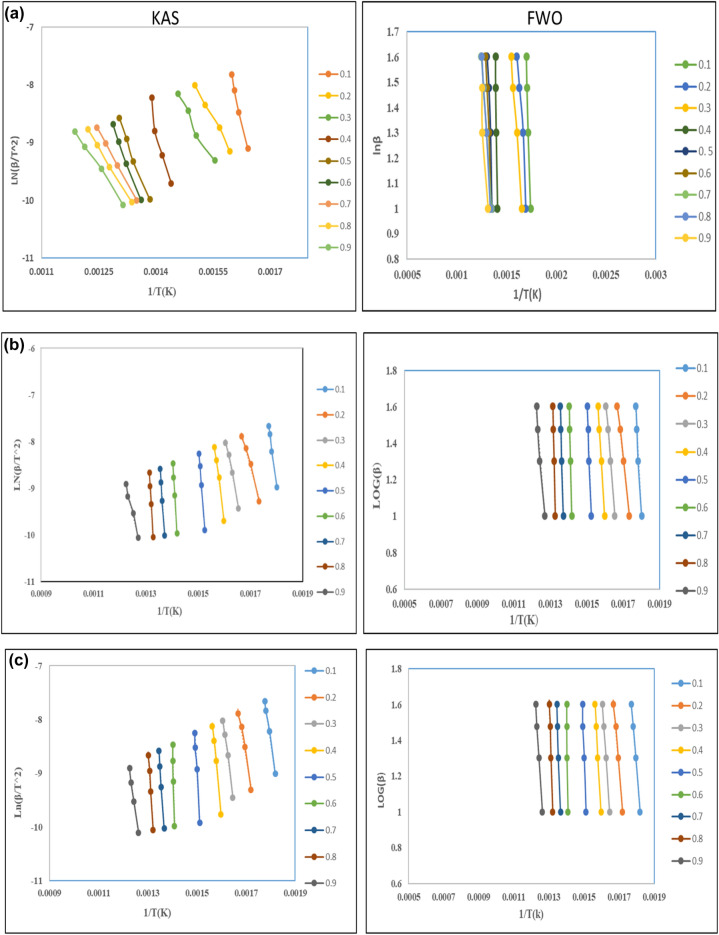
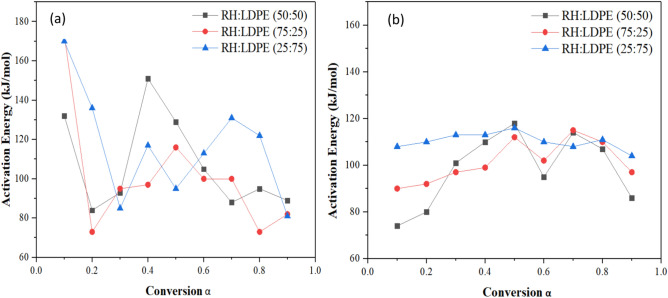
The purpose of this study is to examine how co-pyrolysis of low-density polyethylene (LDPE) and rice husk is impacted by LDPE. It also looks into the physicochemical characteristics, thermal behavior, and kinetic parameters of these materials. To understand the thermal behavior through TGA, rice husk and LDPE blends in the ratios of LDPE: RH (50:50), LDPE: RH (25:75), and LDPE: RH (75:25) were prepared and tested. These tests were carried out in the presence of a nitrogen environment at a flow rate of 20 ml/min with a different heating rate of 10 to 40 °C/min from 30 to 600 °C.In this paper, activation energy (E) was measured using the integral method (coats and Redfern) and two distinct iso-conversional approaches are Flynn wall Ozawa (FWO) and Kissinger Akahira Sunose (KAS). According to this study, the E values during co-pyrolysis varied with the conversion points, demonstrating the complex nature of the materials that resulted from the process. Moreover, it can be said that the assessment of low-density polyethylene in conjunction with rice husk led to noteworthy changes in thermos kinetic behaviors. In the meantime, the calculated average activation energy is, in turn, 110-117, 101-102, and 102-107 kJ/mol. In this study, we analyze the thermodynamic parameters, including enthalpy, Gibbs free energy, and entropy, and also pyrolysis performance index was thoroughly explored to understand the co-pyrolysis process of rice husk and plastic waste. To develop efficient reactors for continuous operation regardless of feedstock composition, it was necessary to establish the significance of blending biomass with plastics in terms of augmented carbon conversion, volatiles, and reaction rate.
本研究的目的是考察低密度聚乙烯(LDPE)对低密度聚乙烯与稻壳共热解的影响。研究还探究了这些材料的物理化学特性、热行为和动力学参数。为通过热重分析(TGA)了解热行为,制备并测试了LDPE与稻壳比例为LDPE:RH(50:50)、LDPE:RH(25:75)和LDPE:RH(75:25)的混合物。这些测试在氮气环境中进行,流速为20毫升/分钟,从30至600℃以10至40℃/分钟的不同加热速率进行。本文采用积分法(Coats和Redfern)测量活化能(E),并采用两种不同的等转化率方法,即Flynn-Wall-Ozawa(FWO)法和Kissinger-Akahira-Sunose(KAS)法。根据本研究,共热解过程中的E值随转化点变化,表明该过程产生的材料具有复杂性质。此外,可以说低密度聚乙烯与稻壳结合的评估导致了热动力学行为的显著变化。同时,计算得到的平均活化能依次为110 - 117、101 - 102和102 - 107千焦/摩尔。在本研究中,我们分析了包括焓、吉布斯自由能和熵在内的热力学参数,并深入探讨了热解性能指标,以了解稻壳与塑料废弃物的共热解过程。为开发无论原料组成如何都能连续运行的高效反应器,有必要确定将生物质与塑料混合在提高碳转化率、挥发物和反应速率方面的意义。