Parenti Mariana, Shoff Shannon, Sotelo-Orozco Jennie, Hertz-Picciotto Irva, Slupsky Carolyn M
Department of Nutrition, Department of Food Science and Technology, University of California, One Shields Avenue, Davis, CA, 95616, USA.
Center for Developmental Biology and Regenerative Medicine, Seattle Children's Research Institute, Seattle, WA, USA.
Sci Rep. 2024 Dec 30;14(1):31981. doi: 10.1038/s41598-024-83587-x.
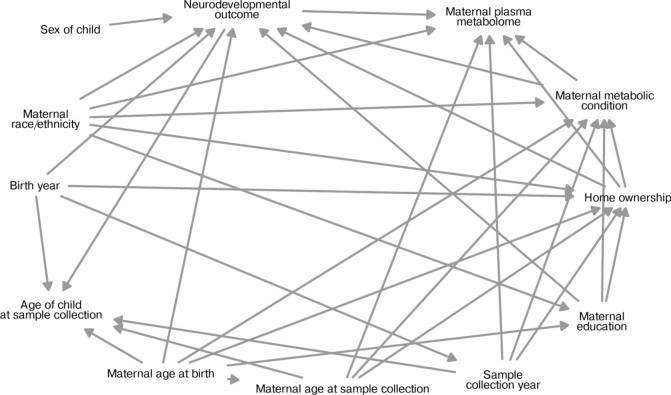
Developmental delays have been associated with metabolic disturbances in children. Previous research in the childhood autism risk from genetics and the environment (CHARGE) case-control study identified neurodevelopment-related plasma metabolites in children, suggesting disturbances in the energy-related tricarboxylic acid (TCA) cycle and 1-carbon metabolism (1CM). Here, we investigated associations between children's neurodevelopmental outcomes and their mothers' plasma metabolite profiles in a subset of mother-child dyads from CHARGE, including those with autism spectrum disorder (ASD, n = 209), Down syndrome (DS, n = 76), idiopathic developmental delay (iDD, n = 64), and typically developed (TD, n = 185) controls. Multiple linear regression revealed associations between child neurodevelopmental outcomes and maternal plasma metabolites related to the TCA cycle, 1CM, and lipid metabolism. Despite profound metabolic disturbances in children with DS reported previously, few of these differences were observed in the mothers, which might reflect differences in gene dosage between children with DS and their euploid mothers. Notably differences in maternal metabolism related to ASD and iDD followed similar patterns of disturbance in previously reported metabolic signatures in children but were generally smaller in magnitude. Similar patterns of metabolic disturbances observed in mothers and their children with ASD or iDD could reflect shared genetic, mitochondrial, and/or environmental risk factors.
发育迟缓与儿童代谢紊乱有关。先前在儿童自闭症遗传与环境风险(CHARGE)病例对照研究中的研究确定了儿童中与神经发育相关的血浆代谢物,提示能量相关的三羧酸(TCA)循环和一碳代谢(1CM)存在紊乱。在此,我们在CHARGE研究中的一部分母婴对子中调查了儿童神经发育结局与其母亲血浆代谢物谱之间的关联,包括患有自闭症谱系障碍(ASD,n = 209)、唐氏综合征(DS,n = 76)、特发性发育迟缓(iDD,n = 64)和发育正常(TD,n = 185)的对照组。多元线性回归揭示了儿童神经发育结局与母亲血浆中与TCA循环、1CM和脂质代谢相关的代谢物之间的关联。尽管先前报道患有DS的儿童存在严重的代谢紊乱,但在母亲中几乎未观察到这些差异,这可能反映了DS患儿与其整倍体母亲之间的基因剂量差异。值得注意的是,与ASD和iDD相关的母亲代谢差异遵循了先前报道的儿童代谢特征中类似的紊乱模式,但程度通常较小。在患有ASD或iDD的母亲及其子女中观察到的类似代谢紊乱模式可能反映了共同的遗传、线粒体和/或环境风险因素。