Tang Fang, Zhou Minghe, Li Bo
College of Systems Engineering, National University of Defense Technology, Changsha, China.
The Second Xiangya Hospital, Central South University, Changsha, China.
Sci Rep. 2024 Dec 30;14(1):31938. doi: 10.1038/s41598-024-83459-4.
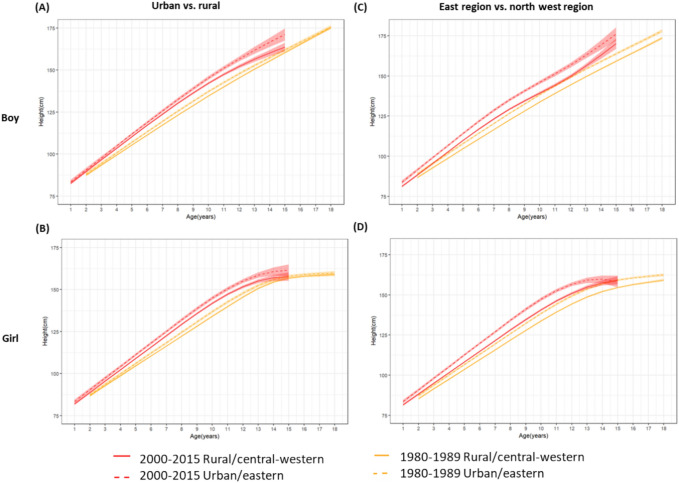
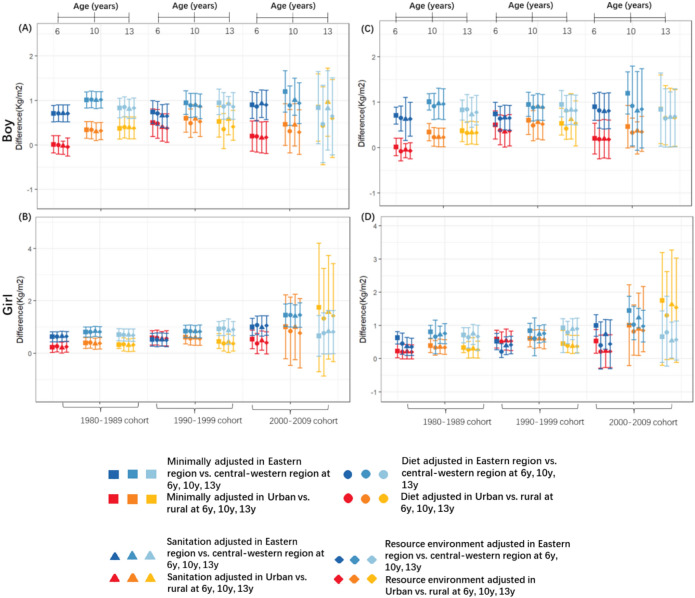
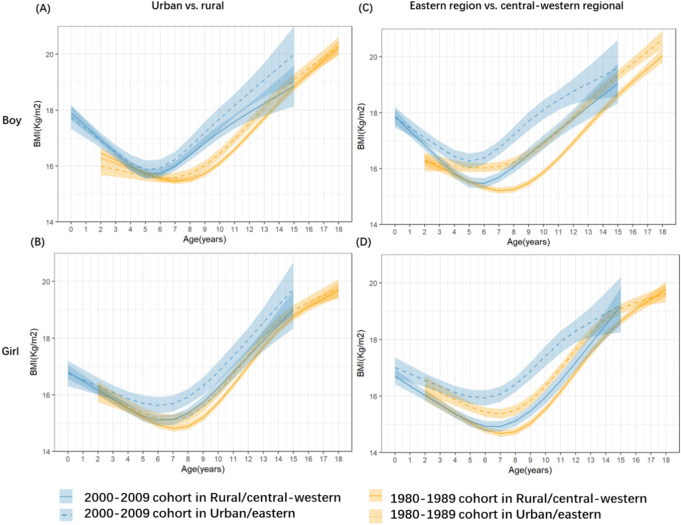
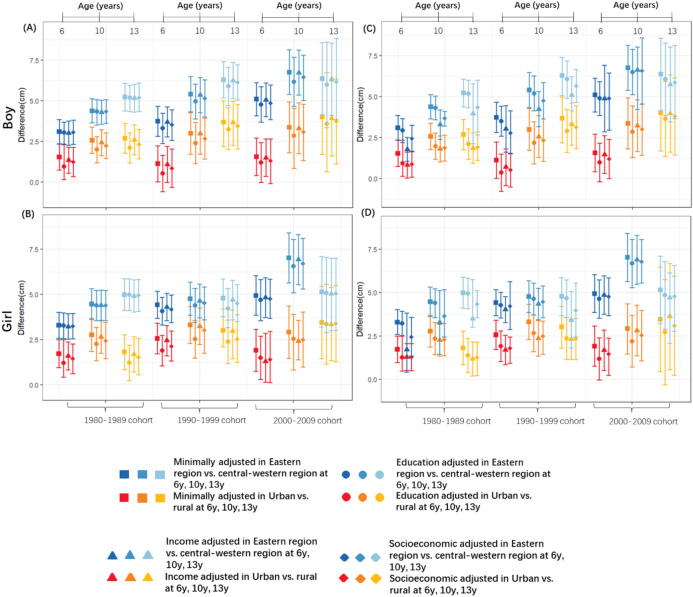
Children in urban and eastern regions tend to be taller and have higher body mass index (BMI) compared to those in rural and central-western regions, partially due to better family resources. We examined urban‒rural areas, regional differences in growth trajectories, focusing on family influences. Longitudinal data on 8542 children from the China Health and Nutrition Survey (1991-2015) were used. Random effects models assessed the mean height/BMI growth trajectories across different regions, urban-rural areas, and sexes within cohorts born in 1980-1989, 1990-1999, and 2000-2009. In the 1980-1989 cohort, before adjusting for family dietary structure, children from eastern regions were on average 3.3 cm taller than those from central-western regions at age 6. After adjustment, the height difference decreased to 2.44 cm. In the 2000-2009 cohort, the urban-rural BMI difference at age 6 was initially 0.53 kg/m, which narrowed to 0.40 kg/m after adjusting for family socioeconomic factors. After adjusting for family environmental sanitation, the regional difference in the 2000-2009 cohort was attenuated by half before adjustment and was 0.44 kg/m after adjustment. Family factors significantly account for the regional and urban-rural disparities in height and BMI. These disparities were driven by the family resource environment, like dietary structure and sanitation. However, with China's socioeconomic changes, broader socioeconomic factors, including household income and parental education, have become more influential.
与农村和中西部地区的儿童相比,城市和东部地区的儿童往往更高,体重指数(BMI)也更高,部分原因是家庭资源更好。我们研究了城乡地区、生长轨迹的区域差异,重点关注家庭影响。使用了来自中国健康与营养调查(1991 - 2015年)的8542名儿童的纵向数据。随机效应模型评估了1980 - 1989年、1990 - 1999年和2000 - 2009年出生队列中不同地区、城乡地区和性别的平均身高/BMI生长轨迹。在1980 - 1989年队列中,在调整家庭饮食结构之前,东部地区的儿童在6岁时平均比中西部地区的儿童高3.3厘米。调整后,身高差异降至2.44厘米。在2000 - 2009年队列中,6岁时城乡BMI差异最初为0.53kg/m²,在调整家庭社会经济因素后缩小至0.40kg/m²。在调整家庭环境卫生后,2000 - 2009年队列中的区域差异在调整前减弱了一半,调整后为0.44kg/m²。家庭因素显著解释了身高和BMI的区域及城乡差异。这些差异是由家庭资源环境驱动的,如饮食结构和卫生条件。然而,随着中国社会经济的变化,包括家庭收入和父母教育程度在内的更广泛的社会经济因素变得更具影响力。