Korpinen K, Autere T A, Tuominen J, Löyttyniemi E, Eigeliene N, Talvinen K, Kronqvist P
Institute of Biomedicine, University of Turku, Kiinamyllynkatu 10/MedD5A, 20500, Turku, Finland.
Department of Pathology, Turku University Hospital, Turku, Finland.
Breast Cancer Res Treat. 2025 Apr;210(2):463-475. doi: 10.1007/s10549-024-07584-4. Epub 2024 Dec 30.
Due to biological heterogeneity of breast carcinoma, predicting the individual response to neoadjuvant treatment (NAT) is complex. Consequently, there are no comprehensive, generally accepted practices to guide post-treatment follow-up. We present clinical and histopathological criteria to advance the prediction of disease outcome in NA-treated breast cancer.
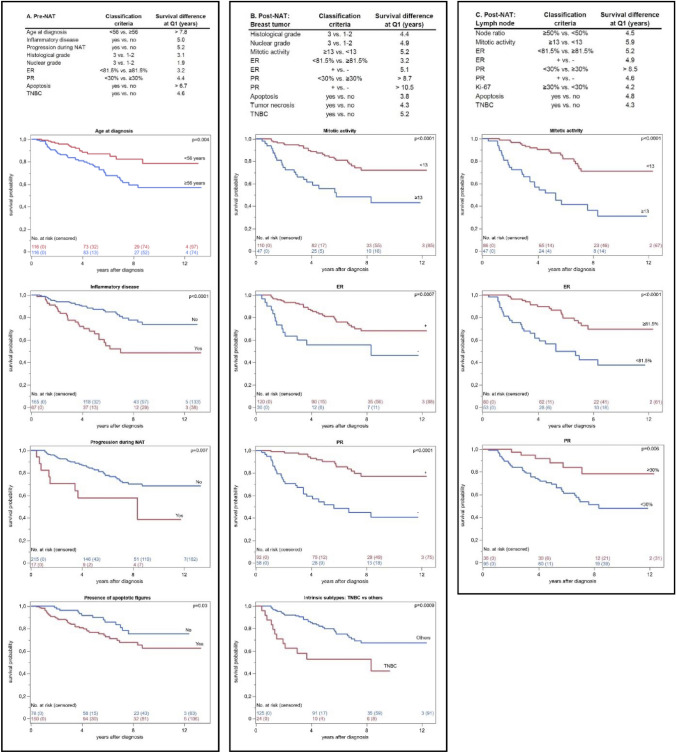
A retrospective consecutive cohort of 257 NA-treated Finnish breast cancer patients with up to 13-year follow-up and the corresponding tissue samples of pre- and post-NAT breast and metastatic specimen were evaluated for prognostic impacts. All relevant clinical and biomarker characteristics potentially correlated with tumor response to NAT, course of disease, or outcome of breast cancer were included in the statistical analyses.
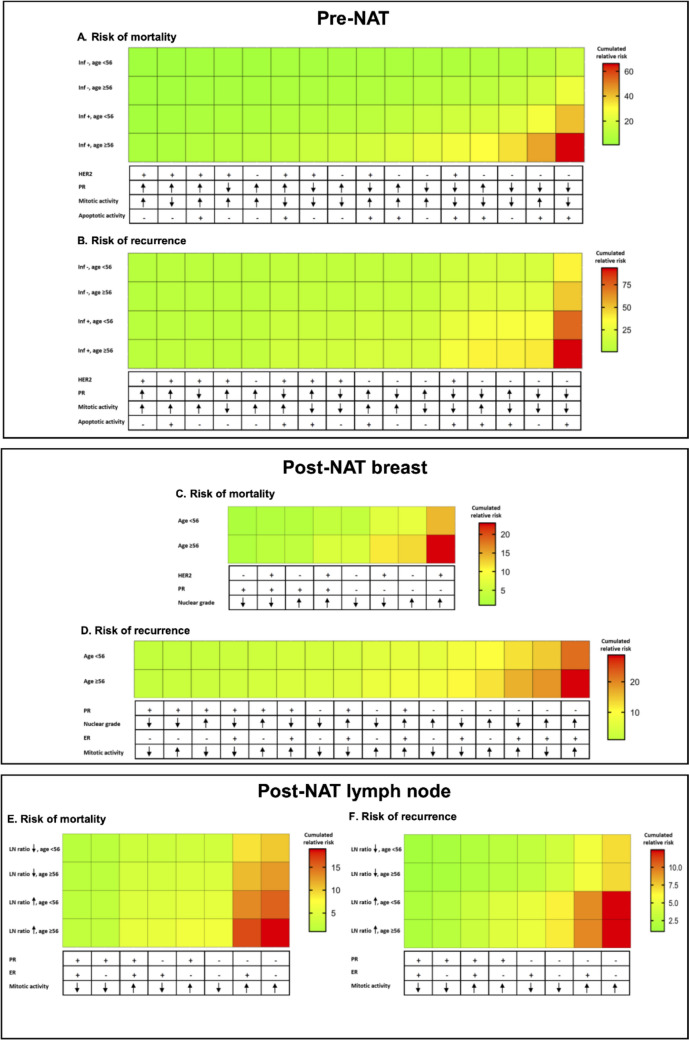
The results highlight the intensified characterization of distinguished prognostic factors and previously overlooked histological features, e.g., mitotic and apoptotic activity. Particularly, decreased PR indicated 3.8-fold (CI 1.9-7.4, p = 0.0001) mortality risk, and a > 10.5-year shorter survival for the majority, > 75% of patients (Q1). Clinically applicable prognostic factors both preceding and following NAT were identified and compiled into heat maps to quantify mortality and recurrence risks. Combinations of risk factors for aggressive disease were exemplified as an interactive tool (bcnatreccalc.utu.fi) to illustrate the spectrum of disease outcomes.
The results emphasize the value of comprehensive evaluation of conventional patient and biomarker characteristics, especially concerning re-assessment of biomarkers, risk-adapted surveillance, and personalized treatment strategies. Future personalized NA-treatment strategies might benefit from models combining risk-adapted surveillance data and post-NAT re-assessed biomarkers.
由于乳腺癌的生物学异质性,预测个体对新辅助治疗(NAT)的反应很复杂。因此,目前尚无全面、被广泛接受的方法来指导治疗后的随访。我们提出临床和组织病理学标准,以改进对接受新辅助治疗的乳腺癌患者疾病预后的预测。
对257例接受新辅助治疗的芬兰乳腺癌患者进行回顾性连续队列研究,随访时间长达13年,并对新辅助治疗前后的乳腺及转移标本的相应组织样本进行预后影响评估。所有可能与肿瘤对新辅助治疗的反应、疾病进程或乳腺癌预后相关的临床和生物标志物特征均纳入统计分析。
结果突出了对显著预后因素和先前被忽视的组织学特征(如有丝分裂和凋亡活性)的强化特征描述。特别是,孕激素受体(PR)降低表明死亡风险增加3.8倍(置信区间1.9 - 7.4,p = 0.0001),且大多数(> 75%)患者(第一四分位数)的生存期缩短超过10.5年。确定了新辅助治疗前后临床上适用的预后因素,并编制成热图以量化死亡和复发风险。侵袭性疾病风险因素的组合被举例说明为一个交互式工具(bcnatreccalc.utu.fi),以展示疾病预后的范围。
结果强调了对传统患者和生物标志物特征进行综合评估的价值,特别是关于生物标志物的重新评估、风险适应性监测和个性化治疗策略。未来的个性化新辅助治疗策略可能受益于结合风险适应性监测数据和新辅助治疗后重新评估的生物标志物的模型。