Turan Gözem, Spiertz Veronika, Bein Oded, Shing Yee Lee, Nolden Sophie
Department of Psychology, Goethe University Frankfurt, Frankfurt Am Main, Germany.
IDeA Center for Individual Development and Adaptive Education, DIPF Leibniz Institute for Research and Information in Education, Frankfurt am Main, Germany.
Psychophysiology. 2025 Jan;62(1):e14752. doi: 10.1111/psyp.14752.
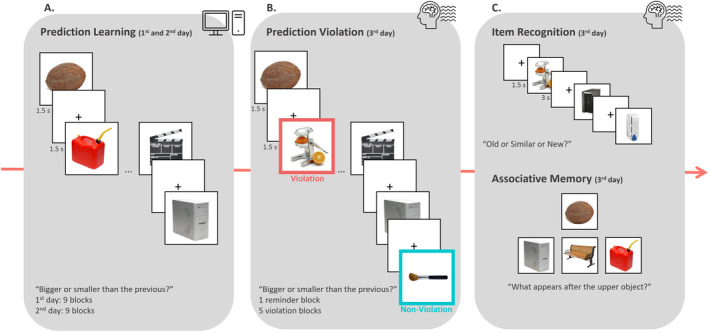
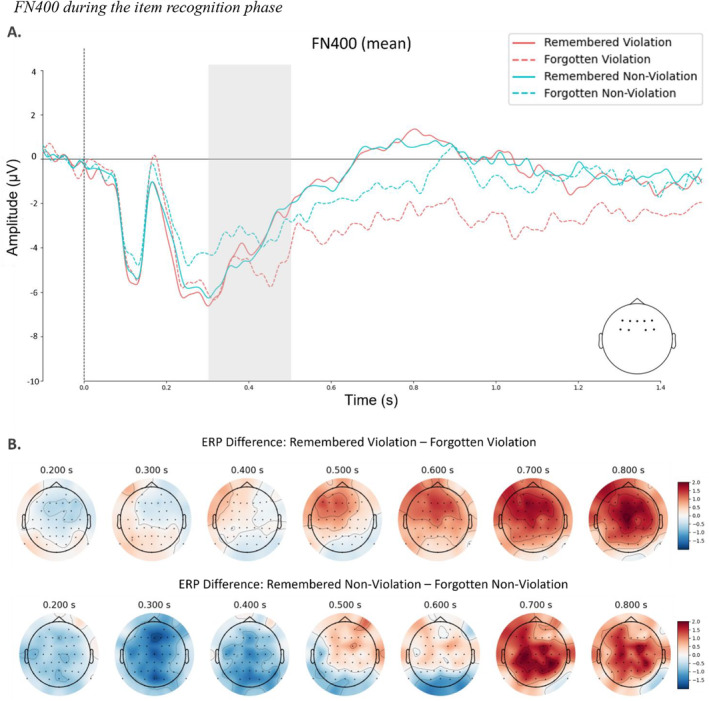
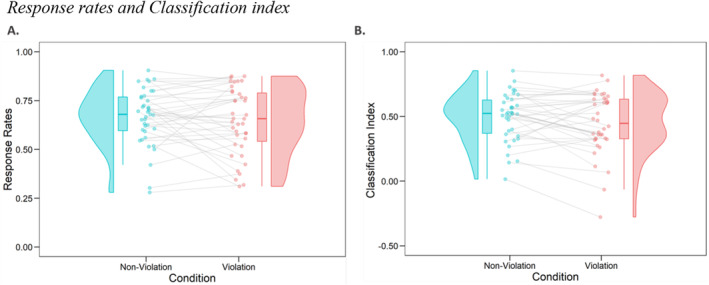
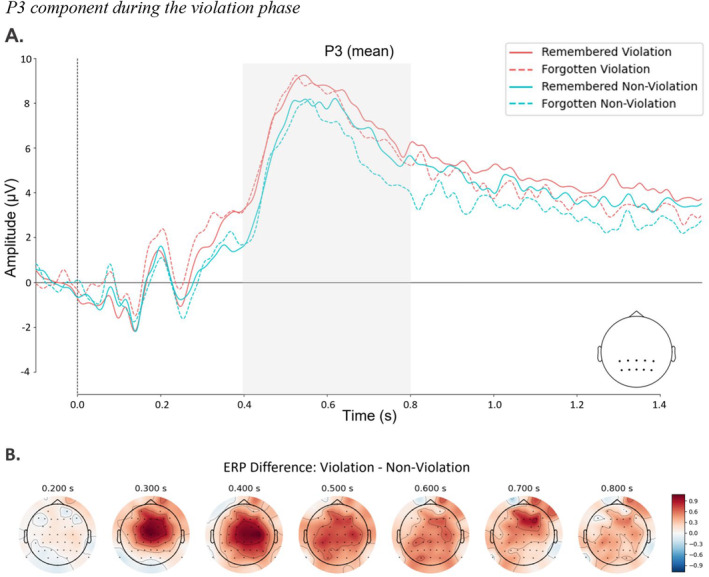
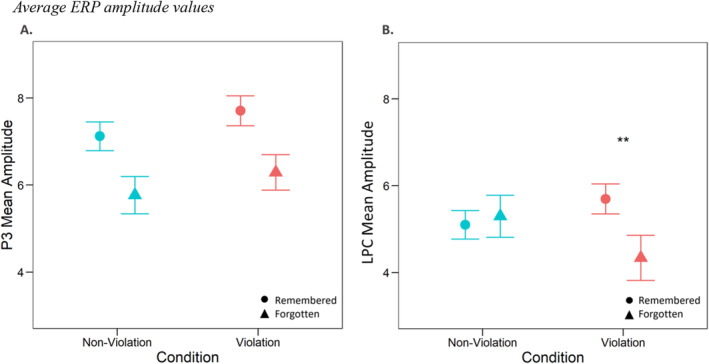
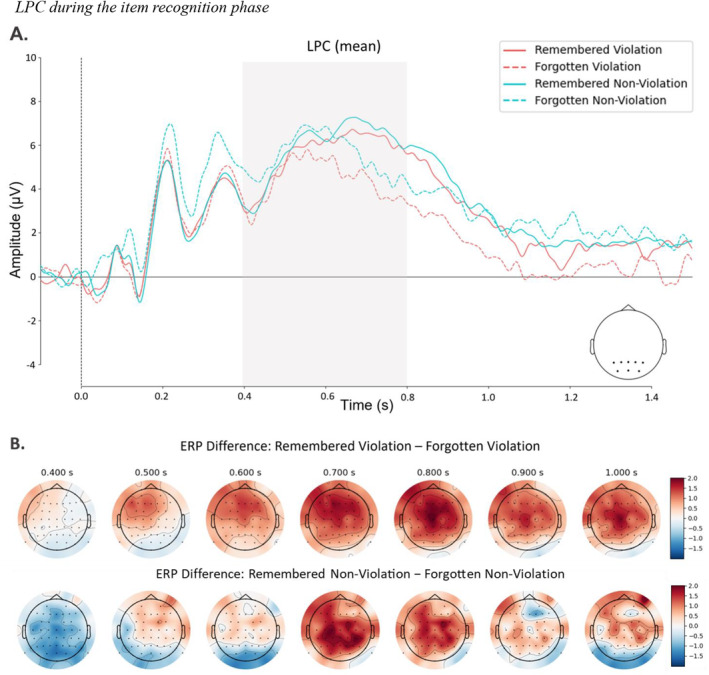
According to the predictive processing framework, our brain constantly generates predictions based on past experiences and compares these predictions with incoming sensory information. When an event contradicts these predictions, it results in a prediction error (PE), which has been shown to enhance subsequent memory. However, the neural mechanisms underlying the influence of PEs on subsequent memory remain unclear. This study investigated the electrophysiological correlates during encoding and retrieval of events eliciting PEs. We employed a statistical learning task in which participants were presented with pairs of objects in sequence. Subsequently, while recording electroencephalography (EEG), we introduced PEs by replacing the second object of each pair with new objects and we then tested the participants' memory. Behaviorally, PEs did not enhance memory. During retrieval, we observed higher amplitudes in the recollection-related late positive component for violation items that were remembered compared to those that were forgotten. In contrast, no evidence for the presence of the FN400 component associated with familiarity was found. These results suggest that recollection, but not familiarity, plays a crucial role in the interplay between PE and memory. Contrary to our hypothesis, we did not observe a relationship between PEs and the P3 component during encoding. In conclusion, our study contributes to the growing body of knowledge concerning the intricate relationship between PEs and episodic memory. It sheds light on the underlying neural mechanisms involved and emphasizes the importance of recollection in this context.
根据预测处理框架,我们的大脑会不断根据过去的经验生成预测,并将这些预测与传入的感官信息进行比较。当一个事件与这些预测相矛盾时,就会产生预测误差(PE),研究表明这种误差会增强后续记忆。然而,预测误差对后续记忆影响的神经机制仍不清楚。本研究调查了引发预测误差的事件在编码和检索过程中的电生理相关性。我们采用了一项统计学习任务,让参与者依次看到成对的物体。随后,在记录脑电图(EEG)时,我们通过用新物体替换每对中的第二个物体来引入预测误差,然后测试参与者的记忆。在行为层面,预测误差并没有增强记忆。在检索过程中,我们观察到,与被遗忘的违反项目相比,被记住的违反项目在与回忆相关的晚期正成分中具有更高的振幅。相比之下,没有发现与熟悉度相关的FN400成分存在的证据。这些结果表明,在预测误差与记忆的相互作用中,起关键作用的是回忆而非熟悉度。与我们的假设相反,在编码过程中,我们没有观察到预测误差与P3成分之间的关系。总之,我们的研究为有关预测误差与情景记忆之间复杂关系的知识体系增添了内容。它揭示了其中潜在的神经机制,并强调了回忆在这种情况下的重要性。