Zhang Yixuan, Tang Xiaoyue, Zhang Yue, Cao Can
Department of Stomatology, General Hospital of Northern Theater Command, Shenyang City, 110016, Liaoning, People's Republic of China.
China Medical University, Shenyang City, 110122, Liaoning, People's Republic of China.
BMC Oral Health. 2024 Dec 31;24(1):1574. doi: 10.1186/s12903-024-05377-1.
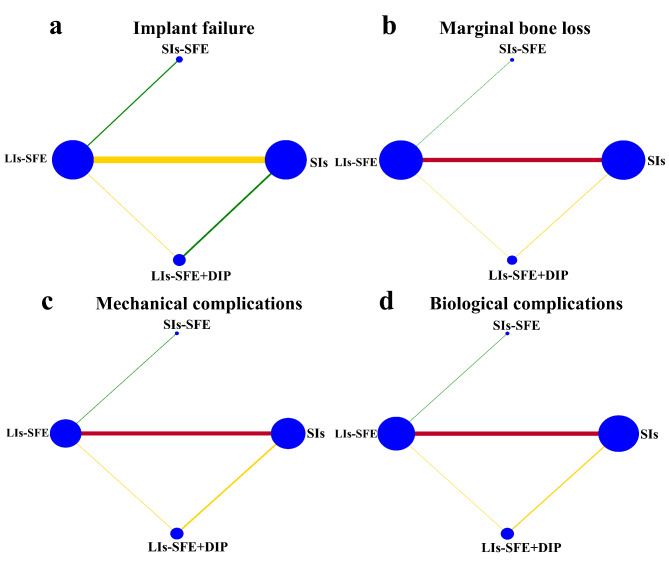
Based on the critical role of implant length and placement timing in treatment success, this study aimed to compare clinical outcomes (implant failure, marginal bone loss, biological and mechanical complications) between short implants (4-8 mm) versus long implants (≥ 8 mm) with sinus floor elevation, and between delayed versus immediate placement of long implants in the posterior maxilla.
This network meta-analysis was prospectively registered in the PROSPERO database (CRD42023495027). Adhering to PRISMA-NMA guidelines, we systematically reviewed eligible studies from January 2014 to November 2024 was conducted across major databases, such as the Cochrane Library, PubMed, Embase, Scopus and Web of Science. The main focus of this NMA was to determine the rate of implant failure, as well as to assess marginal bone loss and the occurrence of biological and mechanical complications related to the implants.
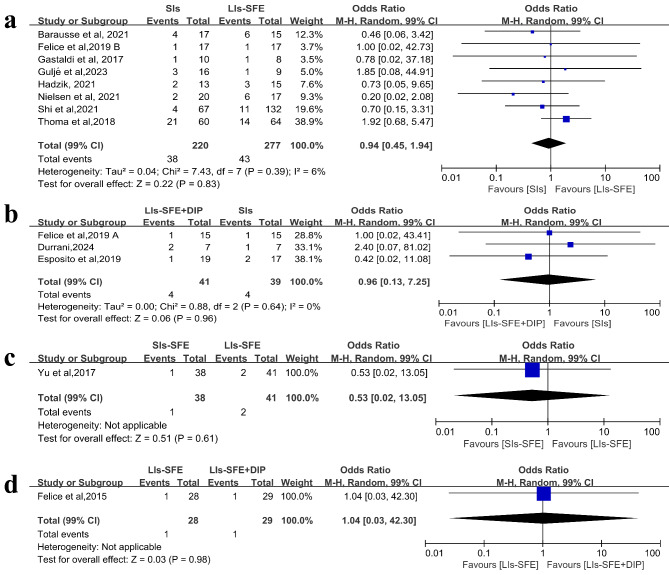
Data from 17 studies, involving 1,076 patients and 1,751 implants, was collected and examined. Long implants have lower failure rates (OR = 1.26; 95% CI = 0.53, 3.00) and short dental implants showed a trend towards lower biological (OR = 0.47; 95% CI = 0.19, 1.18) and mechanical (OR = 0.94; 95% CI = 0.45, 1.94) complications rates, although this trend was not statistically significant. Additionally, compared to longer implants, short implants resulted in a significant reduction in marginal bone loss, regardless of whether long implants were immediately (MD=-0.17; 95%CI: -0.29, -0.05) or delayed (MD = 0.35; 95%CI: 0.05, 0.64) placed following sinus floor elevation. The analysis of cumulative ranking probabilities revealed that delayed placement of long implants with SFE demonstrated the highest efficacy in reducing implant failure (73.9%). SIs were found to excel in reducing marginal bone loss (88.7%) and biological complications (88.2%%), while short implants with SFE proved to be the most effective in preventing mechanical complications (66.0%%).
Short implants achieved comparable clinical outcomes to long implants with sinus floor elevation in posterior maxilla with limited vertical bone height. Given the limitations of the network meta-analysis and included studies, treatment selection should be individualized based on specific patient conditions.
基于种植体长度和植入时机对治疗成功的关键作用,本研究旨在比较短种植体(4 - 8毫米)与长种植体(≥8毫米)在上颌窦底提升后的临床结果(种植体失败、边缘骨丢失、生物和机械并发症),以及后牙区上颌骨长种植体延迟植入与即刻植入的临床结果。
本网络荟萃分析已在PROSPERO数据库(CRD42023495027)中进行前瞻性注册。遵循PRISMA - NMA指南,我们系统回顾了2014年1月至2024年11月期间在Cochrane图书馆、PubMed、Embase、Scopus和Web of Science等主要数据库中进行的符合条件的研究。本NMA的主要重点是确定种植体失败率,并评估边缘骨丢失以及与种植体相关的生物和机械并发症的发生情况。
收集并分析了17项研究的数据,涉及1076例患者和1751颗种植体。长种植体的失败率较低(OR = 1.26;95%CI = 0.53,3.00),短牙种植体在生物(OR = 0.47;95%CI = 0.19,1.18)和机械(OR = 0.94;95%CI = 0.45,1.94)并发症发生率上有降低趋势,尽管这一趋势无统计学意义。此外,与长种植体相比,短种植体导致边缘骨丢失显著减少,无论长种植体在上颌窦底提升后是即刻植入(MD = -0.17;95%CI:-0.29,-0.05)还是延迟植入(MD = 0.35;95%CI:0.05,0.64)。累积排序概率分析显示,上颌窦底提升后长种植体延迟植入在降低种植体失败方面显示出最高疗效(73.9%)。短种植体在减少边缘骨丢失(88.7%)和生物并发症(88.2%)方面表现出色,而上颌窦底提升后的短种植体在预防机械并发症方面最为有效(66.0%)。
在垂直骨高度有限的后牙区上颌骨,短种植体在上颌窦底提升后的临床结果与长种植体相当。鉴于网络荟萃分析及纳入研究的局限性,治疗选择应根据患者具体情况个体化。