Lawson Ryan J, Lipovsek Nicholas J, Brown Samuel P, Jena Achintya K, Osko Joanna J, Ransdell Joseph L
Department of Biology, Miami University, Oxford, OH, United States.
Front Behav Neurosci. 2024 Dec 17;18:1474066. doi: 10.3389/fnbeh.2024.1474066. eCollection 2024.
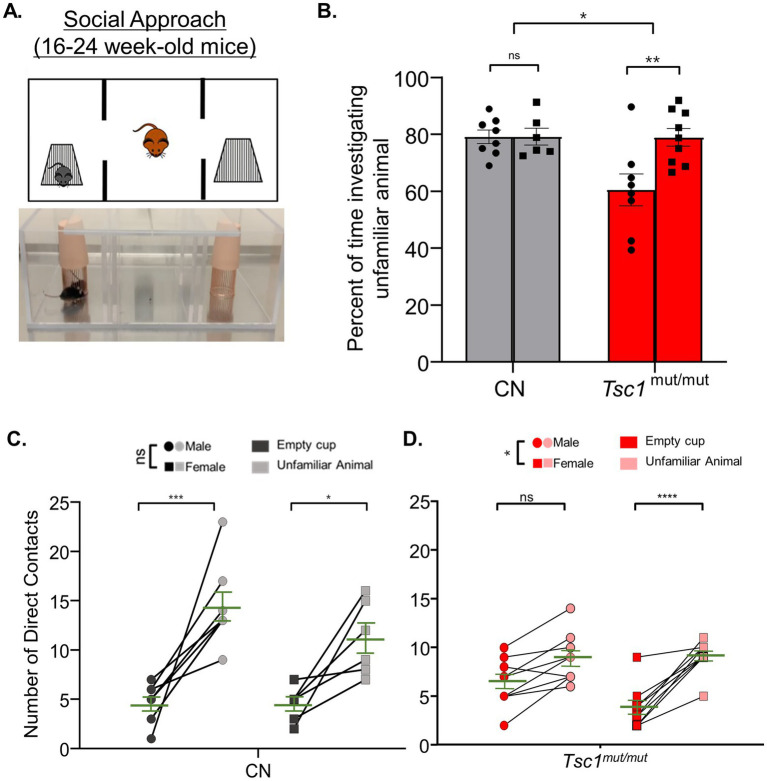
There is a striking sex bias in the prevalence and severity of autism spectrum disorder (ASD) with 80% of diagnoses occurring in males. Because the molecular etiology of ASD is likely combinatorial, including interactions across multiple genetic and environmental factors, it is difficult to investigate the physiological mechanisms driving sex-specific differences. Loss of function mutations in result in dysregulated mTORC1 signaling and underlie a multi-system disorder known as tuberous sclerosis (TSC). Interestingly, more than 50% of individuals diagnosed with TSC are also diagnosed with ASD, making TSC mutations one of the most prevalent monogenic causes of ASD. Mice harboring targeted deletion of selectively in cerebellar Purkinje neurons, referred to here as , have multiple ASD-linked behavioral impairments, including deficits in social interactions, motor coordination, and vocalizations. However, these ASD-linked behavioral deficits have only been investigated using male animals. Here, we used cohorts of male and female animals to determine if behavioral impairments, previously identified in this model, are similar across sex. Specifically, we measured balance and motor coordination and social interaction behaviors in two age groups across sex. We determined balance and motor coordination deficits are similar in male and female mice, and that deficits in the firing of Purkinje neurons located in the cerebellar vermis are also similar across sex. However, impairments in social approach behavior were found to be significantly more severe in males compared to females. These results indicate the selective deletion of in Purkinje neurons differentially impairs cerebellar circuits based on sex.
自闭症谱系障碍(ASD)的患病率和严重程度存在显著的性别偏差,80%的诊断病例发生在男性中。由于ASD的分子病因可能是组合性的,包括多种遗传和环境因素之间的相互作用,因此很难研究导致性别特异性差异的生理机制。[基因名称]功能丧失突变会导致mTORC1信号失调,并成为一种称为结节性硬化症(TSC)的多系统疾病的基础。有趣的是,超过50%被诊断为TSC的个体也被诊断患有ASD,这使得TSC突变成为ASD最常见的单基因病因之一。在小脑浦肯野神经元中选择性靶向缺失[基因名称]的小鼠(在此称为[小鼠模型名称])具有多种与ASD相关的行为障碍,包括社交互动、运动协调和发声方面的缺陷。然而,这些与ASD相关的行为缺陷仅在雄性[小鼠模型名称]动物中进行了研究。在这里,我们使用雄性和雌性[小鼠模型名称]动物队列来确定先前在该模型中确定的行为障碍在不同性别中是否相似。具体而言,我们测量了两个年龄组不同性别的平衡和运动协调以及社交互动行为。我们确定雄性和雌性[小鼠模型名称]小鼠的平衡和运动协调缺陷相似,并且位于小脑蚓部的[小鼠模型名称]浦肯野神经元放电缺陷在不同性别中也相似。然而,发现雄性[小鼠模型名称]的社交接近行为障碍比雌性严重得多。这些结果表明,浦肯野神经元中[基因名称]的选择性缺失根据性别对小脑回路产生不同程度的损害。