Li Kexin, Li Meng, Wei Panpan, Tian Kangli, Liu Haole, Fu Weilai, Hou Haiwen, Chen Yajie, Xu Baohui, Li Yankui, Zhao Sihai
Institute of Cardiovascular Science, Translational Medicine Institute, Xi'an Jiaotong University Health Science Center, Xi'an, Shaanxi 710061, China.
Department of Vascular Surgery, The Second Hospital of Tianjin Medical University, Tianjin 300211, China.
Cardiovasc Ther. 2024 Nov 27;2024:8826287. doi: 10.1155/2024/8826287. eCollection 2024.
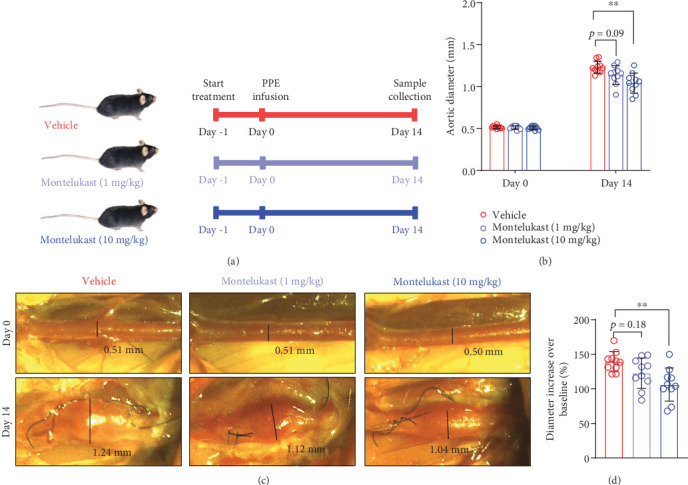
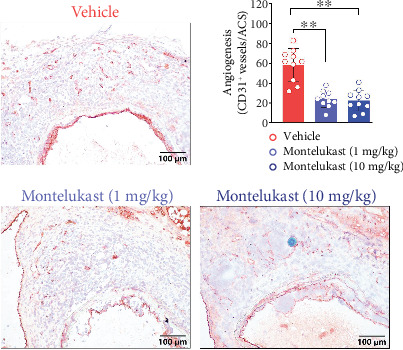
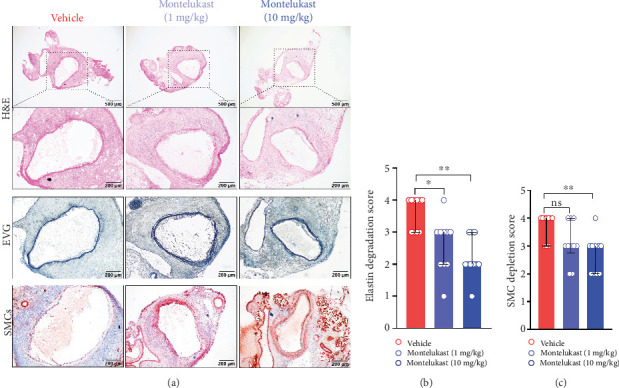
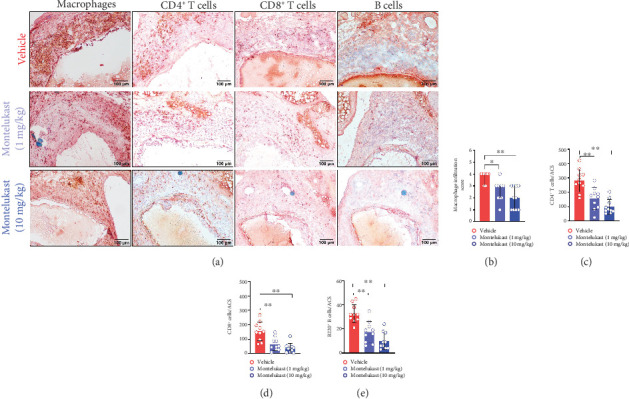
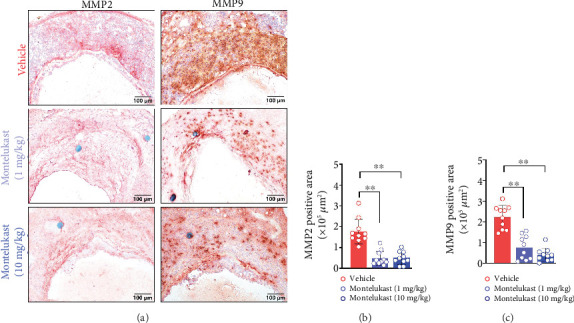
Cysteinyl leukotrienes (LTs) and their receptors are involved in the pathogenesis of abdominal aortic aneurysms (AAAs). However, whether CysLT1 receptor antagonists such as montelukast can influence experimental nondissecting AAA remains unclear. Nondissecting AAAs were induced in C57BL/6J mice by transient aortic luminal infusion of porcine pancreatic elastase (PPE). All animals were administrated montelukast (1 or 10 mg/kg, daily) or vehicle by gavage beginning 1 day before PPE infusion for 14 days. On day 0 (baseline) and day 14 after PPE infusion, abdominal aortic diameters were directly measured. Aortic aneurysmal segment samples were collected, and histopathological analysis was performed. Compared to vehicle treatment, montelukast significantly decreased PPE infusion-induced aortic expansion in a dose-dependent manner (0.09-mm reduction at a low dose and 0.19-mm reduction at a high dose). Histopathological analysis also revealed that compared with vehicle treatment, montelukast treatment, especially in the high-dose group, significantly improved PPE-induced aortic elastin degradation and medial smooth muscle cell depletion. Both doses of montelukast also markedly decreased the number of local leucocytes, including macrophages, CD4 T cells, CD8 T cells, and B cells, infiltration and accumulation in aortic aneurysmal lesions. Montelukast treatment also downregulated matrix metalloproteinase 2 (MMP2) and MMP9 expression and inhibited mural angiogenesis in aneurysmal aortas. Montelukast treatment improves experimental nondissected AAAs in mice partly by improving aortic inflammation.
半胱氨酰白三烯(LTs)及其受体参与腹主动脉瘤(AAA)的发病机制。然而,孟鲁司特等半胱氨酰白三烯1(CysLT1)受体拮抗剂是否能影响实验性非夹层AAA仍不清楚。通过短暂主动脉腔内输注猪胰弹性蛋白酶(PPE)在C57BL/6J小鼠中诱导非夹层AAA。在PPE输注前1天开始,所有动物通过灌胃给予孟鲁司特(1或10mg/kg,每日)或赋形剂,持续14天。在第0天(基线)和PPE输注后第14天,直接测量腹主动脉直径。收集主动脉瘤段样本并进行组织病理学分析。与赋形剂治疗相比,孟鲁司特以剂量依赖性方式显著降低PPE输注诱导的主动脉扩张(低剂量时减少0.09mm,高剂量时减少0.19mm)。组织病理学分析还显示,与赋形剂治疗相比,孟鲁司特治疗,尤其是高剂量组,显著改善了PPE诱导的主动脉弹性蛋白降解和中膜平滑肌细胞耗竭。两种剂量的孟鲁司特还显著减少了包括巨噬细胞、CD4 T细胞、CD8 T细胞和B细胞在内的局部白细胞在主动脉瘤病变中的浸润和积聚。孟鲁司特治疗还下调了基质金属蛋白酶2(MMP2)和MMP9的表达,并抑制了动脉瘤主动脉壁的血管生成。孟鲁司特治疗部分通过改善主动脉炎症来改善小鼠实验性非夹层AAA。