Institute of Cardiovascular Science, Translational Medicine Institute, Xi'an Jiaotong University Health Science Center, Xi'an, Shaanxi, China.
Department of Cardiology, The Second Affiliated Hospital of Xi'an Jiaotong University, Xi'an, Shaanxi, China.
Front Immunol. 2023 Sep 11;14:1233807. doi: 10.3389/fimmu.2023.1233807. eCollection 2023.
C-reactive protein (CRP) levels are elevated in patients with abdominal aortic aneurysms (AAA). However, it has not been investigated whether CRP contributes to AAA pathogenesis.
CRP deficient and wild type (WT) male mice were subjected to AAA induction via transient intra-aortic infusion of porcine pancreatic elastase. AAAs were monitored by measurements of maximal infrarenal aortic external diameters immediately prior to and 14 days following elastase infusion. Key AAA pathologies were assessed by histochemical and immunohistochemical staining procedures. The influence of CRP deficiency on macrophage activation was evaluated in peritoneal macrophages .
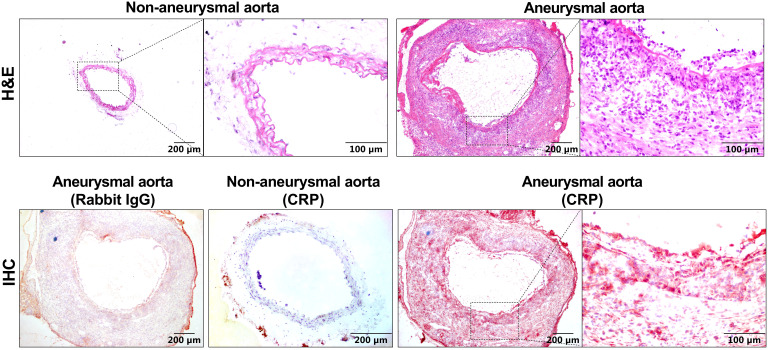
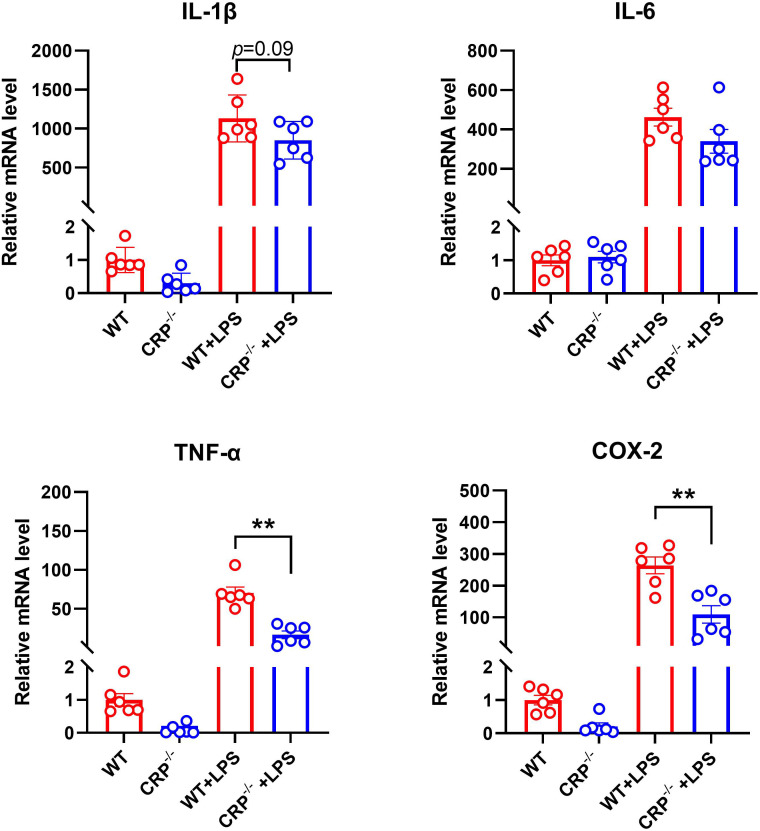
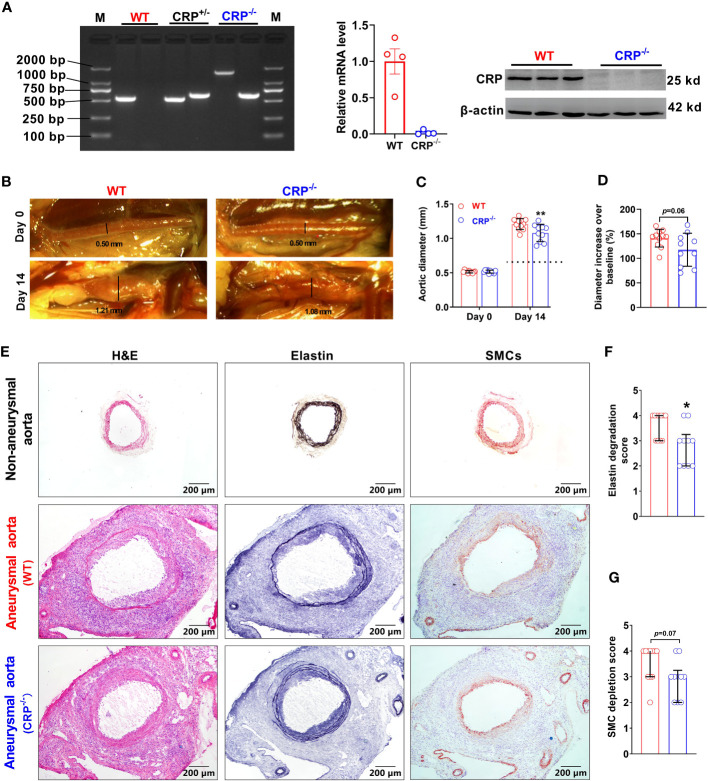
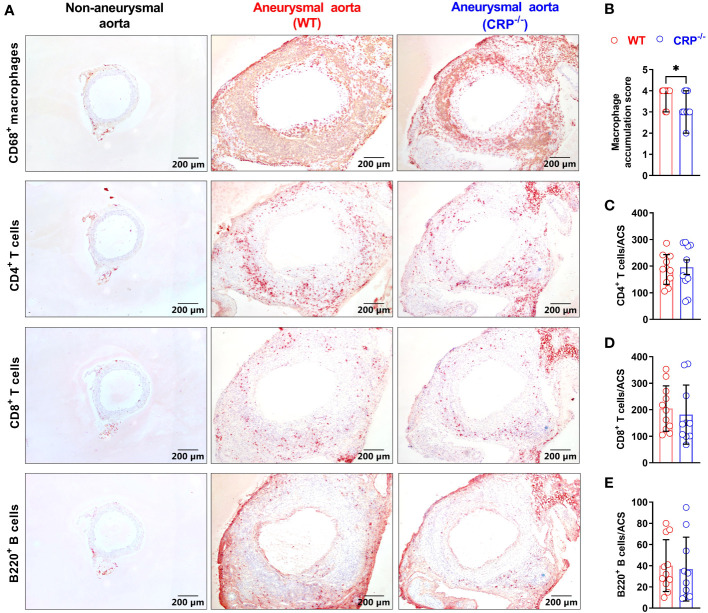
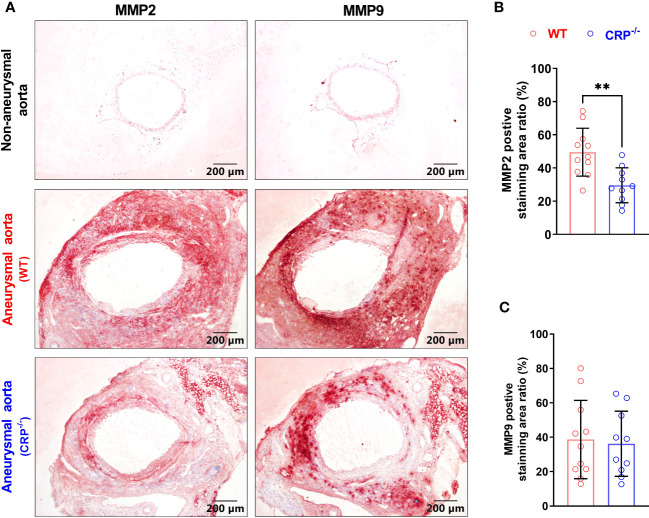
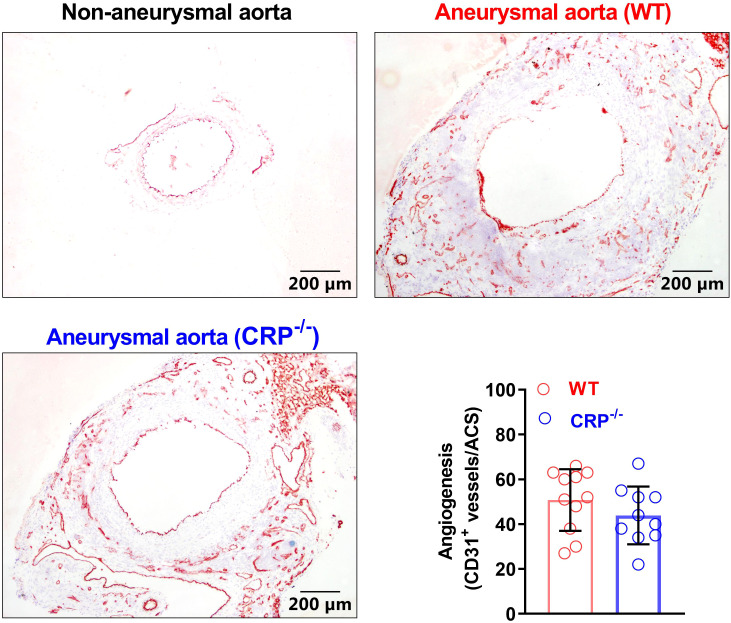
CRP protein levels were higher in aneurysmal than that in non-aneurysmal aortas. Aneurysmal aortic dilation was markedly suppressed in CRP deficient (aortic diameter: 1.08 ± 0.11 mm) as compared to WT (1.21 ± 0.08 mm) mice on day 14 after elastase infusion. More medial elastin was retained in CRP deficient than in WT elastase-infused mice. Macrophage accumulation was significantly less in aneurysmal aorta from CRP deficient than that from WT mice. Matrix metalloproteinase 2 expression was also attenuated in CRP deficient as compared to WT aneurysmal aortas. CRP deficiency had no recognizable influence on medial smooth muscle loss, lymphocyte accumulation, aneurysmal angiogenesis, and matrix metalloproteinase 9 expression. In assays, mRNA levels for tumor necrosis factor α and cyclooxygenase 2 were reduced in lipopolysaccharide activated peritoneal macrophages from CRP deficient as compared to wild type mice.
CRP deficiency suppressed experimental AAAs by attenuating aneurysmal elastin destruction, macrophage accumulation and matrix metalloproteinase 2 expression.
C 反应蛋白(CRP)水平在腹主动脉瘤(AAA)患者中升高。然而,CRP 是否有助于 AAA 的发病机制尚未得到研究。
通过短暂的主动脉内猪胰弹性蛋白酶输注,使 CRP 缺陷型和野生型(WT)雄性小鼠发生 AAA 诱导。在弹性蛋白酶输注前和输注后 14 天,通过测量最大肾下主动脉外径来监测 AAA。通过组织化学和免疫组织化学染色程序评估 AAA 的关键病理。通过腹膜巨噬细胞评估 CRP 缺乏对巨噬细胞激活的影响。
与非动脉瘤主动脉相比,动脉瘤主动脉中的 CRP 蛋白水平更高。与 WT(1.21 ± 0.08mm)小鼠相比,CRP 缺陷型(主动脉直径:1.08 ± 0.11mm)小鼠在弹性蛋白酶输注后 14 天,动脉瘤性主动脉扩张明显受到抑制。CRP 缺陷型弹性蛋白酶输注小鼠比 WT 弹性蛋白酶输注小鼠保留更多的中层弹性蛋白。与 WT 小鼠相比,CRP 缺陷型动脉瘤主动脉中的巨噬细胞积聚明显减少。与 WT 动脉瘤主动脉相比,基质金属蛋白酶 2 的表达也减弱。CRP 缺陷对中层平滑肌丢失、淋巴细胞积聚、动脉瘤性血管生成和基质金属蛋白酶 9 的表达没有明显影响。在体外实验中,与 WT 小鼠相比,CRP 缺陷型腹膜巨噬细胞中肿瘤坏死因子 α 和环氧化酶 2 的 mRNA 水平降低。
CRP 缺乏通过减弱动脉瘤性弹性蛋白破坏、巨噬细胞积聚和基质金属蛋白酶 2 的表达来抑制实验性 AAA。