Bonhomme Brittaney, Nandi Neilanjan, Berera Shivali, Lee Helen, Leung Galen, Tse Chung Sang, Weiss Alexandra, Nessel Lisa, Ren Yue, Li Hongzhe, Aberra Faten N, Lewis James D
Center for Clinical Epidemiology and Biostatistics, Perelman School of Medicine, University of Pennsylvania, Philadelphia, PA, USA.
Division of Gastroenterology and Hepatology, Perelman School of Medicine, University of Pennsylvania, Philadelphia, PA, USA.
Crohns Colitis 360. 2024 Dec 23;7(1):otae069. doi: 10.1093/crocol/otae069. eCollection 2025 Jan.
While patients with Crohn's disease commonly report fatigue, an association of Crohn's disease with mild neurocognitive impairment has also been suggested. This study investigated the relationship between Crohn's disease activity, fatigue, and neurocognitive functioning.
In this cross-sectional study, adults with Crohn's disease ( = 25) and healthy controls ( = 26) completed the PROMIS Fatigue 7a form and Multidimensional Fatigue Inventory and neurocognitive testing across 6 domains. Symptomatic and endoscopic remission were assessed with a short Crohn's Disease Activity Index and Simple Endoscopic Score for Crohn's Disease. Linear regression adjusting for age and sex was used to compare fatigue and neurocognition among patients with Crohn's disease versus controls and those with active Crohn's disease versus those in remission.
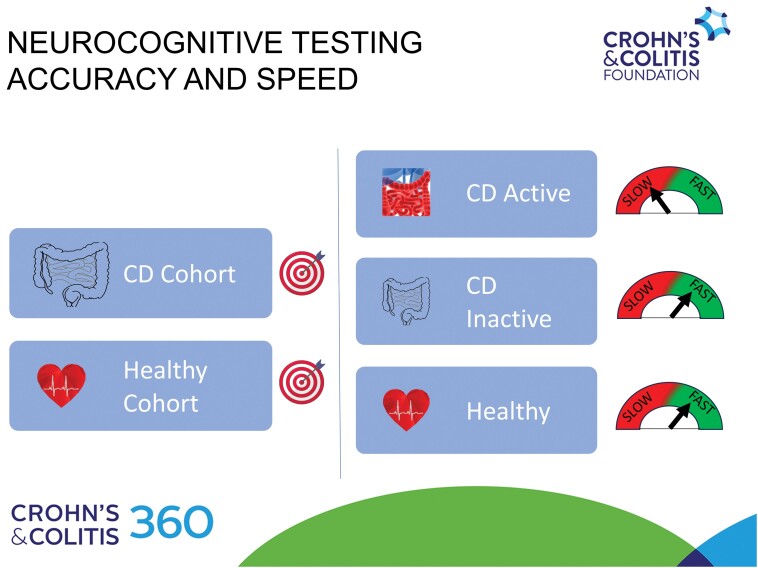
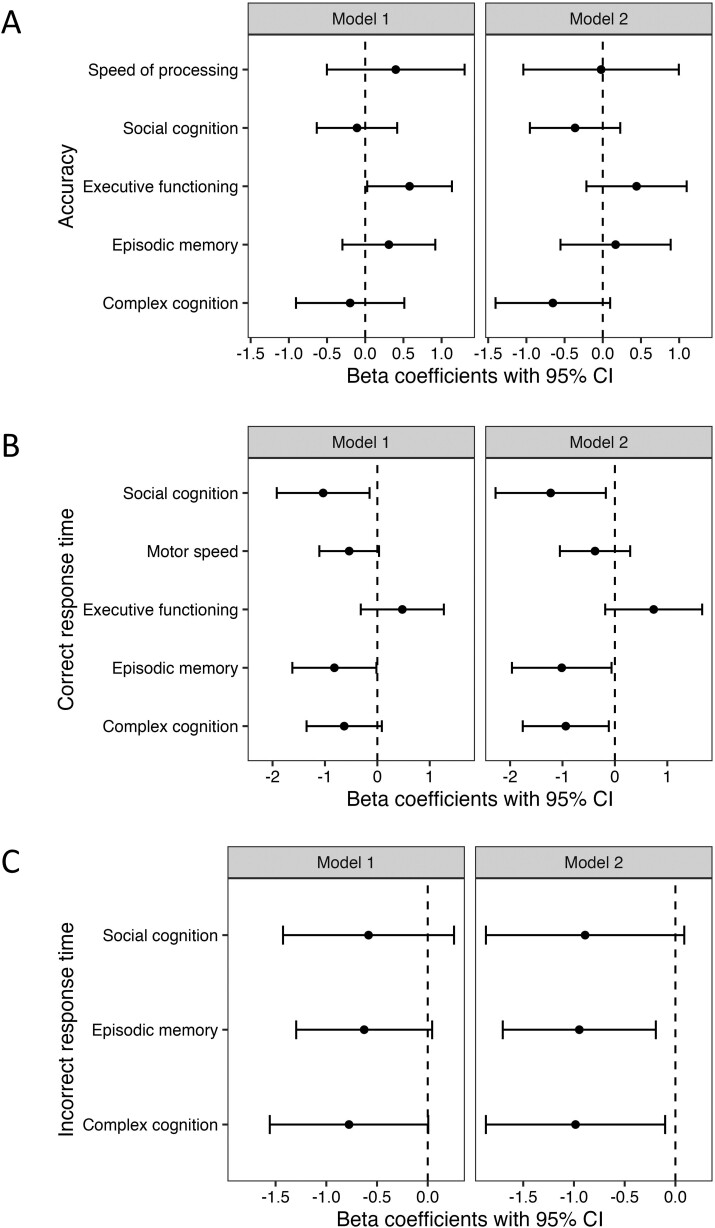
Compared to controls, adults with Crohn's disease reported greater overall and domain-specific fatigue (general, physical, and mental) ( < .05 for all comparisons). Patients in symptomatic remission had significantly less fatigue ( < .05). No differences were found in neurocognitive accuracy or speed between Crohn's disease and controls. Disease activity was not associated with accuracy on neurocognitive testing; however, patients with symptomatic Crohn's disease had longer correct response times for social cognition and episodic memory compared to asymptomatic patients ( < .05). Endoscopic disease activity was associated with longer correct response times for tasks linked to social cognition, episodic memory, and complex cognition ( < .05). These differences persisted after adjusting for fatigue.
Patients with symptomatic Crohn's disease experience greater fatigue and have slower response times on neurocognitive testing. However, fatigue does not appear to mediate the slower response times.
虽然克罗恩病患者普遍报告有疲劳症状,但也有人提出克罗恩病与轻度神经认知障碍有关。本研究调查了克罗恩病活动、疲劳与神经认知功能之间的关系。
在这项横断面研究中,患有克罗恩病的成年人(n = 25)和健康对照者(n = 26)完成了患者报告结果测量信息系统疲劳7a量表、多维疲劳量表以及6个领域的神经认知测试。使用简短的克罗恩病活动指数和克罗恩病简易内镜评分评估症状缓解和内镜缓解情况。采用调整年龄和性别的线性回归分析,比较克罗恩病患者与对照者以及活动期克罗恩病患者与缓解期患者之间的疲劳和神经认知情况。
与对照者相比,患有克罗恩病的成年人报告的总体疲劳和特定领域疲劳(全身、身体和精神)程度更高(所有比较P < 0.05)。症状缓解的患者疲劳程度明显更低(P < 0.05)。克罗恩病患者与对照者在神经认知准确性或速度方面未发现差异。疾病活动与神经认知测试的准确性无关;然而,有症状的克罗恩病患者与无症状患者相比,社交认知和情景记忆的正确反应时间更长(P < 0.05)。内镜下疾病活动与社交认知、情景记忆和复杂认知相关任务的正确反应时间更长有关(P < 0.05)。在调整疲劳因素后,这些差异仍然存在。
有症状的克罗恩病患者疲劳程度更高,神经认知测试的反应时间更慢。然而,疲劳似乎并未介导反应时间变慢。