Saarela Laura, Lehtisalo Jenni, Ngandu Tiia, Kyrönlahti Saila, Havulinna Satu, Strandberg Timo, Levälahti Esko, Antikainen Riitta, Soininen Hilkka, Tuomilehto Jaakko, Laatikainen Tiina, Kivipelto Miia, Kulmala Jenni
Department of Healthcare and Social Welfare, Services Unit, Finnish Institute for Health and Welfare (THL), Helsinki, Finland.
Department of Public Health, University of Helsinki, Helsinki, Finland.
Ann Med. 2025 Dec;57(1):2446699. doi: 10.1080/07853890.2024.2446699. Epub 2025 Jan 1.
Frailty is a common geriatric syndrome associated with poor clinical outcomes. Effectiveness of lifestyle intervention programmes among frail older people has been examined earlier, but effects of interventions on prevention of frailty have been rarely studied. The aim of this study was to investigate to what extent the multidomain lifestyle intervention in the Finnish Geriatric Intervention Study to Prevent Cognitive Impairment and Disability (FINGER) affected changes in frailty status among older men and women at risk of cognitive disorders.
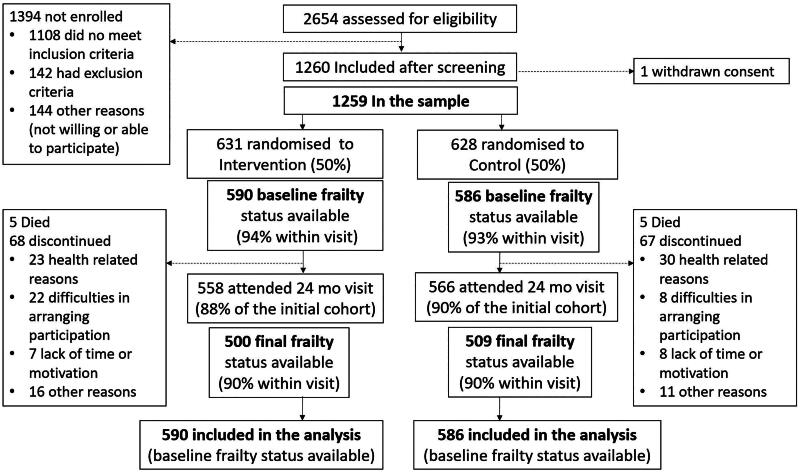
The 2-year multidomain lifestyle intervention trial including simultaneous nutritional counseling, physical exercise, cognitive training and social activity, and management of metabolic and vascular risk factors, was conducted among 1259 older people (mean age 68.9 years). A modified Fried's frailty phenotype (weight loss, exhaustion, weakness, slowness, and low physical activity) was used to assess frailty at baseline and after the 2-year intervention. Participants with one or more components of the frailty phenotype were classified as pre-frail or frail. A multinomial regression model was applied to investigate efficacy of the intervention on frailty.
We observed a favorable trend in reversing frailty among older men with the intervention. Pre-frail or frail men in the intervention group had higher probability of being non-frail after the intervention (44%) than pre-frail or frail men in the control group (30%) ( = 0.040). Among men, the intervention was especially beneficial in terms of increasing physical activity. Among women, multidomain lifestyle intervention did not affect the frailty status.
Modifying lifestyle-related factors may have potential to reverse first signs of frailty among older men. However, the intervention lasted only two years, therefore, research with longer follow-up is needed to see possible long-term effects of lifestyle management on the development of frailty.
衰弱是一种常见的老年综合征,与不良临床结局相关。此前已对衰弱老年人的生活方式干预项目的有效性进行了研究,但干预对衰弱预防的影响鲜有研究。本研究的目的是调查芬兰预防认知障碍和残疾老年干预研究(FINGER)中的多领域生活方式干预在多大程度上影响有认知障碍风险的老年男性和女性的衰弱状态变化。
在1259名老年人(平均年龄68.9岁)中进行了为期2年的多领域生活方式干预试验,包括同时进行营养咨询、体育锻炼、认知训练和社交活动,以及代谢和血管危险因素管理。采用改良的弗里德衰弱表型(体重减轻、疲惫、虚弱、行动迟缓及体力活动不足)在基线和2年干预后评估衰弱情况。具有衰弱表型一个或多个组成部分的参与者被分类为衰弱前期或衰弱。应用多项回归模型研究干预对衰弱的疗效。
我们观察到干预对老年男性衰弱逆转有良好趋势。干预组中衰弱前期或衰弱的男性在干预后非衰弱的概率(44%)高于对照组中衰弱前期或衰弱的男性(30%)(=0.040)。在男性中,干预在增加体力活动方面特别有益。在女性中,多领域生活方式干预未影响衰弱状态。
改变与生活方式相关的因素可能有潜力逆转老年男性衰弱的最初迹象。然而,干预仅持续了两年,因此,需要进行更长随访期的研究,以观察生活方式管理对衰弱发展可能产生的长期影响。