Li Hua-Dong, Liu Ya-Nan, Wu Shuang, Quan Xu-Feng, Wang Xiao-Yan, Xiang Tian-Dan, Li Shu-Meng, Xu Ling, Wang Tong, Wang Hua, Zheng Xin
Department of Infectious Diseases, Union Hospital, Tongji Medical College, Huazhong University of Science and Technology, Wuhan 430022, Hubei Province, China.
Department of Infectious Diseases, Wuhan Jinyintan Hospital, Wuhan 430023, Hubei Province, China.
World J Hepatol. 2024 Dec 27;16(12):1395-1406. doi: 10.4254/wjh.v16.i12.1395.
The effect of nonalcoholic fatty liver disease (NAFLD) on the efficacy of nucleoside analogues (NAs) in antiviral therapy for patients with chronic hepatitis B (CHB) remains controversial.
To investigate the influence of NAFLD on virological response in CHB patients undergoing NAs treatment.
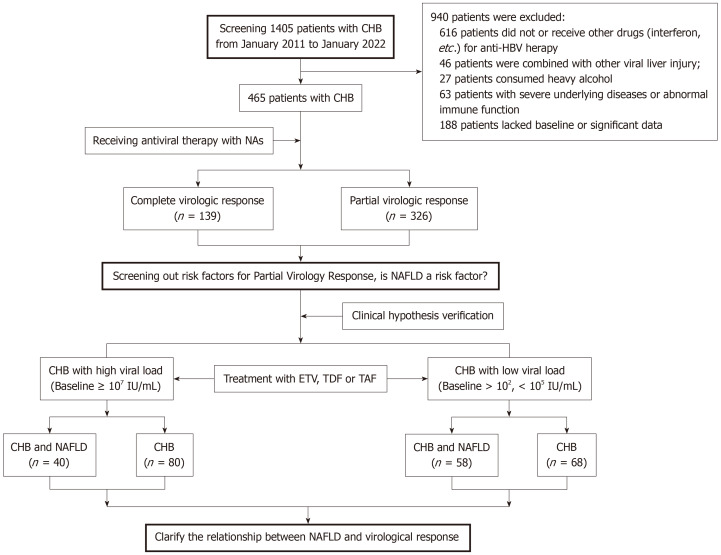
Logistic regression analysis was conducted on a cohort of 465 CHB patients from two hospitals to determine whether NAFLD was a risk factor for adverse reactions to NAs. CHB patients were followed up for more than 28 months after initial antiviral treatment, and further validation was performed using different viral load populations.
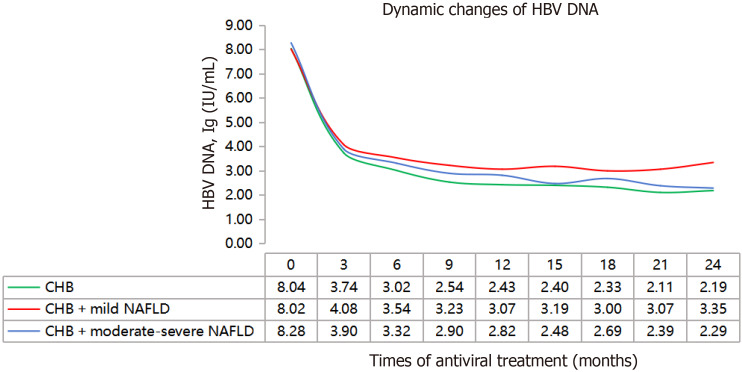
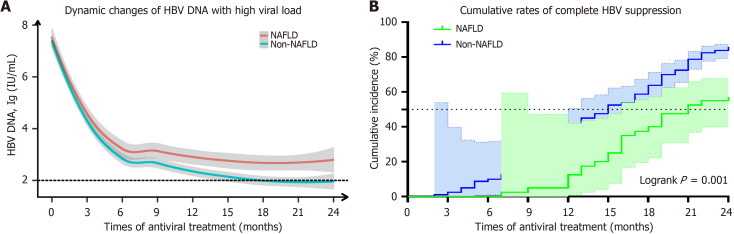
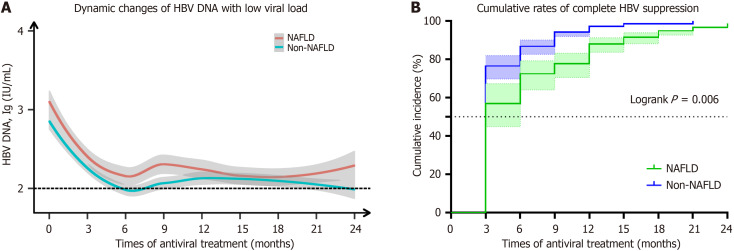
NAFLD was identified as an independent risk factor for partial virological response following antiviral therapy with NAs (odds ratio = 1.777, = 0.017). In our subsequent analysis focusing on CHB patients with high viral load, the NAFLD group exhibited significantly longer virus shedding time and lower proportion of the complete virological response compared with the non-NAFLD group (16.8 ± 6.1 13.0 ± 6.8, < 0.05). During the 24-month period of antiviral treatment with NAs, hepatitis B virus (HBV) DNA levels decreased slowly in the NAFLD group, and the negative conversion rate of HBV was notably lower than that observed in non-NAFLD group ( = 0.001). Similar results were obtained when analyzing patients with low baseline HBV viral load within the NAFLD group.
Coexistence of NAFLD may diminish virological response among CHB patients receiving antiviral treatment with NAs.
非酒精性脂肪性肝病(NAFLD)对慢性乙型肝炎(CHB)患者抗病毒治疗中核苷类似物(NAs)疗效的影响仍存在争议。
探讨NAFLD对接受NAs治疗的CHB患者病毒学应答的影响。
对来自两家医院的465例CHB患者队列进行逻辑回归分析,以确定NAFLD是否为NAs不良反应的危险因素。CHB患者在初始抗病毒治疗后随访超过28个月,并使用不同病毒载量人群进行进一步验证。
NAFLD被确定为接受NAs抗病毒治疗后部分病毒学应答的独立危险因素(比值比 = 1.777,P = 0.017)。在我们随后针对高病毒载量CHB患者的分析中,与非NAFLD组相比,NAFLD组的病毒清除时间明显更长,完全病毒学应答比例更低(16.8±6.1对13.0±6.8,P<0.05)。在NAs抗病毒治疗的2年期间,NAFLD组的乙型肝炎病毒(HBV)DNA水平下降缓慢,HBV阴性转化率明显低于非NAFLD组(P = 0.001)。在分析NAFLD组中基线HBV病毒载量低的患者时也获得了类似结果。
NAFLD的共存可能会降低接受NAs抗病毒治疗的CHB患者的病毒学应答。