Muchangi Josphat Martin, Mturi James, Mukasa Hajra, Kithuki Kioko, Kosgei Sarah Jebet, Kanyangi Lennah Muhoja, Moraro Rogers, Kamau Samuel, Nankanja Maureen
Amref Health Africa, Nairobi, Kenya.
Amref Health Africa, Dar es Salaam, Tanzania.
Front Public Health. 2024 Dec 18;12:1417866. doi: 10.3389/fpubh.2024.1417866. eCollection 2024.
The government's role in influencing policies related to Coronavirus disease 2019 (COVID-19) vaccine distribution and handwashing practices is essential in controlling the spread of severe acute respiratory syndrome coronavirus 2.
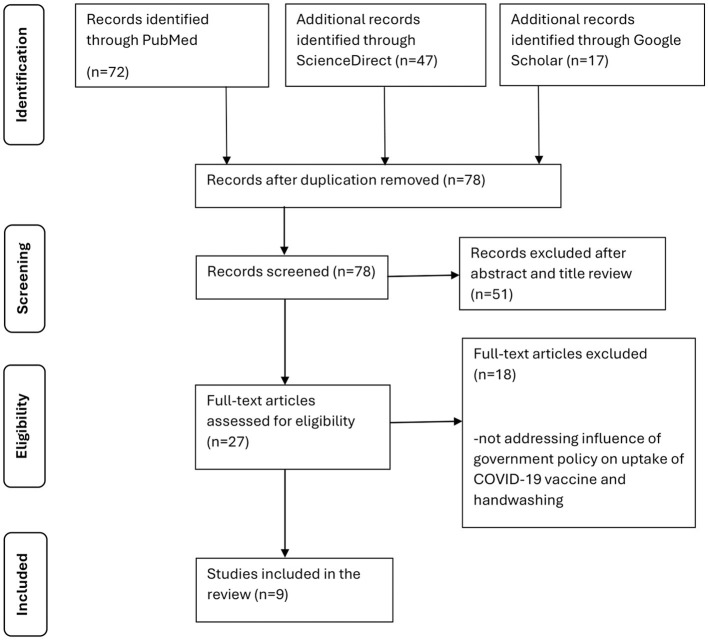
This study aimed to systematically review published studies to explore the influence of government policies on handwashing and vaccine uptake in Kenya, Uganda and Tanzania to prevent and control COVID-19. A comprehensive search strategy was applied across three databases, and eligibility was determined using strict inclusion and exclusion criteria. We reviewed 9 of 136 research papers following the Preferred Reporting Items for Systematic Review and Meta-Analysis (PRISMA) guidelines.
The findings revealed that the government has a role in influencing policies related to COVID-19 vaccine distribution and handwashing uptake. Employment of public health campaigns and communication strategies by the government in Uganda increased vaccine acceptance and hand hygiene uptake. Similarly, government efforts to make hand hygiene accessible increased the uptake of handwashing in Tanzania. In Kenya, government efforts to increase access to soap and clean water in informal settlements and markets resulted in increased adherence to handwashing practices. Further, government incentives such as cash increased vaccination rates while vaccination reminders combined with cash incentives increased childhood immunization coverage.
Overall, this review indicates that monitoring and enforcing compliance increases vaccine and handwashing uptake across the three countries. The effectiveness of government policies on handwashing and vaccine uptake is influenced by factors such as safety, efficacy and access to information, among others. Therefore, there is a need to address these factors for the successful implementation of these policies.
PROSPERO ID CRD42023396319, https://www.crd.york.ac.uk/prospero/.
政府在影响与2019冠状病毒病(COVID-19)疫苗分发和洗手习惯相关的政策方面的作用,对于控制严重急性呼吸综合征冠状病毒2的传播至关重要。
本研究旨在系统回顾已发表的研究,以探讨政府政策对肯尼亚、乌干达和坦桑尼亚洗手和疫苗接种情况的影响,以预防和控制COVID-19。在三个数据库中应用了全面的检索策略,并使用严格的纳入和排除标准确定入选资格。我们按照系统评价和Meta分析的首选报告项目(PRISMA)指南,对136篇研究论文中的9篇进行了回顾。
研究结果表明,政府在影响与COVID-19疫苗分发和洗手习惯相关的政策方面发挥着作用。乌干达政府开展的公共卫生运动和宣传策略提高了疫苗的接受度和手部卫生习惯的养成。同样,坦桑尼亚政府为使手部卫生更易实现所做的努力增加了洗手行为的采用率。在肯尼亚,政府在非正式住区和市场增加肥皂和清洁水供应的努力,导致洗手习惯的依从性提高。此外,现金等政府激励措施提高了疫苗接种率,而接种提醒与现金激励相结合提高了儿童免疫接种覆盖率。
总体而言,本综述表明,监测和加强合规性可提高这三个国家的疫苗接种率和洗手率。政府关于洗手和疫苗接种的政策效果受到安全性、有效性和信息获取等因素的影响。因此,为成功实施这些政策,有必要解决这些因素。
PROSPERO编号CRD42023396319,https://www.crd.york.ac.uk/prospero/ 。