Wijesinghe Printha, Li Hao Ran, Ai Zhengyuan, Campbell Matthew, Chen Si Xuan, Xi Jeanne, Pham Wellington, Matsubara Joanne A
Department of Ophthalmology and Visual Sciences, Faculty of Medicine, Eye Care Centre, The University of British Columbia, Vancouver, BC, Canada.
Department of Radiology and Radiological Sciences, Vanderbilt University Medical Center, Nashville, TN, United States.
Front Aging Neurosci. 2024 Dec 18;16:1495615. doi: 10.3389/fnagi.2024.1495615. eCollection 2024.
Apolipoprotein E (ApoE) plays a crucial role in lipid homeostasis, predominantly expressed in astrocytes and to a lesser extent in microglia within the central nervous system (CNS). While the allele is the strongest genetic risk factor for late-onset Alzheimer's disease (AD), its precise role in AD pathogenesis remains elusive. -knockout (-ko) mice, mice expressing human , and human carriers exhibit similar deficits in lipid metabolism, cognitive and behavioral functions, and neurodegeneration. The retina, as part of the CNS, has been studied to investigate the underlying mechanisms of AD, including neuroinflammation, amyloid aggregation, and neurodegeneration. This study explores ApoE's role in AD by analyzing brain and eye samples from -ko mice, focusing on identifying potential retinal biomarkers associated with ApoE dysfunction.
We compared female -ko mice on a regular diet to age-matched C57BL/6J controls at 3 and 9 months. Our investigations included microRNAs (miRNAs), their target messenger RNAs (mRNAs), and selected protein markers, including astroglial (Gfap), microglial/macrophage (Iba1 and Trem2) markers, and amyloid precursor protein (APP)/amyloid-β (Aβ) peptides implicated in AD pathogenesis. We also examined female -ko mice on a high-fat diet versus a regular diet at 9 months for differential miRNA and mRNA expressions.
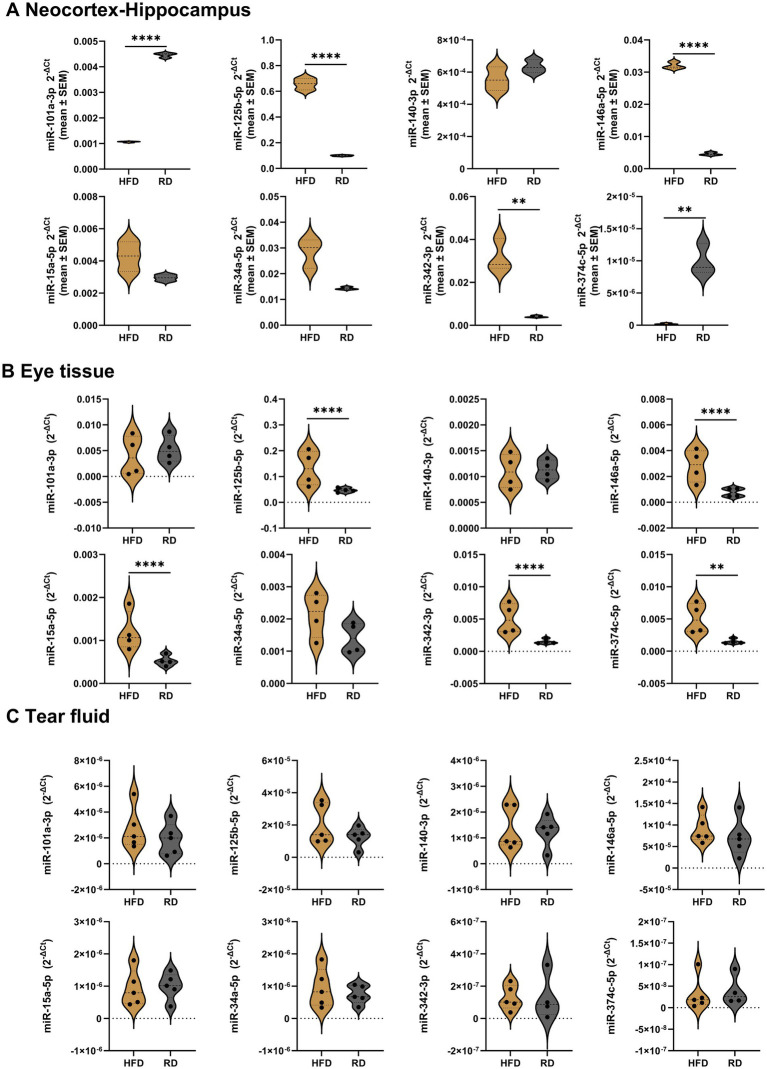
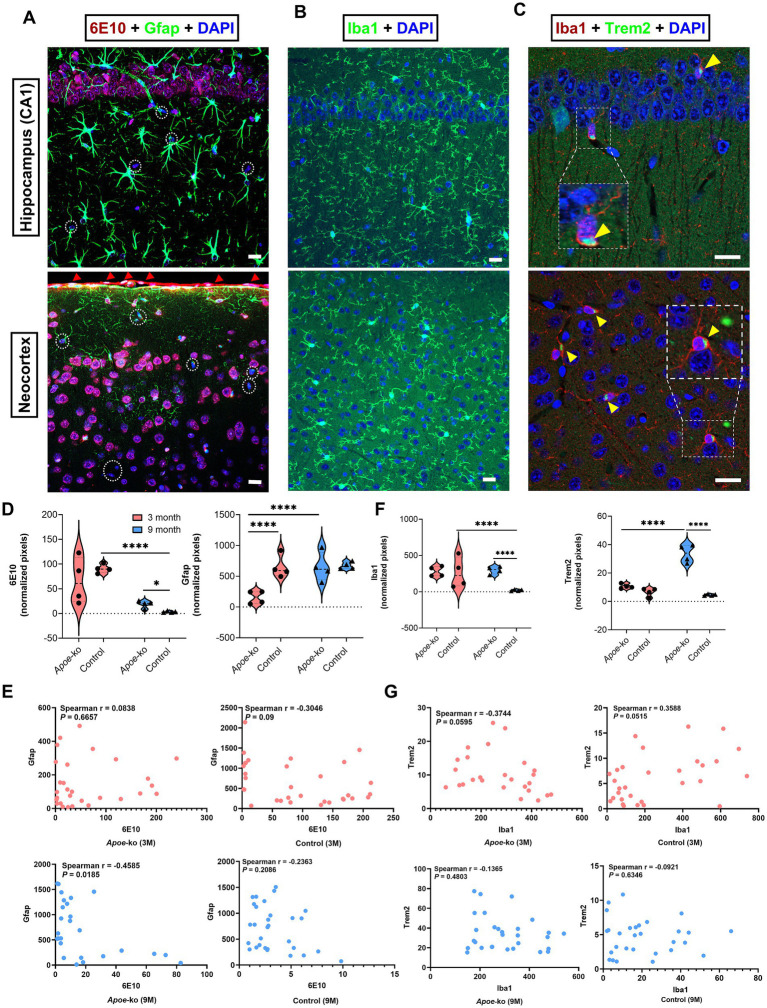
Our findings demonstrated that miRNA levels were generally lower in 3-month-old -ko mice but increased in 9-month-old mice across five distinct brain regions, as well as in eye tissue and tear fluid. A high-fat diet further enhanced miRNA dysregulation in brain and eye tissues, but not in tear fluid. Target mRNAs were generally higher in the neocortex-hippocampus and eye tissue of 3-month-old -ko mice but decreased with age, except for glial cell mRNAs like and . Protein analysis revealed elevated Gfap expression, and increased APP/Aβ peptide accumulation in the neocortex-hippocampus, including brain endothelial cells at the meninges, as well as in the retina of 9-month-old -ko mice. These findings highlight ApoE's pivotal role in AD, demonstrating its impact on inflammatory and amyloidogenic/angiogenic miRNA expression, glial homeostasis, and APP/Aβ peptide clearance. The observed upregulation of proinflammatory miR-146a and anti-amyloidogenic/angiogenic miR-15a in 9-month-old -ko mice suggests their potential as tear-based biomarkers for ApoE dysfunction.
载脂蛋白E(ApoE)在脂质稳态中起关键作用,主要在星形胶质细胞中表达,在中枢神经系统(CNS)中的小胶质细胞中表达较少。虽然ε4等位基因是晚发性阿尔茨海默病(AD)最强的遗传风险因素,但其在AD发病机制中的精确作用仍不清楚。ApoE基因敲除(ApoE -/-)小鼠、表达人类ε4的小鼠和人类ε4携带者在脂质代谢、认知和行为功能以及神经退行性变方面表现出相似的缺陷。视网膜作为中枢神经系统的一部分,已被研究以探究AD的潜在机制,包括神经炎症、淀粉样蛋白聚集和神经退行性变。本研究通过分析ApoE -/-小鼠的脑和眼样本,探讨ApoE在AD中的作用,重点是鉴定与ApoE功能障碍相关的潜在视网膜生物标志物。
我们将正常饮食的雌性ApoE -/-小鼠与3个月和9个月大的年龄匹配的C57BL/6J对照小鼠进行比较。我们的研究包括微小RNA(miRNA)、其靶信使RNA(mRNA)和选定的蛋白质标志物,包括星形胶质细胞(Gfap)、小胶质细胞/巨噬细胞(Iba1和Trem2)标志物以及与AD发病机制相关的淀粉样前体蛋白(APP)/淀粉样β(Aβ)肽。我们还在9个月大时检查了高脂饮食与正常饮食的雌性ApoE -/-小鼠的miRNA和mRNA差异表达。
我们的研究结果表明,在五个不同的脑区以及眼组织和泪液中,3个月大的ApoE -/-小鼠的miRNA水平普遍较低,但在9个月大的小鼠中有所升高。高脂饮食进一步加剧了脑和眼组织中的miRNA失调,但泪液中没有。在3个月大的ApoE -/-小鼠的新皮质 - 海马体和眼组织中,靶mRNA通常较高,但随着年龄增长而下降,神经胶质细胞mRNA如Gfap和Iba1除外。蛋白质分析显示,9个月大的ApoE -/-小鼠的新皮质 - 海马体中Gfap表达升高,APP/Aβ肽积累增加,包括脑膜处的脑内皮细胞以及视网膜。这些发现突出了ApoE在AD中的关键作用,证明了其对炎症和淀粉样蛋白生成/血管生成性miRNA表达、神经胶质稳态以及APP/Aβ肽清除的影响。在9个月大的ApoE -/-小鼠中观察到促炎miR - 146a和抗淀粉样蛋白生成/血管生成miR - 15a的上调,表明它们有可能作为基于泪液的ApoE功能障碍生物标志物。