Rodriguez Gustavo A, Tai Leon M, LaDu Mary Jo, Rebeck G William
Department of Neuroscience, Georgetown University Medical Center, 3970 Reservoir Road, NW Washington, DC 20057, USA.
J Neuroinflammation. 2014 Jun 19;11:111. doi: 10.1186/1742-2094-11-111.
Having the apolipoprotein E4 (APOE-ϵ4) allele is the strongest genetic risk factor for the development of Alzheimer's disease (AD). Accumulation of amyloid beta (Aβ) in the brain is influenced by APOE genotype. Transgenic mice co-expressing five familial AD mutations (5xFAD) in the presence of human APOE alleles (ϵ2, ϵ3 or ϵ4) exhibit APOE genotype-specific differences in early Aβ accumulation, suggesting an interaction between APOE and AD pathology. Whether APOE genotype affects Aβ-plaque-associated neuroinflammation remains unclear. In the current study, we address the role of APOE genotype on Aβ-associated microglial reactivity in the EFAD transgenic mouse model.
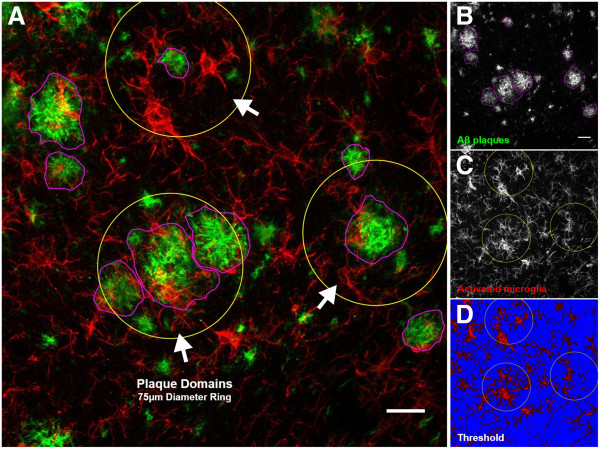
We analyzed Aβ-induced glial activation in the brains of 6-month-old EFAD transgenic mice (E2FAD, E3FAD and E4FAD). Region-specific morphological profiles of Aβ plaques in EFAD brain sections were compared using immunofluorescence staining. We then determined the degree of glial activation in sites of Aβ deposition while comparing levels of the inflammatory cytokine Interleukin-1β (IL-1β) by ELISA. Finally, we quantified parameters of Aβ-associated microglial reactivity using double-stained EFAD brain sections.
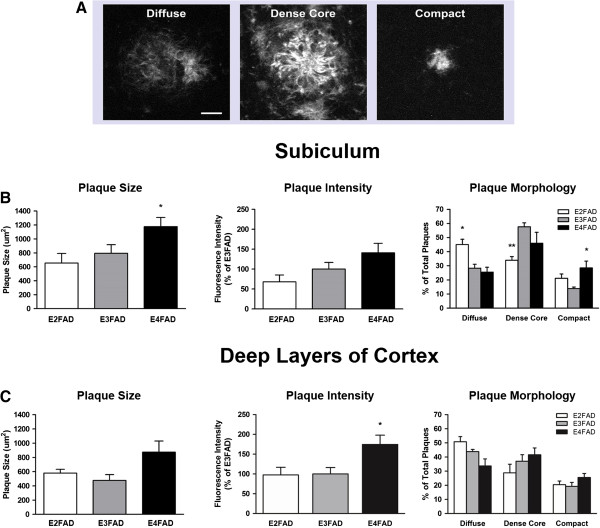
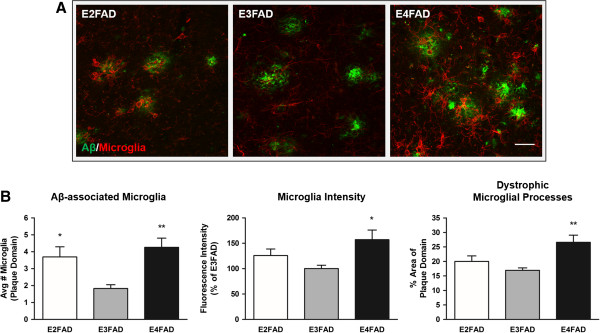
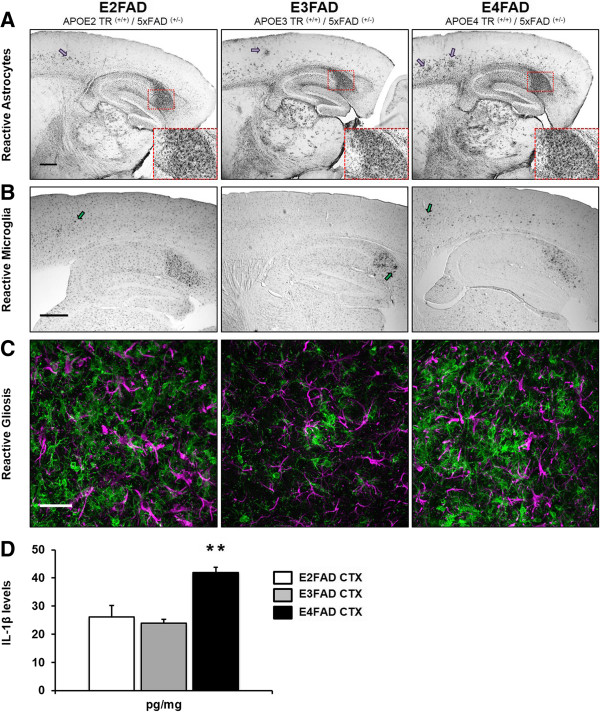
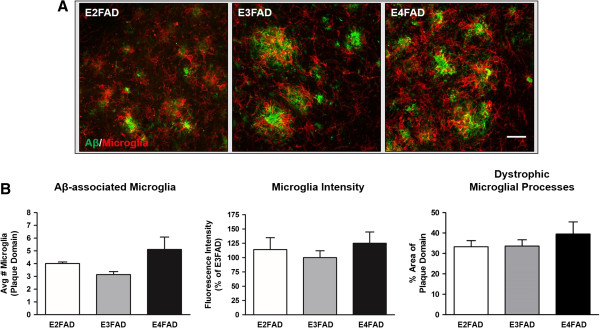
Characterization of Aβ plaques revealed there were larger and more intensely stained plaques in E4FAD mice relative to E2FAD and E3FAD mice. E4FAD mice also had a greater percentage of compact plaques in the subiculum than E3FAD mice. Reactive microglia and dystrophic astrocytes were prominent in EFAD brains, and primarily localized to two sites of significant Aβ deposition: the subiculum and deep layers of the cortex. Cortical levels of IL-1β were nearly twofold greater in E4FAD mice relative to E3FAD mice. To control for differences in levels of Aβ in the different EFAD mice, we analyzed the microglia within domains of specific Aβ deposits. Morphometric analyses revealed increased measures of microglial reactivity in E4FAD mice, including greater dystrophy, increased fluorescence intensity and a higher density of reactive cells surrounding cortical plaques, than in E3FAD mice.
In addition to altering morphological profiles of Aβ deposition, APOE genotype influences Aβ-induced glial activation in the adult EFAD cortex. These data support a role for APOE in modulating Aβ-induced neuroinflammatory responses in AD progression, and support the use of EFAD mice as a suitable model for mechanistic studies of Aβ-associated neuroinflammation.
载脂蛋白E4(APOE-ϵ4)等位基因是阿尔茨海默病(AD)发生发展的最强遗传风险因素。脑内β淀粉样蛋白(Aβ)的积累受APOE基因型影响。在存在人类APOE等位基因(ϵ2、ϵ3或ϵ4)的情况下共表达五种家族性AD突变(5xFAD)的转基因小鼠在早期Aβ积累方面表现出APOE基因型特异性差异,提示APOE与AD病理之间存在相互作用。APOE基因型是否影响Aβ斑块相关的神经炎症仍不清楚。在本研究中,我们探讨了APOE基因型在EFAD转基因小鼠模型中对Aβ相关小胶质细胞反应性的作用。
我们分析了6月龄EFAD转基因小鼠(E2FAD、E3FAD和E4FAD)脑内Aβ诱导的胶质细胞活化。使用免疫荧光染色比较EFAD脑切片中Aβ斑块的区域特异性形态学特征。然后我们在Aβ沉积部位测定胶质细胞活化程度,同时通过酶联免疫吸附测定法(ELISA)比较炎性细胞因子白细胞介素-1β(IL-1β)水平。最后,我们使用双重染色的EFAD脑切片对Aβ相关小胶质细胞反应性参数进行定量分析。
Aβ斑块特征显示,与E2FAD和E3FAD小鼠相比,E4FAD小鼠的斑块更大且染色更强烈。与E3FAD小鼠相比,E4FAD小鼠海马下托中紧密斑块的比例也更高。反应性小胶质细胞和营养不良性星形胶质细胞在EFAD脑中很突出,主要定位于两个显著Aβ沉积部位:海马下托和皮质深层。与E3FAD小鼠相比,E4FAD小鼠皮质中IL-1β水平几乎高出两倍。为了控制不同EFAD小鼠中Aβ水平的差异,我们分析了特定Aβ沉积物区域内的小胶质细胞。形态计量学分析显示,与E3FAD小鼠相比,E4FAD小鼠中小胶质细胞反应性指标增加,包括更大的营养不良、荧光强度增加以及皮质斑块周围反应性细胞密度更高。
除了改变Aβ沉积的形态学特征外,APOE基因型还影响成年EFAD皮质中Aβ诱导的胶质细胞活化。这些数据支持APOE在AD进展过程中调节Aβ诱导的神经炎症反应中的作用,并支持将EFAD小鼠作为Aβ相关神经炎症机制研究的合适模型。