Quyen Tran Lam Tu, Hsieh Yu-Chia, Li Shiao-Wen, Wu Lii-Tzu, Liu Ya-Zhu, Pan Yi-Jiun
Department of Biological Science and Technology, College of Life Science, China Medical University, Taichung, Taiwan.
Department of Microbiology and Immunology, School of Medicine, College of Medicine, China Medical University, Taichung, Taiwan.
mSphere. 2025 Jan 28;10(1):e0079324. doi: 10.1128/msphere.00793-24. Epub 2024 Dec 31.
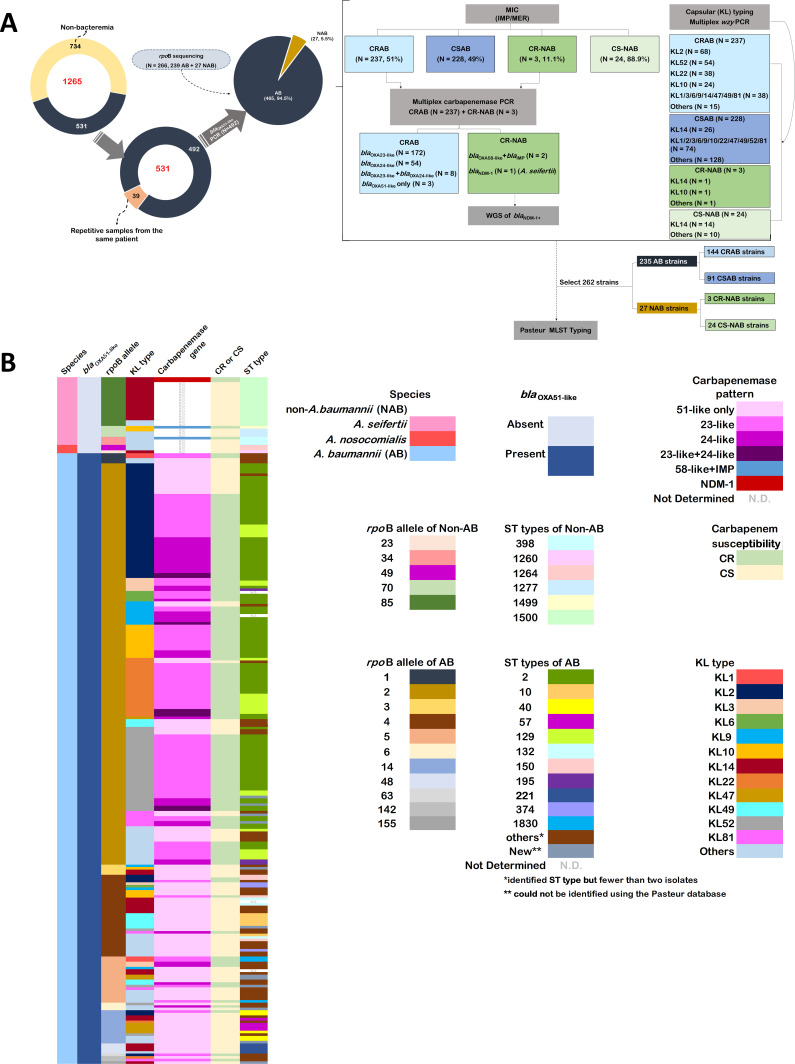
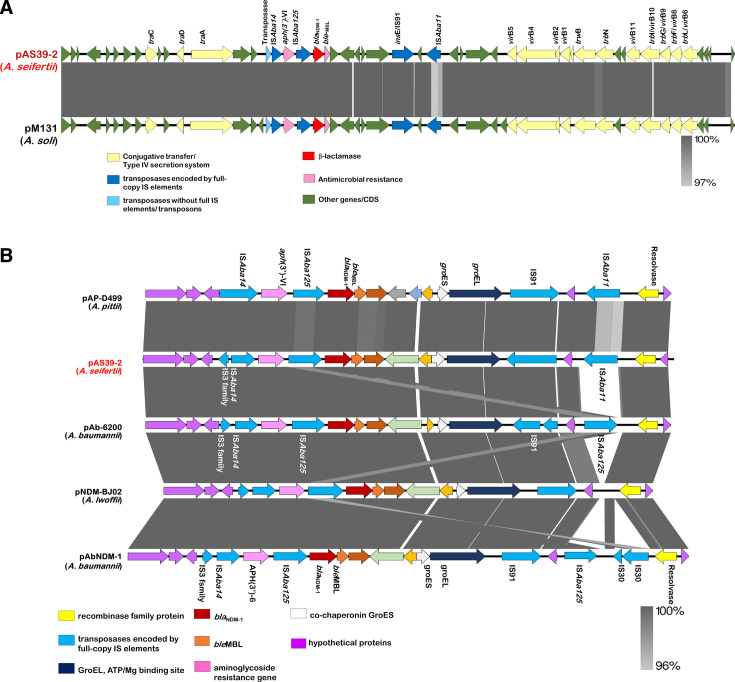
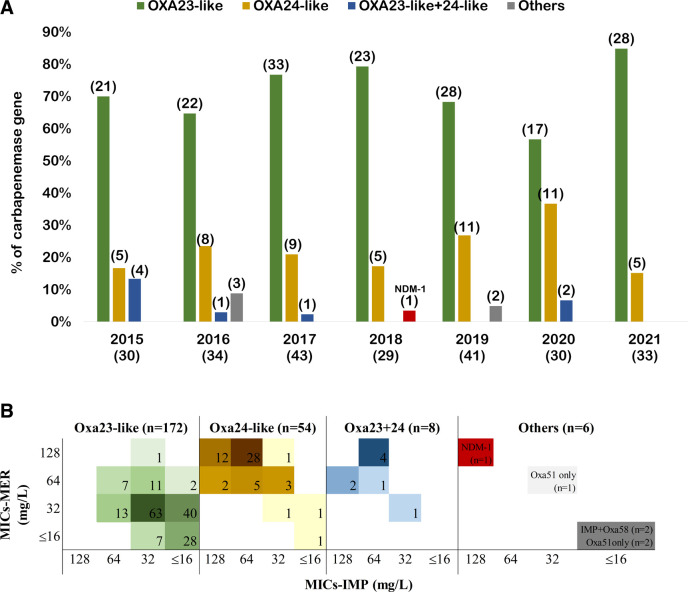
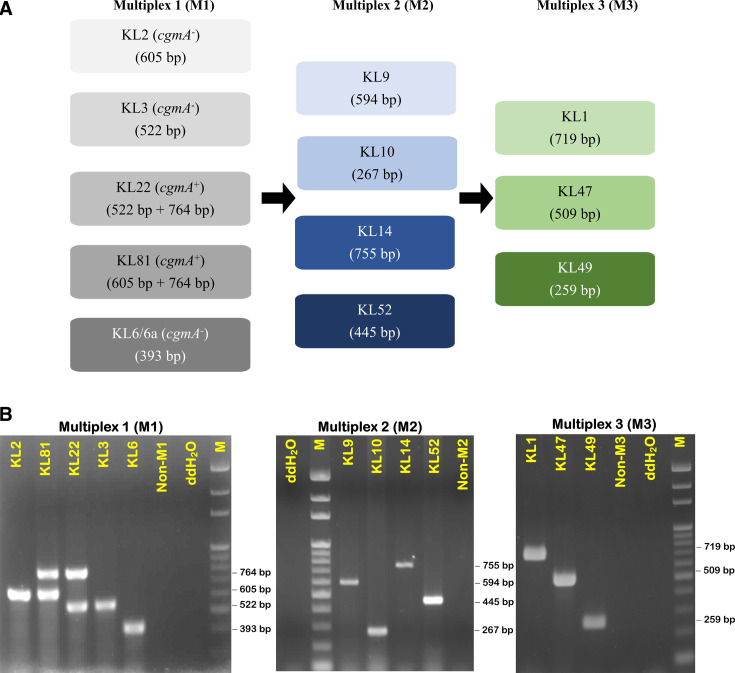
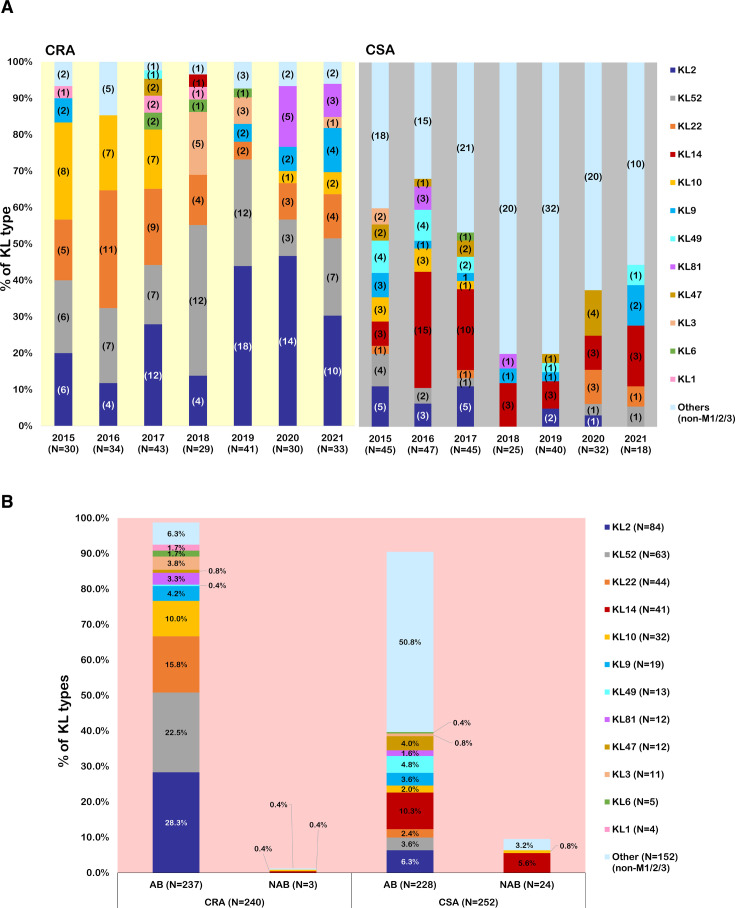
particularly the group, is a major cause of nosocomial infections, and carbapenem-resistant spp. are important human pathogens. We collected 492 spp. strains from two hospitals in Taiwan and classified them using MALDI-TOF MS and PCR; 94.5% were and 5.5% were non-. (NAB). We confirmed their identity by B gene sequencing of 239 randomly selected strains and all 27 NAB strains. Our analysis revealed that the B alleles of OXA51-like-negative strains matched those of two NAB species, and , while all OXA51-like-positive strains matched , as per the Pasteur MLST scheme database. Among the 492 strains, 240 exhibited carbapenem resistance, including 237 carbapenem-resistant (CRAB) strains and three CR-NAB strains. All CRAB strains were positive for ; 72.6% also carried , 22.8% carried , 3.4% co-carried +, and 1.27% carried alone. Among the three CR-NAB strains, one carried , and two co-carried +. We also established a new multiplex PCR method for rapid screening of common capsular types (KL), which showed a difference between CRAB and carbapenem-susceptible (CSAB). KL2, KL10, KL22, and KL52 accounted for 76.6% of CRAB strains, whereas about half of the CSAB strains were other KL types. Of the remaining CSAB strains, KL14 was the most predominant type at 10.3%. We further conducted MLST Pasteur typing for 262 isolates and found that the carbapenemase genes were correlated with either ST or KL types. Additionally, KL types showed correlations with ST types, carbapenem resistance, and certain clinical records. Whole-genome sequencing of a -carrying strain revealed a plasmid transferable via conjugation, suggesting may be a reservoir for NDM-1 plasmids.IMPORTANCECarbapenem-resistant spp. have been identified by the World Health Organization as a top priority for new antibiotic development. We established a rapid KL-typing method for efficient screening of strains to enable epidemiological surveillance and provide a foundation for effective infection control. Our investigation of the molecular epidemiology of the group isolates revealed the prevalence of carbapenemase genes and major KL types among CR and CS strains of and NAB. We identified an strain carrying a Ti-type conjugative operon on a small plasmid that harbored genes encoding the NDM-1 carbapenemase alongside genes conferring resistance to aminoglycosides and bleomycin and closely resembled sequences detected in and in Taiwan and China, respectively, suggesting its potential for transmitting multidrug resistance and contributing to the spread of antimicrobial resistance.
特别是该菌属,是医院感染的主要原因,而耐碳青霉烯类该菌属是重要的人类病原体。我们从台湾的两家医院收集了492株该菌属菌株,并使用基质辅助激光解吸电离飞行时间质谱(MALDI - TOF MS)和聚合酶链反应(PCR)对其进行分类;94.5%为该菌属,5.5%为非该菌属(NAB)。我们通过对239株随机选择的该菌属菌株和所有27株NAB菌株进行B基因测序来确认它们的身份。我们的分析表明,根据巴斯德多位点序列分型(MLST)方案数据库,OXA51样阴性菌株的B等位基因与两种NAB菌种的等位基因匹配,即和,而所有OXA51样阳性菌株与匹配。在这492株菌株中,240株表现出对碳青霉烯类耐药,包括237株耐碳青霉烯类该菌属(CRAB)菌株和3株耐碳青霉烯类非该菌属(CR - NAB)菌株。所有CRAB菌株对均呈阳性;72.6%还携带,22.8%携带,3.4%共同携带 +,1.27%单独携带。在3株CR - NAB菌株中,1株携带,2株共同携带 +。我们还建立了一种新的多重PCR方法用于快速筛选常见荚膜类型(KL),该方法显示CRAB菌株和碳青霉烯类敏感该菌属(CSAB)之间存在差异。KL2、KL10、KL22和KL52占CRAB菌株的76.6%,而约一半的CSAB菌株为其他KL类型。在其余的CSAB菌株中,KL14是最主要的类型,占10.3%。我们进一步对262株分离株进行了巴斯德MLST分型,发现碳青霉烯酶基因与ST型或KL类型相关。此外,KL类型与ST类型、碳青霉烯类耐药性以及某些临床记录相关。一株携带的该菌属菌株的全基因组测序揭示了一种可通过接合转移的质粒,表明可能是NDM - 1质粒的储存库。
耐碳青霉烯类该菌属已被世界卫生组织确定为新抗生素研发的首要重点。我们建立了一种快速的KL分型方法,用于高效筛选该菌属菌株,以进行流行病学监测,并为有效的感染控制提供基础。我们对该菌属分离株的分子流行病学调查揭示了碳青霉烯酶基因以及CR和CS该菌属及NAB菌株中主要KL类型的流行情况。我们鉴定出一株在小质粒上携带Ti型接合操纵子的该菌属菌株,该质粒含有编码NDM - 1碳青霉烯酶的基因以及赋予对氨基糖苷类和博来霉素耐药性的基因,并且分别与在台湾和中国的和中检测到的序列非常相似,表明其具有传播多重耐药性并促进抗菌药物耐药性传播的潜力。