Ion Titapiccolo Jasmine, Neri Luca, Schaufler Thilo, Arens Hans-Jurgen, Usvyat Len, Stuard Stefano, Soro Marco
Fresenius Medical Care Italia SpA, Palazzo Pignano, Italy.
CSL Vifor, Glattbrugg, Switzerland.
Adv Ther. 2025 Feb;42(2):1283-1289. doi: 10.1007/s12325-024-03090-7. Epub 2025 Jan 2.
Chronic kidney disease-associated pruritus (CKD-aP) is a common, yet underdiagnosed condition among patients on hemodialysis. Considering the lack of established treatment pathways, we sought to evaluate the use of antidepressant, systemic antihistamines, or gabapentinoid medications among patients with CKD-aP in the year following pruritus assessment.
We included 6209 patients on hemodialysis in the analysis. We retrospectively extracted clinical and patient-reported data from electronic health records. The intensity of CKD-aP was assessed by KDQOL-36 and 5-D Itch questionnaires. Prescription of antidepressant, antihistamine, and gabapentinoids was ascertained by the occurrence of a relevant active medical order in patients' medical records.
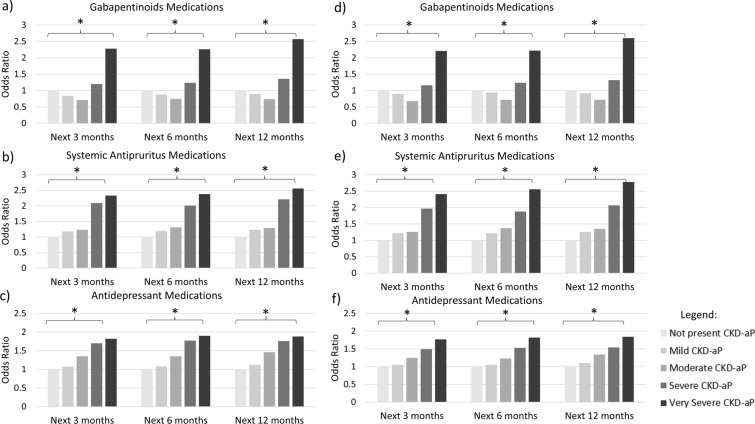
We observed a consistent and graded association between the severity of CKD-aP and the use of antidepressant, systemic antihistamines, and gabapentinoid medications. This association remained consistent and intensified over the duration of the year after pruritus screening. This trend was robust even after accounting for potential confounding factors.
Patterns of antipruritic medication use in a cohort of patients with CKD-aP was identified and the frequent use of off-label treatments in the absence of approved therapies was highlighted. These observations reflect clinical practices aimed at managing severe pruritus but do not imply a causal relationship between the medications and pruritus severity. Even though we cannot exclude the possibility that these drugs have been prescribed to treat medical conditions warranting their use, previous evidence suggested that doctors may also use such medications in an attempt to buffer CKD-aP. These findings underline the importance of further elucidating current treatment strategies adopted in clinical practice to address CKD-aP.
慢性肾脏病相关性瘙痒(CKD-aP)在血液透析患者中很常见,但诊断不足。考虑到缺乏既定的治疗途径,我们试图评估在瘙痒评估后的一年中,抗抑郁药、全身性抗组胺药或加巴喷丁类药物在CKD-aP患者中的使用情况。
我们纳入了6209例接受血液透析的患者进行分析。我们从电子健康记录中回顾性提取临床和患者报告的数据。通过KDQOL-36和5-D瘙痒问卷评估CKD-aP的强度。通过患者病历中相关有效医嘱的出现来确定抗抑郁药、抗组胺药和加巴喷丁类药物的处方情况。
我们观察到CKD-aP的严重程度与抗抑郁药、全身性抗组胺药和加巴喷丁类药物的使用之间存在一致的分级关联。在瘙痒筛查后的一年时间里,这种关联保持一致并增强。即使考虑了潜在的混杂因素,这一趋势仍然强劲。
确定了CKD-aP患者队列中使用止痒药物的模式,并强调了在缺乏批准疗法的情况下频繁使用标签外治疗的情况。这些观察结果反映了旨在管理严重瘙痒的临床实践,但并不意味着药物与瘙痒严重程度之间存在因果关系。尽管我们不能排除这些药物是用于治疗需要使用它们的医疗状况的可能性,但先前的证据表明,医生也可能使用此类药物来缓解CKD-aP。这些发现强调了进一步阐明临床实践中采用的当前治疗策略以解决CKD-aP的重要性。