Madhi Shabir A, Kampmann Beate, Simões Eric A F, Zachariah Philip, Pahud Barbara A, Radley David, Sarwar Uzma N, Shittu Emma, Llapur Conrado, Pérez Marc Gonzalo, Maldonado Yvonne, Kachikis Alisa, Zar Heather J, Swanson Kena A, Lino Maria Maddalena, Anderson Annaliesa S, Gurtman Alejandra, Munjal Iona
South African Medical Research Council Vaccines and Infectious Diseases Analytics Research Unit and the Wits Infectious Diseases and Oncology Research Institute, Faculty of Health Sciences, University of the Witwatersrand, Johannesburg, and the Department of Paediatrics and Child Health, Red Cross War Memorial Children's Hospital, SA-MRC Unit on Child and Adolescent Health, University of Cape Town, Cape Town, South Africa; the Vaccines and Immunity Team, Medical Research Council Unit The Gambia at the London School of Hygiene and Tropical Medicine, Fajara, the Gambia; the Institute for International Health Charité, Universitätsmedizin, Berlin, Germany; Children's Hospital Colorado, Aurora, Colorado; Vaccine Research and Development, Pfizer Inc, Pearl River, New York; Vaccine Research and Development, Pfizer Inc, Hurley, United Kingdom; Instituto de Maternidad y Ginecología Nuestra Señora de Las Mercedes, San Miguel de Tucumán, Argentina; iTrials-Hospital Militar Central, Buenos Aires, Argentina; the Stanford University School of Medicine, Palo Alto, California; the Department of Obstetrics and Gynecology, University of Washington, Seattle, Washington; and Worldwide Safety, Pfizer Srl, Milan, Italy.
Obstet Gynecol. 2025 Feb 1;145(2):147-156. doi: 10.1097/AOG.0000000000005817. Epub 2025 Jan 2.
To describe preterm birth frequency and newborn and infant outcomes overall and among preterm children in the MATISSE (Maternal Immunization Study for Safety and Efficacy) trial of maternal vaccination with bivalent respiratory syncytial virus (RSV) prefusion F protein-based vaccine (RSVpreF) to protect infants against severe RSV-associated illness.
MATISSE was a global, phase 3, randomized, double-blind trial. Pregnant individuals received single injections of RSVpreF or placebo. Adverse events of special interest, including preterm birth (gestational age less than 37 weeks) and low birth weight (2,500 g or less), were collected through 6 months after delivery (pregnant participants) and from birth through age 12 or 24 months (pediatric participants).
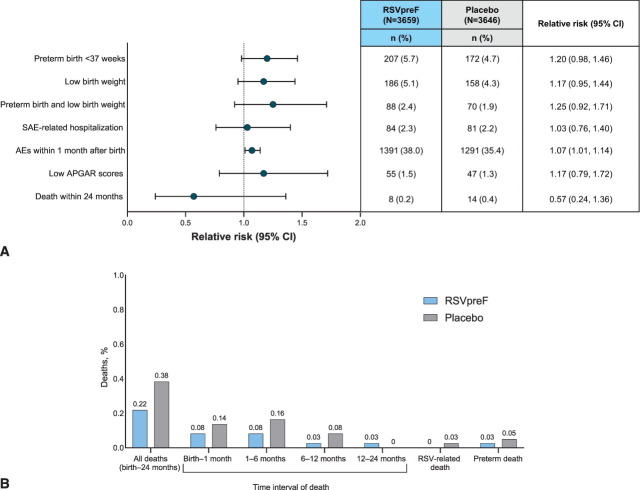
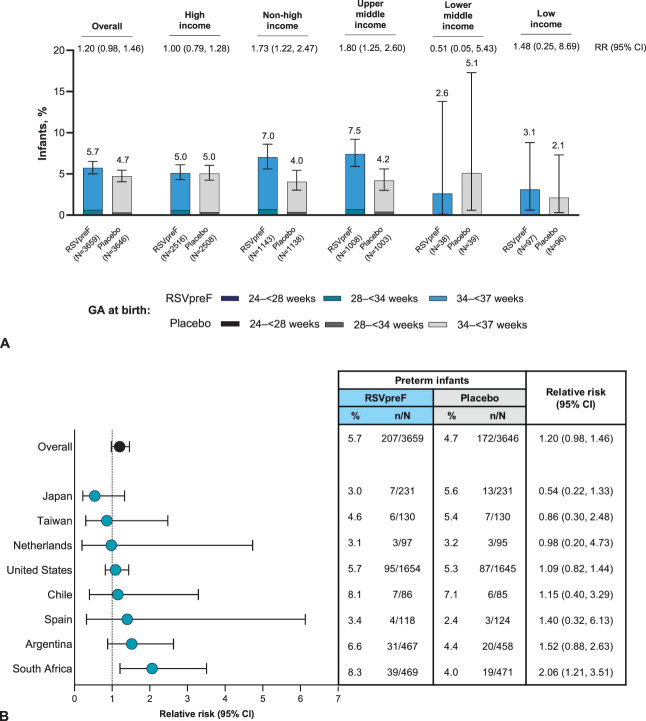
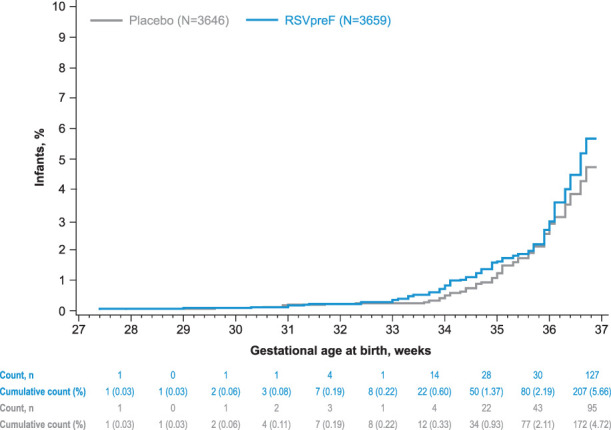
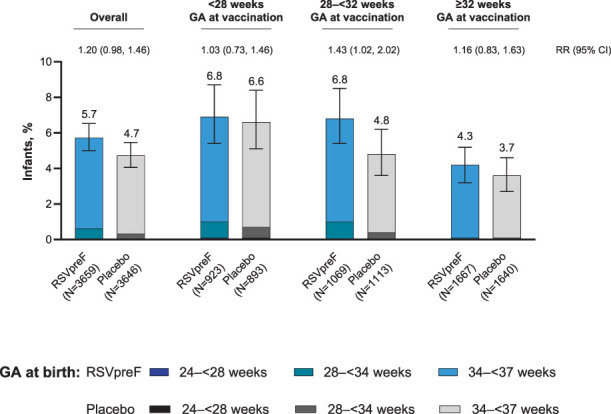
Overall, 7,386 pregnant participants received RSVpreF (n=3,698) or placebo (n=3,688); 7,305 newborns and infants were included in the analysis. Most children in both groups were born full term (more than 93%) with normal birth weight (95% or higher). Newborn and infant outcomes, including rates of low birth weight and neonatal hospitalization, were favorable and comparable between groups. Preterm birth rates were 5.7% in the RSVpreF arm and 4.7% in the placebo arm (relative risk [RR] 1.20, 95% CI, 0.98-1.46); most were late preterm. Newborn and infant outcomes, including rates of low birth weight and neonatal hospitalization, were comparable between groups. Twenty-two newborn or infant deaths occurred during the study (RSVpreF n=8, placebo n=14). When stratified by income region, preterm birth rates in RSVpreF and placebo recipients were both 5.0% in high-income countries. Rates in non-high-income countries were 7.0% and 4.0% in the RSVpreF and placebo groups, respectively, and 8.3% and 4.0% in South Africa (RR 2.06, 95% CI, 1.21-3.51).
In this study of maternal RSVpreF vaccination, no clinically significant increase in adverse events of special interest, including preterm birth, low birth weight, or neonatal hospitalization, was observed among pregnant people in the overall analysis. In subgroup analysis of non-high-income countries, an elevated risk of preterm birth was observed. More research is needed to better ascertain preterm delivery risk factors, particularly aimed at minimizing disparities among geographic regions.
This study was sponsored by Pfizer.
ClinicalTrials.gov , NCT04424316.
描述在MATISSE(母体免疫安全性和有效性研究)试验中,孕妇接种基于二价呼吸道合胞病毒(RSV)预融合F蛋白的疫苗(RSVpreF)以保护婴儿免受严重RSV相关疾病影响时的早产频率以及新生儿和婴儿的总体结局,以及早产儿童的结局。
MATISSE是一项全球性、3期、随机、双盲试验。孕妇接受单剂量RSVpreF或安慰剂注射。通过产后6个月(孕妇参与者)以及从出生到12或24个月龄(儿科参与者)收集特别关注的不良事件,包括早产(孕周小于37周)和低出生体重(2500克或以下)。
总体而言,7386名孕妇接受了RSVpreF(n = 3698)或安慰剂(n = 3688);7305名新生儿和婴儿纳入分析。两组中的大多数儿童为足月出生(超过93%)且出生体重正常(95%或更高)。包括低出生体重率和新生儿住院率在内的新生儿和婴儿结局良好,且两组之间具有可比性。RSVpreF组的早产率为5.7%,安慰剂组为4.7%(相对风险[RR]1.20,95%CI,0.98 - 1.46);大多数为晚期早产。包括低出生体重率和新生儿住院率在内的新生儿和婴儿结局在两组之间具有可比性。研究期间发生了22例新生儿或婴儿死亡(RSVpreF组8例,安慰剂组14例)。按收入地区分层时,高收入国家中接受RSVpreF和安慰剂的人群早产率均为5.0%。在非高收入国家,RSVpreF组和安慰剂组的早产率分别为7.0%和4.0%,在南非分别为8.3%和4.0%(RR 2.06,95%CI,1.21 - 3.51)。
在这项关于母体RSVpreF疫苗接种的研究中,总体分析中未观察到包括早产、低出生体重或新生儿住院在内的特别关注不良事件有临床上显著的增加。在非高收入国家的亚组分析中,观察到早产风险升高。需要更多研究以更好地确定早产的危险因素,特别是旨在最小化地理区域间的差异。
本研究由辉瑞公司赞助。
ClinicalTrials.gov,NCT04424316。