Bouwman Mara, de Bakker Dennis E M, Honkoop Hessel, Giovou Alexandra E, Versteeg Danielle, Boender Arie R, Nguyen Phong D, Slotboom Merel, Colquhoun Daniel, Vigil-Garcia Marta, Kooijman Lieneke, Janssen Rob, Hooijkaas Ingeborg B, Günthel Marie, Visser Kimberly J, Klerk Mischa, Zentilin Lorena, Giacca Mauro, Kaslin Jan, Boink Gerard J J, van Rooij Eva, Christoffels Vincent M, Bakkers Jeroen
Hubrecht Institute, Royal Netherlands Academy of Arts and Sciences (KNAW) and University Medical Center Utrecht, Utrecht, The Netherlands.
Leibniz Institute on Aging, Fritz Lipmann Institute (FLI), Jena, Germany.
Nat Cardiovasc Res. 2025 Jan;4(1):64-82. doi: 10.1038/s44161-024-00588-9. Epub 2025 Jan 2.
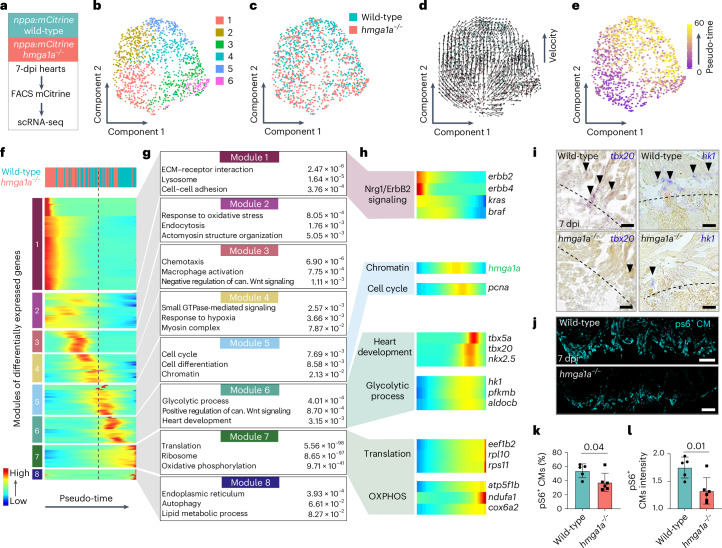
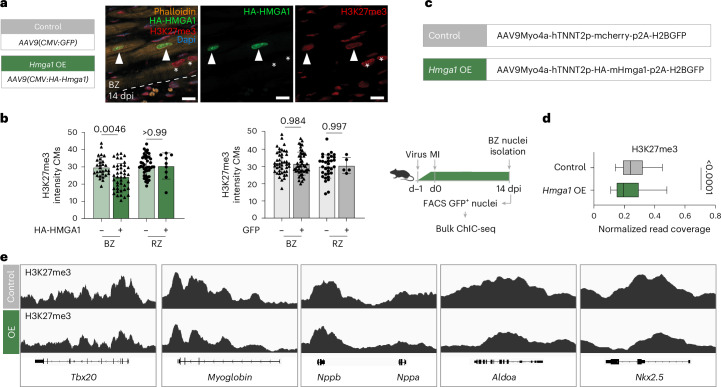
In contrast to adult mammalian hearts, the adult zebrafish heart efficiently replaces cardiomyocytes lost after injury. Here we reveal shared and species-specific injury response pathways and a correlation between Hmga1, an architectural non-histone protein, and regenerative capacity, as Hmga1 is required and sufficient to induce cardiomyocyte proliferation and required for heart regeneration. In addition, Hmga1 was shown to reactivate developmentally silenced genes, likely through modulation of H3K27me3 levels, poising them for a pro-regenerative gene program. Furthermore, AAV-mediated Hmga1 expression in injured adult mouse hearts led to controlled cardiomyocyte proliferation in the border zone and enhanced heart function, without cardiomegaly and adverse remodeling. Histone modification mapping in mouse border zone cardiomyocytes revealed a similar modulation of H3K27me3 marks, consistent with findings in zebrafish. Our study demonstrates that Hmga1 mediates chromatin remodeling and drives a regenerative program, positioning it as a promising therapeutic target to enhance cardiac regeneration after injury.
与成年哺乳动物心脏不同,成年斑马鱼心脏能够有效地替代损伤后丢失的心肌细胞。在此,我们揭示了共同的和物种特异性的损伤反应途径,以及一种结构非组蛋白Hmga1与再生能力之间的相关性,因为Hmga1是诱导心肌细胞增殖所必需且足够的,并且是心脏再生所必需的。此外,Hmga1被证明可重新激活发育过程中沉默的基因,可能是通过调节H3K27me3水平,使其为促再生基因程序做好准备。此外,腺相关病毒介导的Hmga1在成年损伤小鼠心脏中的表达导致边界区心肌细胞的可控增殖并增强心脏功能,而不会出现心脏肥大和不良重塑。对小鼠边界区心肌细胞的组蛋白修饰图谱分析揭示了H3K27me3标记的类似调节,这与在斑马鱼中的发现一致。我们的研究表明,Hmga1介导染色质重塑并驱动再生程序,使其成为损伤后增强心脏再生的有前景的治疗靶点。