Butsing Nipaporn, Voss Joachim G, Keandoungchun Jesada, Thongniran Nalinrat, Griffin Mary T Quinn
Ramathibodi School of Nursing, Faculty of Medicine Ramathibodi Hospital, Mahidol University, 270, Rama 6 Road, Ratchathewi, Bangkok, 10400, Thailand.
University of Nebraska Medical Center College of Nursing, Omaha, NE, USA.
Sci Rep. 2025 Jan 2;15(1):416. doi: 10.1038/s41598-024-84454-5.
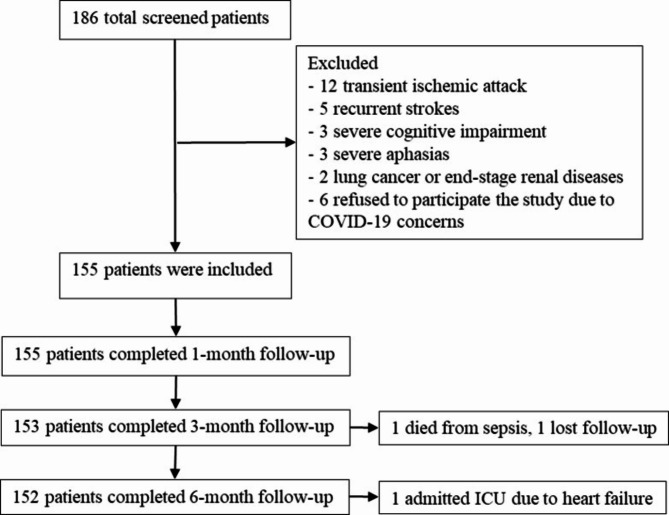
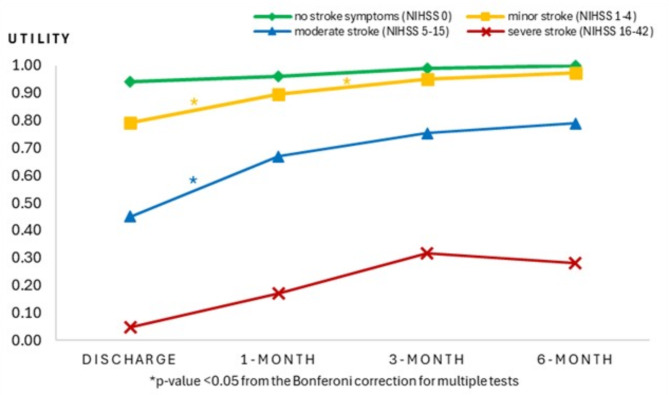
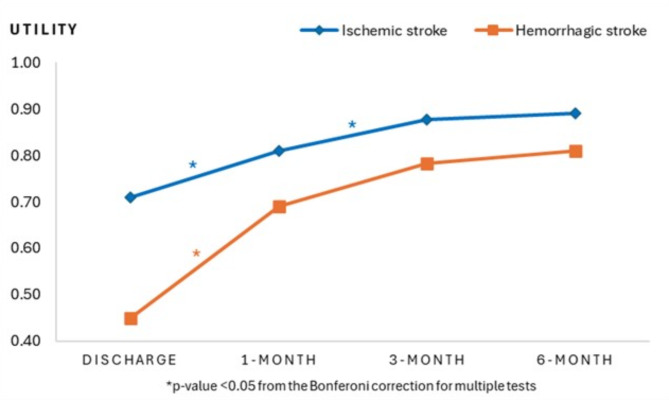
Stroke causes functional disabilities and reduces the quality of life of stroke survivors. This retrospective cohort study aimed to examine changes in health-related quality of life (HRQoL) six months after a stroke and the effect of stroke characteristics and sociodemographic factors on HRQoL. Participants completed a questionnaire that included the stroke characteristics, sociodemographic characteristics, and the 5-level European Quality of Life 5 dimensions (EQ-5D-5L) before discharge. Follow-up assessments of HRQoL were performed at one, three, and six months after discharge. Descriptive statistics and linear mixed models were used for data analyses. A total of 155 first-stroke patients were included, of which N = 152 patients completed follow-up assessments until six months. The mean EQ-5D-5L index score at discharge was 0.69 (SD 0.33). The trends of HRQoL significantly increased from discharge to three months, but there was no significant HRQoL improvement after three months. Considering stroke severity, mean HRQoL significantly improved for patients with no stroke symptoms, minor stroke, and moderate stroke (p < 0.05) but not those with severe stroke (p = 0.156). HRQoL among patients with sufficient monthly income significantly increased over six months (p < 0.05). HRQoL among patients with severe stroke and having insufficient income were poor. Supportive programs are required to improve their HRQoL.
中风会导致功能残疾,并降低中风幸存者的生活质量。这项回顾性队列研究旨在调查中风六个月后与健康相关的生活质量(HRQoL)的变化,以及中风特征和社会人口学因素对HRQoL的影响。参与者在出院前完成了一份问卷,其中包括中风特征、社会人口学特征以及5级欧洲生活质量5维度量表(EQ-5D-5L)。在出院后1个月、3个月和6个月对HRQoL进行随访评估。采用描述性统计和线性混合模型进行数据分析。共纳入155例首次中风患者,其中152例患者完成了6个月的随访评估。出院时EQ-5D-5L指数平均得分为0.69(标准差0.33)。HRQoL从出院到3个月显著上升,但3个月后HRQoL没有显著改善。考虑到中风严重程度,无症状中风、轻度中风和中度中风患者的平均HRQoL显著改善(p<0.05),但重度中风患者没有显著改善(p=0.156)。月收入充足的患者在6个月内HRQoL显著提高(p<0.05)。重度中风且收入不足的患者HRQoL较差。需要支持性项目来改善他们的HRQoL。