Tang Lifei, Guo Ran, Quan Yaochen, Zhang Haiwen, Qian Yingcong, Yu Youjia, Song Shaoyong, Li Jian
Department of Anesthesiology, The 904 th Hospital of the Joint Service Support Force of the Chinese People's Liberation Army, Wuxi, Jiangsu, 214000, China.
Department of Pain Medicine, Zhejiang Provincial People's Hospital, Hangzhou, Zhejiang, 310014, China.
BMC Anesthesiol. 2025 Jan 2;25(1):1. doi: 10.1186/s12871-024-02869-z.
Intravenous anesthesia with high-flow nasal cannula (HFNC) has been reported to benefit oxygen reserves and enhance postoperative recovery in surgeries requiring low neuromuscular blockade. This study investigated whether HFNC improves recovery quality in elderly undergoing ureteroscopic holmium laser lithotripsy (UHLL).
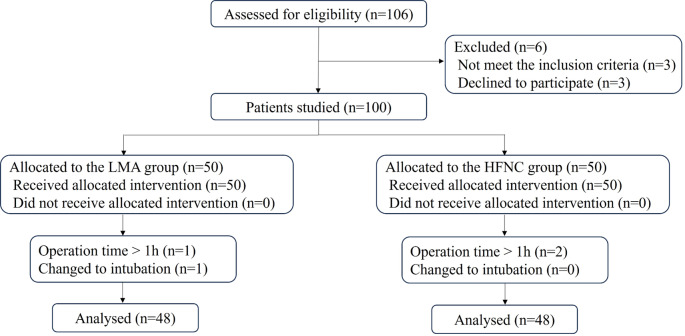
We enrolled 106 elderly patients undergoing UHLL, with 96 patients (48 per group) included in the final analysis. Patients were randomly assigned (1:1, stratified by sex) to receive either HFNC (HFNC group) or laryngeal mask airway (LMA) assisted general anesthesia (LMA group). The primary outcome was the Quality of Recovery 15-questionnaire (QoR-15) scores. Secondary outcomes included PACU stay duration, time to out-of-bed mobilization, length of hospital stay, airway dryness scores, surgeons' satisfaction, and postoperative complications.
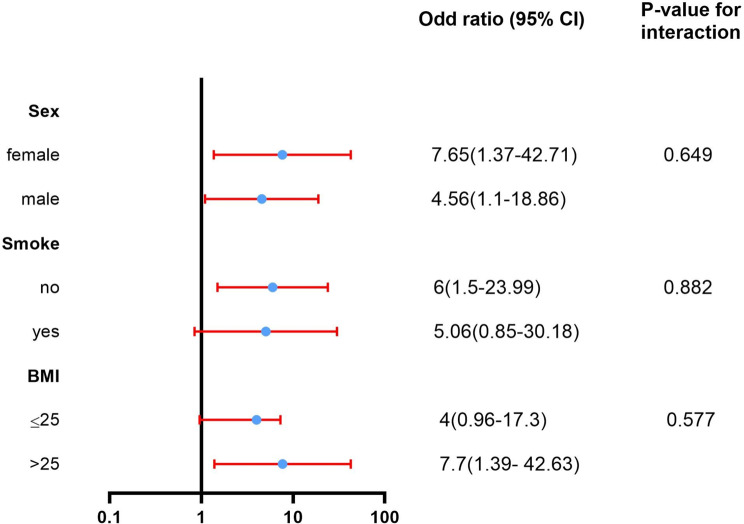
Compared to the LMA group, the HFNC group achieved significantly higher QoR-15 scores (125.5 [118.3-130.0] vs. 136.5 [126.3-139.0]; difference = -9, 95%CI, -11 to -5; P < 0.001) on the first postoperative day. For secondary outcomes, the HFNC group had a shorter PACU stay (difference = 11.6 min, 95% CI, 10.4-12.8 min), earlier out-of-bed mobilization (difference = 31.8 min, 95% CI, 30.6-33.1 min), lower mouth (difference = 2, 95% CI, 1-3) and throat dryness scores (difference = 2, 95% CI, 1-3) at 30 min post-operation, and lower rates of postoperative sore throat (14.6% vs. 0%; P = 0.019) and cough with sputum (odds ratio [OR] = 9.4, 95% CI, 1.1-78.4). No significant differences were observed between the groups for other measures.
HFNC can improve recovery quality in elderly patients after UHLL compared to LMA-assisted general anesthesia.
This trial was registered on July 20, 2023, in the Chinese Clinical Trial Registry (ChiCTR2300073757).
据报道,在需要低水平神经肌肉阻滞的手术中,高流量鼻导管(HFNC)静脉麻醉有助于维持氧储备并促进术后恢复。本研究调查了HFNC是否能改善老年患者输尿管镜钬激光碎石术(UHLL)后的恢复质量。
我们纳入了106例接受UHLL的老年患者,最终分析纳入96例患者(每组48例)。患者被随机分配(1:1,按性别分层)接受HFNC(HFNC组)或喉罩气道(LMA)辅助全身麻醉(LMA组)。主要结局指标为术后恢复质量15项问卷(QoR-15)评分。次要结局指标包括麻醉后恢复室(PACU)停留时间、下床活动时间、住院时间、气道干燥评分、外科医生满意度及术后并发症。
与LMA组相比,HFNC组术后第1天的QoR-15评分显著更高(125.5[118.3 - 130.0]对136.5[126.3 - 139.0];差值 = -9,95%置信区间,-11至-5;P < 0.001)。对于次要结局指标,HFNC组的PACU停留时间更短(差值 = 11.6分钟,95%置信区间,10.4 - 12.8分钟),下床活动更早(差值 = 31.8分钟,95%置信区间,30.6 - 33.1分钟),术后30分钟时口腔(差值 = 2,95%置信区间,1 - 3)和咽喉干燥评分更低(差值 = 2,95%置信区间,1 - 3),术后咽痛发生率更低(14.6%对0%;P = 0.019),咳痰咳嗽发生率更低(比值比[OR] = 9.4,95%置信区间,1.1 - 78.4)。两组在其他指标上未观察到显著差异。
与LMA辅助全身麻醉相比,HFNC可改善老年患者UHLL术后的恢复质量。
本试验于2023年7月20日在中国临床试验注册中心(ChiCTR2300073757)注册。