Nattey Cornelius, Onoya Dorina, Shumba Khumbo, Gareta Dickman, Macleod William, Fox Matthew P, Puren Adrian, Mlisana Koleka, Bor Jacob
Health Economics and Epidemiology Research Office, Department of Internal Medicine, Faculty of Health Sciences, School of Clinical Medicine, University of the Witwatersrand, Johannesburg, South Africa.
Data Science Unit, Africa Health Research Institute, Durban, South Africa.
BMC Glob Public Health. 2025 Jan 2;3(1):2. doi: 10.1186/s44263-024-00118-6.
Under South Africa's Universal Test and Treat (UTT) policy, CD4 counts are no longer required to determine HIV treatment eligibility. However, CD4 count at presentation remains an important marker of disease progression. We assessed whether CD4 testing declined in the UTT era and, if so, by how much.
We analysed CD4 count data from the National Health Laboratory Service (NHLS) National HIV Cohort and TIER.Net database for individuals in HIV care across five South African provinces. "First CD4 count" was defined as the first CD4 test recorded for each patient. In TIER.Net, "date of presentation" was the earliest date of HIV testing, CD4 measurement, or clinic visit. Trends in first CD4 testing volumes (2004-2018) were analyzed, with interrupted time-series analyses assessing the impact of UTT (September 2016).
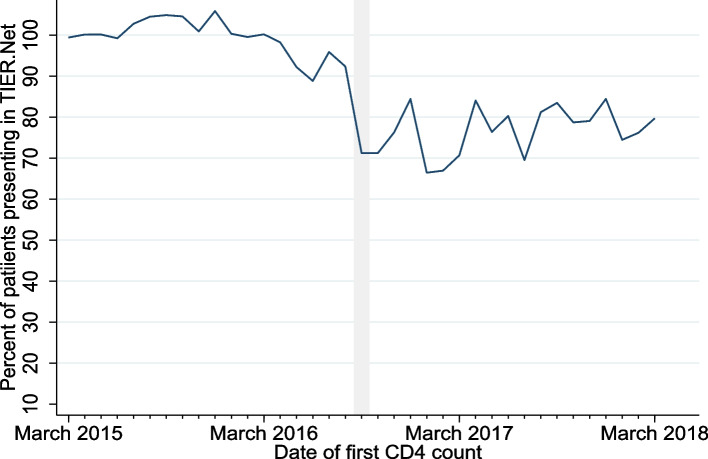
Data included 5,274,218 (NHLS) and 2,265,557 (TIER.Net) individuals with a first CD4 count. In NHLS, first CD4 counts increased from 47,604 in 2004 to 383,705 in 2010 and then declined. Lower volumes were recorded in TIER.Net. Adjusting for prior trends, first CD4 counts increased slightly after UTT, by 32 individuals/day in NHLS (95% CI: - 6 to 61) and 88 individuals/day in TIER.Net (95% CI: 30 to 148). Among TIER.Net patients, the percentage with a CD4 count decreased by 4.3% (95% CI: - 5.2 to - 3.0%).
We found no major decline in CD4 testing at presentation following UTT, contrasting findings from resource-constrained settings with greater reliance on external donors.
根据南非的普遍检测与治疗(UTT)政策,不再需要通过CD4细胞计数来确定是否符合HIV治疗条件。然而,初诊时的CD4细胞计数仍然是疾病进展的重要指标。我们评估了在UTT时代CD4检测是否减少,如果减少,减少了多少。
我们分析了来自南非五个省份接受HIV治疗的个体的国家卫生实验室服务(NHLS)国家HIV队列和TIER.Net数据库中的CD4细胞计数数据。“首次CD4细胞计数”定义为为每位患者记录的第一次CD4检测。在TIER.Net中,“初诊日期”是HIV检测、CD4测量或门诊就诊的最早日期。分析了首次CD4检测量的趋势(2004 - 2018年),采用中断时间序列分析评估UTT(2016年9月)的影响。
数据包括5,274,218名(NHLS)和2,265,557名(TIER.Net)有首次CD4细胞计数的个体。在NHLS中,首次CD4细胞计数从2004年的47,604例增加到2010年的383,705例,然后下降。TIER.Net记录的检测量较低。根据先前趋势进行调整后,UTT后首次CD4细胞计数略有增加,NHLS中每天增加32例(95%置信区间:-6至61),TIER.Net中每天增加88例(95%置信区间:30至148)。在TIER.Net患者中,CD4细胞计数检测的百分比下降了4.3%(95%置信区间:-5.2至-3.0%)。
我们发现UTT后初诊时的CD4检测没有大幅下降,这与更依赖外部捐助者的资源受限环境中的研究结果形成对比。