Hlávka Jakub P, Kinoshita Andrew T, Jeyasingh Divya, Huang Cheng, Mirsafian Leila, Jacobson Mireille
Health Economics, Policy and Innovation Institute, Faculty of Economics and Administration Masaryk University Brno Czech Republic.
Department of Neurology Second Faculty of Medicine and Motol University Hospital Charles University Prague Czech Republic.
Alzheimers Dement (N Y). 2024 Dec 27;10(4):e70022. doi: 10.1002/trc2.70022. eCollection 2024 Oct-Dec.
Without disease-modifying interventions, Medicare and Medicaid spending on Alzheimer's disease (AD) management is expected to reach 637 billion USD annually by 2050. The recent advent of promising AD therapies after decades of a near-total failure rate in clinical trials suggests that more disease-modifying therapies are on the horizon. In this review, we assess the late-stage pipeline of disease-modifying candidates for AD and offer a novel classification of intervention candidates by treatment paradigms-groups of candidates that share an underlying biological mechanism of action and general disease target.
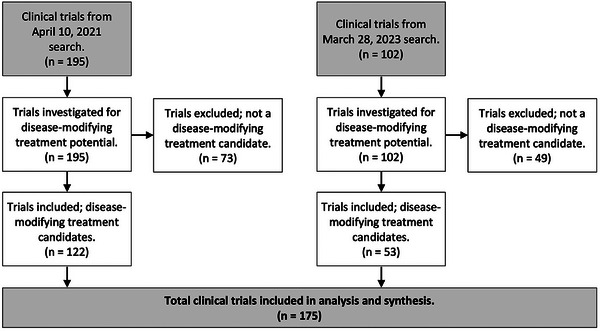
We extracted data from the National Library of Medicine clinical trials database regarding Phase 2 and 3 trials of disease-modifying AD therapies. We categorized trials into eight unique treatment paradigms, which we defined by combinations of therapy (biologic, small molecule, cell and gene therapy, other) and target (amyloid, tau, other). We analyzed primary endpoints, eligibility criteria including clinical ratings of cognition, trial phase and length, and funding sources.
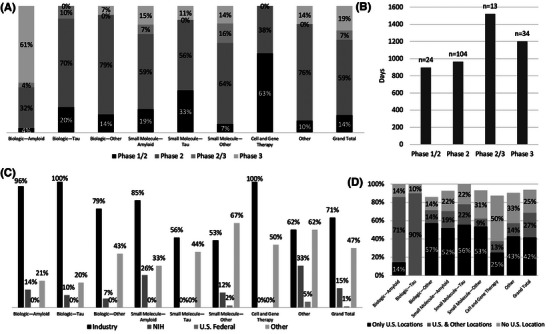
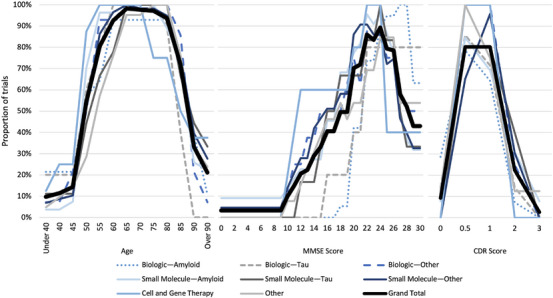
We identified 123 unique disease-modifying intervention candidates in 175 late-stage clinical trials. Biologic and small molecule drugs comprised 30% and 54% of trials, respectively. Eligibility criteria favored patients between the ages of 60 and 80 years with mild cognitive impairment. Including multi-phase trials, 81% of studies were engaged in Phase 2 and 27% in Phase 3. Notably, within the Biologic-Amyloid paradigm, 64% of trials were engaged in Phase 3.
Current studies of disease-modifying therapies for AD comprise a diverse set of approaches to treating the disease. However, effort is largely concentrated in a few treatment paradigms and a narrow patient population, causing varying rates of progress among treatment paradigms in the late-stage clinical trial pipeline. Strategies may be warranted to accelerate successes in the most promising therapeutical paradigms and nurture growth within nascent areas lacking resources but not potential.
An analysis of Alzheimer's disease trial treatment paradigms was conducted.From April 2021 to March 2023, 175 trials of 123 unique candidates were reviewed.Biologic and small molecule drugs comprised 30% and 54% of trials, respectively.Eligibility criteria favored ages 60 through 80 with mild cognitive impairment.
若没有疾病修饰干预措施,预计到2050年,医疗保险和医疗补助计划在阿尔茨海默病(AD)管理方面的支出将达到每年6370亿美元。在经历了数十年临床试验近乎完全失败的情况后,近期出现了有前景的AD疗法,这表明更多的疾病修饰疗法即将出现。在本综述中,我们评估了AD疾病修饰候选药物的后期研发管线,并根据治疗模式——具有共同潜在生物学作用机制和一般疾病靶点的候选药物组,对干预候选药物进行了新的分类。
我们从美国国立医学图书馆临床试验数据库中提取了关于疾病修饰AD疗法的2期和3期试验的数据。我们将试验分为八种独特的治疗模式,这些模式由疗法(生物制剂、小分子、细胞和基因疗法、其他)和靶点(淀粉样蛋白、tau蛋白、其他)的组合来定义。我们分析了主要终点、纳入标准(包括认知的临床评分)、试验阶段和时长以及资金来源。
我们在175项后期临床试验中确定了123种独特的疾病修饰干预候选药物。生物制剂和小分子药物分别占试验的30%和54%。纳入标准倾向于年龄在60至80岁之间、患有轻度认知障碍的患者。包括多阶段试验在内,81%的研究处于2期,27%处于3期。值得注意的是,在生物制剂 - 淀粉样蛋白模式中,64%的试验处于3期。
目前针对AD的疾病修饰疗法研究包括多种治疗该疾病的方法。然而,研究工作主要集中在少数几种治疗模式和狭窄的患者群体中,导致后期临床试验管线中各治疗模式的进展速度不同。可能需要采取策略来加速最有前景的治疗模式取得成功,并在缺乏资源但有潜力的新兴领域培育发展。
对阿尔茨海默病试验治疗模式进行了分析。在2021年4月至2023年3月期间,对123种独特候选药物的175项试验进行了审查。生物制剂和小分子药物分别占试验的30%和54%。纳入标准倾向于60至80岁、患有轻度认知障碍的人群。