Shang Kaiyuan, Guan Jiuqiang, An Tianwu, Zhao Hongwen, Bai Qin, Li Huade, Sha Quan, Jiang Mingfeng, Zhang Xiangfei, Luo Xiaolin
Sichuan Academy of Grassland Sciences, Chengdu, China.
College of Animal and Veterinary Sciences, Southwest Minzu University, Chengdu, China.
Front Vet Sci. 2024 Dec 19;11:1443856. doi: 10.3389/fvets.2024.1443856. eCollection 2024.
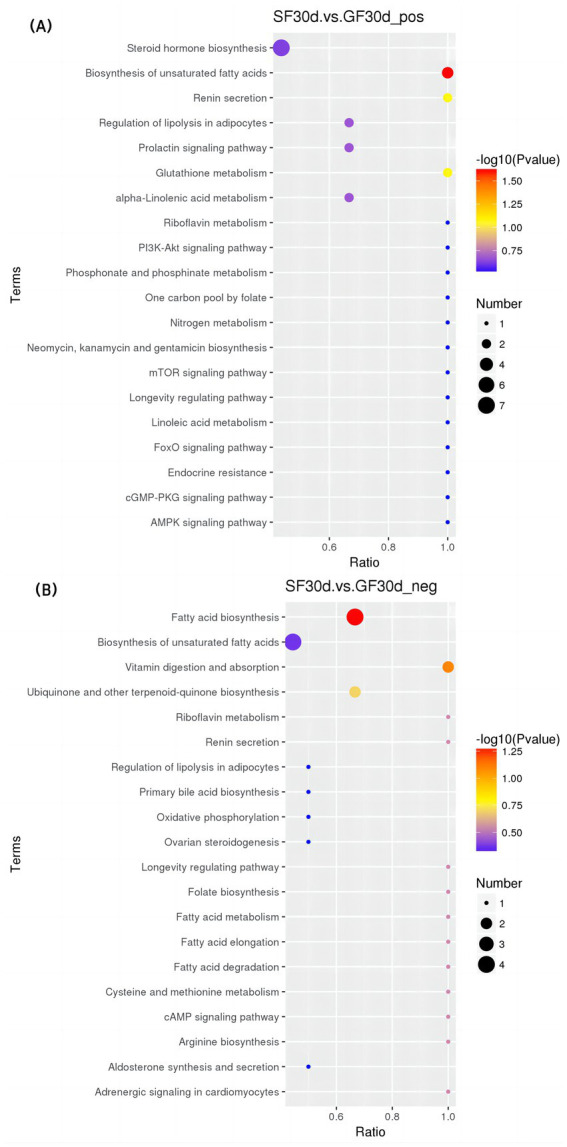
The transition period is a crucial stage in the reproductive cycle for dams and is linked closely with postpartum recovery, reproduction performance, and health. The confronting problem in the yak industry is that transition yaks under a conventional grazing feeding regime endure nutritional deficiency since this period is in late winter and early spring of the Qinghai-Tibet Plateau with the lack of grass on natural pasture. Therefore, this study aimed to investigate the effects of perinatal nutritional supplementation and early weaning on serum biochemistry, reproductive performance, and metabolomics in transition yaks. Eighteen healthy yaks in late pregnancy (233.9 ± 18.3 kg, 2-4 parity) were randomly assigned to three groups: conventional grazing feeding (GF, = 6), additional nutrition supplementation (SF, = 6), and additional nutrition supplementation with early weaning (SW, = 6). Yaks in the GF, SF, and SW groups were free grazing on the same pasture in the daytime from -30 to 90 d relative to parturition. Yaks in SF and SW groups received total mixed ration supplementation in the barn during the night throughout the trial. Calves in the SW group were early weaned and separated from the dam at 60 d postpartum. Maternal body weight was measured at -30 and 90 d, and serum samples were collected to analyze serum biochemistry, hormones, and metabolomics at -15, 30, and 90 d relative to calving. In the SF and SW groups, yaks showed significantly higher body weight gain, serum glucose, globulin, and total protein concentrations. Lipid transportation molecules apolipoprotein B100 and very low-density lipoprotein of SF and SW yaks were significantly increased along with the decreased lipid mobilization products non-esterified fatty acid and β-hydroxybutyric acid when compared to GF yaks at -15 and 30 d. At 90 d, serum non-esterified fatty acid and β-hydroxybutyric acid levels were significantly lower in SW yaks than in SF ones, while apolipoprotein B100 and very low-density lipoprotein levels were significantly higher in SW yaks than in GF yaks. The serum levels of metabolic regulatory hormones, including insulin, leptin, and insulin-like growth factor I were significantly increased, and glucagon was significantly reduced in the SF and SW groups than in the GF group at -15 and 30 d. Among serum reproductive hormones, SF and SW yaks had significantly higher estradiol and progesterone concentrations than GF ones at -15 and 30 d. Follicle-stimulating and luteinizing hormone levels were increased in SW group than in SF and GF ones at 90 d. The calving rates in the following year were 0% (GF), 16.7% (SF), and 83.3% (SW), respectively. The serum metabolomics analysis revealed 848 metabolites in positive mode and 350 in negative mode. With the perinatal nutritional supplementation, the lipid and energy metabolism of transition yaks were improved, meanwhile, lipid mobilization and estrogen production-related pathways were down-regulated. These data suggest that perinatal nutrition supplementation reduces body weight loss, improves glucose and lipid metabolic adaptation to the transition period, and improves yaks' reproductive performance. Additionally, the combination of early weaning and nutritional supplementation results in lower lipid mobilization and up-regulation of lipid transportation and reproductive hormone secretion, which may further contribute to postpartum recovery and acceleration of the reproductive cycle.
围产期是母牦牛繁殖周期中的关键阶段,与产后恢复、繁殖性能和健康密切相关。牦牛产业面临的问题是,在传统放牧饲养模式下,处于围产期的牦牛会出现营养缺乏,因为这一时期正值青藏高原的冬末春初,天然牧场缺乏草料。因此,本研究旨在探讨围产期营养补充和早期断奶对围产期牦牛血清生化指标、繁殖性能和代谢组学的影响。选取18头妊娠后期的健康牦牛(体重233.9±18.3 kg,2-4胎),随机分为三组:传统放牧饲养组(GF,n = 6)、额外营养补充组(SF,n = 6)和额外营养补充并早期断奶组(SW,n = 6)。GF、SF和SW组的牦牛在分娩前-30至90天白天在同一牧场自由放牧。整个试验期间,SF和SW组的牦牛夜间在牛舍内接受全混合日粮补充。SW组的犊牛在产后60天进行早期断奶并与母牛分离。在-30天和90天测量母牦牛体重,并在分娩后-15、30和90天采集血清样本,分析血清生化指标、激素和代谢组学。在SF和SW组中,牦牛的体重增加、血清葡萄糖、球蛋白和总蛋白浓度显著更高。与GF组牦牛相比,在-15天和30天时,SF和SW组牦牛的脂质转运分子载脂蛋白B100和极低密度脂蛋白显著增加,同时脂质动员产物非酯化脂肪酸和β-羟基丁酸减少。在90天时,SW组牦牛的血清非酯化脂肪酸和β-羟基丁酸水平显著低于SF组,而SW组牦牛的载脂蛋白B100和极低密度脂蛋白水平显著高于GF组。在-15天和30天时,SF和SW组中包括胰岛素、瘦素和胰岛素样生长因子I在内的代谢调节激素血清水平显著升高,胰高血糖素显著降低。在血清生殖激素中,在-15天和30天时,SF和SW组牦牛的雌二醇和孕酮浓度显著高于GF组。在90天时,SW组的促卵泡生成素和促黄体生成素水平高于SF组和GF组。次年的产犊率分别为0%(GF)、16.7%(SF)和83.3%(SW)。血清代谢组学分析在正模式下鉴定出848种代谢物,在负模式下鉴定出350种代谢物。通过围产期营养补充,围产期牦牛的脂质和能量代谢得到改善,同时脂质动员和雌激素产生相关途径被下调。这些数据表明,围产期营养补充可减少体重损失,改善葡萄糖和脂质代谢以适应围产期,提高牦牛的繁殖性能。此外,早期断奶与营养补充相结合可降低脂质动员,上调脂质转运和生殖激素分泌,这可能进一步有助于产后恢复和加速繁殖周期。