Zhai Yan, Hui You-Yi, Jiang Ze-Fei, Ding Lin, Cheng Jie, Xing Tang, Zhai Han, Zhang Hong
School of Acupuncture-Moxibustion and Tuina, Chengdu University of Traditional Chinese Medicine, Chengdu, China.
Department of Gastroenterology and Hepatopathy, Xi'an Daxing Hospital, Xi'an, China.
Front Med (Lausanne). 2024 Dec 19;11:1478073. doi: 10.3389/fmed.2024.1478073. eCollection 2024.
Neurodermatitis is a chronic skin condition characterized by intense itching and skin thickening due to neurological dysfunction. Its persistent nature poses a challenge to effective treatment, significantly impacting patients' quality of life. Wet cupping therapy is increasingly being used in clinics to manage neurodermatitis, so it is imperative to assess the evidence regarding its effectiveness and safety.
This review aimed to evaluate the efficacy and safety of wet cupping therapy in patients with neurodermatitis.
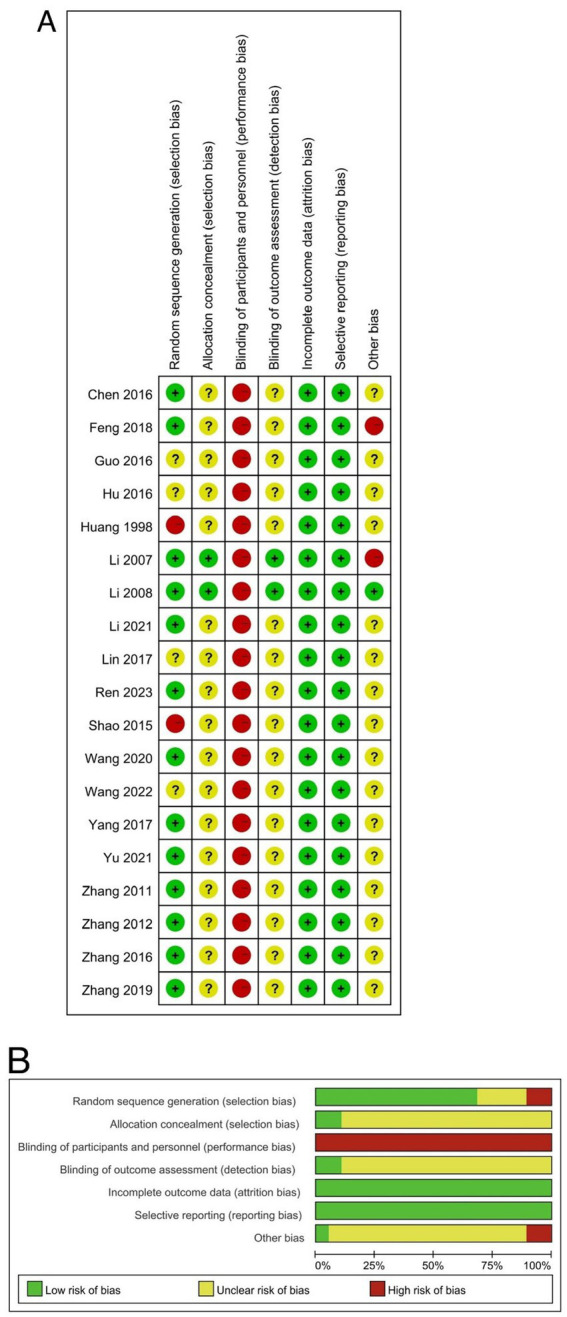
Randomized controlled trials (RCTs) investigating wet cupping for neurodermatitis were identified through searches of eight electronic databases and three clinical trial registration platforms from inception to March 2024, using predefined search terms. Included studies underwent quality appraisal using the Cochrane Collaboration's Risk of Bias Assessment tool. The quality of evidence was assessed independently by two reviewers using the Grading of Recommendations Assessment, Development, and Evaluation System (GRADE). Meta-analysis and publication bias assessment were conducted using ReviewManager 5.4 and STATA 17.0 software, respectively.
This review encompassed 19 studies, comprising 6 types of comparisons and involving 1,505 participants. The findings revealed no significant difference in the total effective rate between wet cupping alone and high-potency steroids ( = 269, RR = 1.13, 95% CI [0.90, 1.41], = 0.29, I = 83%). However, wet cupping combined with medication or moxibustion exhibited superior efficacy compared to medication alone ( = 272, RR = 1.28, 95% CI [1.16, 1.41], < 0.00001, I = 43%) and ( = 534, RR = 1.22, 95% CI [1.14, 1.30], < 0.00001, I = 0%). Wet cupping groups demonstrated lower recurrence rates ( = 266, RR = 0.31, 95% CI [0.16, 0.60], = 0.0005, I = 0%) and a reduced incidence of adverse events ( = 673, RR = 0.44, 95% CI [0.21, 0.90], = 0.02, I = 36%). Furthermore, wet cupping alone or combined with moxibustion effectively lowered the levels of inflammatory factors compared to medication: TNF- ( = 120, MD = -6.99, 95% CI [-8.13, -5.85], < 0.00001, I = 0%), IL-1β ( = 120, MD = -5.28, 95% CI [-6.91, -3.65], < 0.00001, I = 48%), and IL-6 ( = 180, MD = -8.61, 95% CI [-13.24, -3.99], = 0.0003, I = 81%).
The efficacy of wet cupping therapy is comparable to that of high-potency steroids. Its combined use with medication or moxibustion appears to enhance effectiveness, reduce recurrence rates, and improve safety. However, due to the overall low grade of evidence for the identified outcomes and poor methodological quality, caution is advised when interpreting and applying these findings in clinical practice.
https://www.crd.york.ac.uk/prospero, identifier: CRD42024524398.
神经性皮炎是一种慢性皮肤病,其特征是由于神经功能障碍导致剧烈瘙痒和皮肤增厚。其持续性对有效治疗构成挑战,严重影响患者的生活质量。湿拔罐疗法在临床上越来越多地用于治疗神经性皮炎,因此评估其有效性和安全性的证据至关重要。
本综述旨在评估湿拔罐疗法对神经性皮炎患者的疗效和安全性。
通过检索八个电子数据库和三个临床试验注册平台,使用预定义的检索词,识别从开始到2024年3月调查湿拔罐治疗神经性皮炎的随机对照试验(RCT)。纳入的研究使用Cochrane协作网的偏倚风险评估工具进行质量评估。两名评审员使用推荐分级评估、发展和评价系统(GRADE)独立评估证据质量。分别使用ReviewManager 5.4和STATA 17.0软件进行荟萃分析和发表偏倚评估。
本综述纳入了19项研究,包括6种比较类型,涉及1505名参与者。结果显示,单纯湿拔罐与高效类固醇之间的总有效率无显著差异(n = 269,RR = 1.13,95%CI [0.90, 1.41],P = 0.29,I² = 83%)。然而,与单独用药相比,湿拔罐联合药物或艾灸表现出更高的疗效(n = 272,RR = 1.28,95%CI [1.16, 1.41],P < 0.00001,I² = 43%)和(n = 534,RR = 1.22,95%CI [1.14, 1.30],P < 0.00001,I² = 0%)。湿拔罐组的复发率较低(n = 266,RR = 0.31,95%CI [0.16, 0.60],P = 0.0005,I² = 0%),不良事件发生率降低(n = 673,RR = 0.44,95%CI [0.21, 0.90],P = 0.02,I² = 36%)。此外,与药物相比,单纯湿拔罐或联合艾灸能有效降低炎症因子水平:TNF-α(n = 120,MD = -6.99,95%CI [-8.13, -5.85],P < 0.00001,I² = 0%)、IL-1β(n = 120,MD = -5.28,95%CI [-6.91, -3.65],P < 0.00001,I² = 48%)和IL-6(n = 180,MD = -8.61,95%CI [-13.24, -3.99],P = 0.0003,I² = 81%)。
湿拔罐疗法的疗效与高效类固醇相当。其与药物或艾灸联合使用似乎能提高疗效、降低复发率并改善安全性。然而,由于所确定结果的总体证据质量较低且方法学质量较差,在临床实践中解释和应用这些发现时建议谨慎。