Zheng Xin, Yan Yunjun, Li Xin, Liu Mimin, Zhao Xiaoyue, He Jing, Zhuang Xuewei
Department of Clinical Laboratory, Shandong Provincial Third Hospital, Shandong University, Jinan, Shandong, China.
Jinan Dian Medical Laboratory CO., LTD, Jinan, China.
Front Microbiol. 2024 Dec 19;15:1481112. doi: 10.3389/fmicb.2024.1481112. eCollection 2024.
The exact triggers of gallstone formation remain incompletely understood, but research indicates that microbial infection is a significant factor and can interfere with treatment. There is no consensus on the bile microbial culture profiles in previous studies, and determining the microbial profile could aid in targeted prevention and treatment. The primary aim of this study is to investigate the differences in microbial communities cultured from bile specimens of patients with gallstones.
We collected the clinical characteristics and bile microbial status of 9,939 gallstone patients. Statistical analysis was employed to assess the relationship between microbes and clinical features, and a random forest model was utilized to predict recurrence.
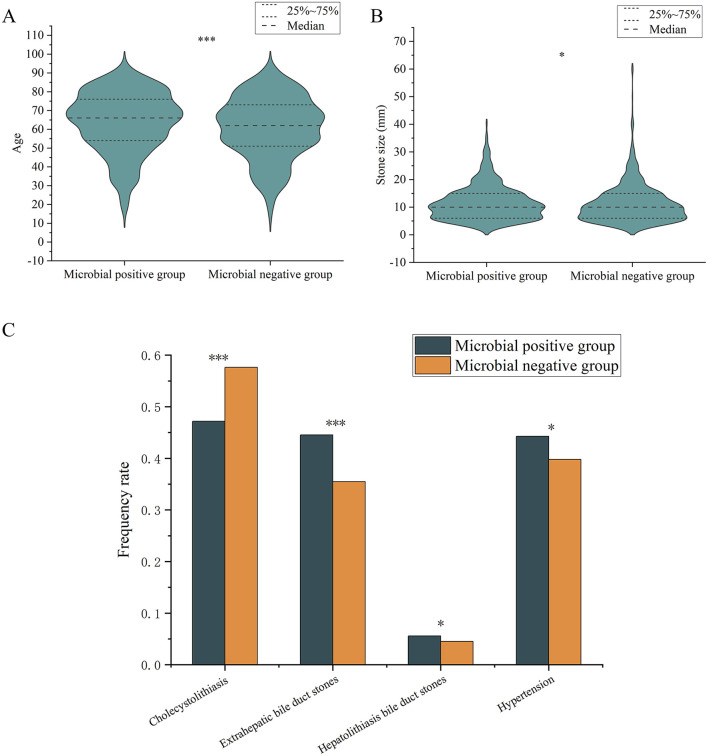
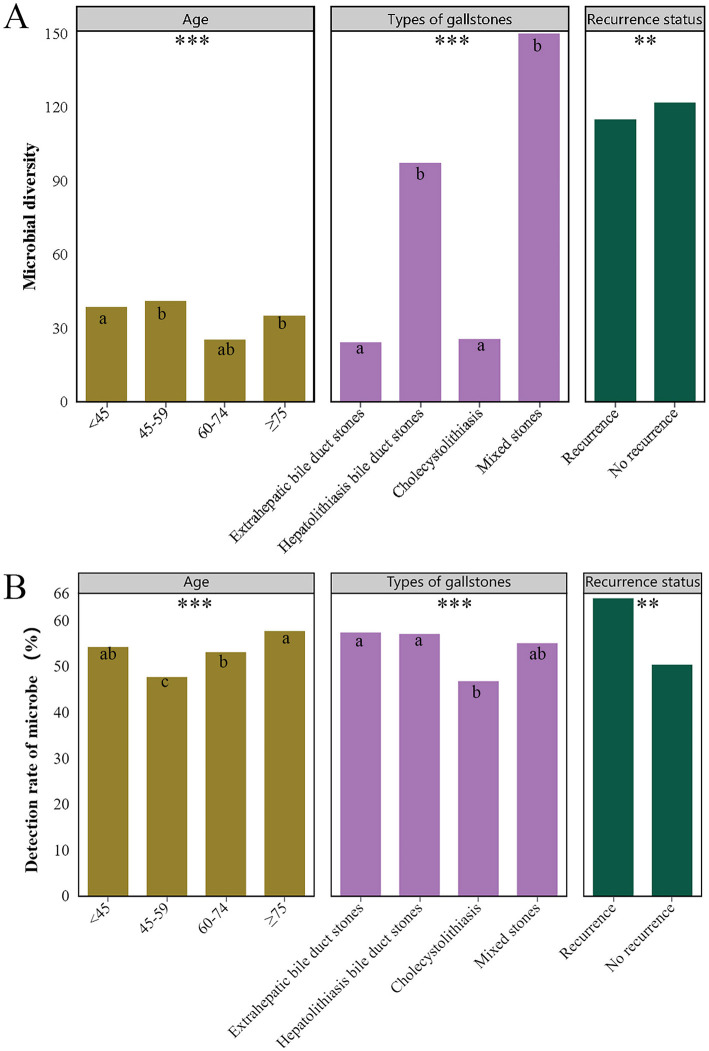
Results showed a higher proportion of females among patients, with the age group of 60-74 years being the most prevalent. The most common type of gallstone was solitary gallbladder stones. A total of 76 microbes were cultured from 5,153 patients, with , and being the most frequently identified. Significant differences in microbial diversity and positive detection rates were observed across different age groups, types of gallstones, and recurrence status. Positive frequencies of , and varied significantly by age group and gallstone type. The microbial diversity in the recurrence group was significantly lower compared to the non-recurrence group. The recurrence rate was significantly higher in the group with single microbial species compared to those with no microbes or multiple microbes. For the recurrence group, there were significant differences in the frequencies of seven microbes () before and after recurrence, with these microbes appearing in a higher number of patients after recurrence. Regression analysis identified patient age, stone size, diabetes, venous thrombosis, liver cirrhosis, malignancy, coronary heart disease, and the number of microbial species as important predictors of recurrence. A random forest model constructed using these variables demonstrated good performance and high predictive ability (ROC-AUC = 0.862).
These findings highlight the significant role of microbial communities in gallstone formation and recurrence. Furthermore, the identified predictors of recurrence, including clinical factors and microbial diversity, may help develop personalized prevention and recurrence strategies for gallstone patients.
胆结石形成的确切触发因素仍未完全明确,但研究表明微生物感染是一个重要因素,且会干扰治疗。先前的研究对于胆汁微生物培养谱尚无共识,而确定微生物谱有助于进行针对性的预防和治疗。本研究的主要目的是调查胆结石患者胆汁标本中培养出的微生物群落差异。
我们收集了9939例胆结石患者的临床特征和胆汁微生物状况。采用统计分析来评估微生物与临床特征之间的关系,并利用随机森林模型预测复发情况。
结果显示患者中女性比例较高,60 - 74岁年龄组最为常见。最常见的胆结石类型是孤立性胆囊结石。共从5153例患者中培养出76种微生物,其中 、 和 是最常鉴定出的。在不同年龄组、胆结石类型和复发状态下,观察到微生物多样性和阳性检出率存在显著差异。 、 和 的阳性频率因年龄组和胆结石类型而异。复发组的微生物多样性明显低于非复发组。单一微生物种类组的复发率显著高于无微生物组或多种微生物组。对于复发组,复发前后七种微生物( )的频率存在显著差异,这些微生物在复发后出现在更多患者中。回归分析确定患者年龄、结石大小、糖尿病、静脉血栓形成、肝硬化、恶性肿瘤、冠心病和微生物种类数量是复发的重要预测因素。使用这些变量构建的随机森林模型表现良好且具有较高的预测能力(ROC-AUC = 0.862)。
这些发现突出了微生物群落在胆结石形成和复发中的重要作用。此外,所确定的复发预测因素,包括临床因素和微生物多样性,可能有助于为胆结石患者制定个性化的预防和复发策略。