Nadeem Ahmed, Donohue Sydney, Shah Fatima Zehra, Perez Jaime Abraham, Harper Elleson, Sinh Preetika, Padival Ruthvik, Cooper Gregory, Katz Jeffry, Cominelli Fabio, Regueiro Miguel, Mansoor Emad
Department of Internal Medicine, Cleveland Clinic Foundation, Cleveland, OH, USA.
Department of Internal Medicine, Case Western Reserve University/University Hospitals Cleveland Medical Center, Cleveland, OH, USA.
Crohns Colitis 360. 2024 Dec 20;7(1):otae066. doi: 10.1093/crocol/otae066. eCollection 2025 Jan.
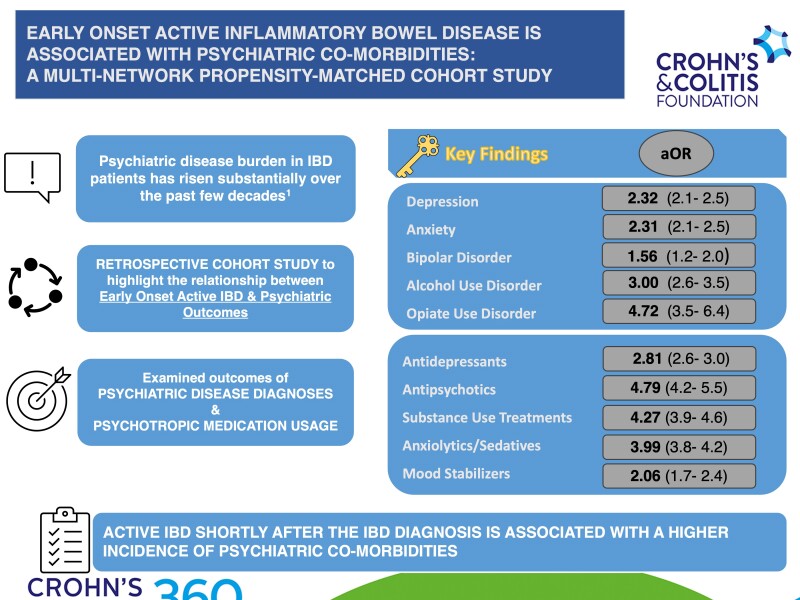
Psychiatric disease burden in patients with Inflammatory bowel disease (IBD) has risen substantially over the past few decades. However, there is limited data on the relationship between IBD disease activity and the incidence of psychiatric comorbidities. We sought to conduct a population-based study to investigate the impact of early onset disease activity in newly diagnosed IBD patients on psychiatric disease diagnoses and medication usage.
We performed a retrospective cohort study using the TriNetX database. We identified all adult patients diagnosed with IBD and documented IBD-specific medication use. We stratified these IBD patients into 2 cohorts based on IBD Disease Activity, occurring 6 months to 1 year after initial IBD diagnosis. Active IBD was defined as the utilization of steroids and/or elevated fecal calprotectin [≥200 µg/g] occurring 6 months to 1 year after initial IBD diagnosis. We examined the outcomes of psychiatric disease diagnoses and psychotropic medication prescriptions occurring 1 year after the initial diagnosis.
Out of 69 105 patients with an IBD diagnosis during the study period, after propensity score matching, 16 922 IBD patients each were included in the 2 cohorts based on disease activity. Patients with active IBD had significantly higher odds of developing major depressive disorder, anxiety disorder, bipolar disorder, alcohol use disorder, opiate use disorder, attention deficit hyperactivity disorder, and obsessive-compulsive disorder. Additionally, patients with active IBD also had significantly higher odds of using all studied psychotropic medications, including antidepressants, antipsychotic medications, anxiolytics, sedatives, hypnotic medications, mood stabilizers, stimulant medications, and medications used for substance use disorders (including alcohol, opioid, and tobacco use).
Active IBD shortly after the IBD diagnosis is associated with a higher incidence of psychiatric comorbidities. Awareness of behavioral health in IBD is important, and proper treatment is necessary.
在过去几十年中,炎症性肠病(IBD)患者的精神疾病负担大幅上升。然而,关于IBD疾病活动与精神疾病共病发生率之间关系的数据有限。我们试图开展一项基于人群的研究,以调查新诊断的IBD患者早期疾病活动对精神疾病诊断和药物使用的影响。
我们使用TriNetX数据库进行了一项回顾性队列研究。我们确定了所有诊断为IBD的成年患者,并记录了IBD特异性药物使用情况。我们根据IBD诊断后6个月至1年出现的IBD疾病活动情况,将这些IBD患者分为2个队列。活动性IBD定义为在IBD初始诊断后6个月至1年使用类固醇和/或粪便钙卫蛋白升高[≥200µg/g]。我们检查了初始诊断后1年出现的精神疾病诊断和精神药物处方的结果。
在研究期间诊断为IBD的69105名患者中,经过倾向得分匹配后,根据疾病活动情况,每个队列纳入了16922名IBD患者。活动性IBD患者发生重度抑郁症、焦虑症、双相情感障碍、酒精使用障碍吸毒、阿片类药物使用障碍、注意力缺陷多动障碍和强迫症的几率显著更高。此外,活动性IBD患者使用所有研究的精神药物的几率也显著更高,包括抗抑郁药、抗精神病药、抗焦虑药、镇静剂、催眠药、情绪稳定剂、兴奋剂药物以及用于物质使用障碍(包括酒精、阿片类药物和烟草使用)的药物。
IBD诊断后不久出现的活动性IBD与精神疾病共病的发生率较高有关。认识到IBD患者的行为健康很重要,适当的治疗是必要的。