Li Chuang, Wang Ning, Zhang Haixin, Yan Yongguang, Chen Huiling, Jiang Ruxin, Chang Yulan, Zhao Pingfan, Cheng Qiaomei, Song Bing, Guo Shujie
Henan Provincial People's Hospital, Zhengzhou University People's Hospital, Zhengzhou, Henan, China.
Outpatient Department, Henan Provincial People's Hospital, Zhengzhou, Henan, China.
Front Public Health. 2024 Dec 19;12:1455305. doi: 10.3389/fpubh.2024.1455305. eCollection 2024.
The provision of high-quality healthcare services and patient satisfaction are fundamental objectives in modern healthcare. Humanistic nursing care, which emphasizes empathy, respect for individuality, and cultural sensitivity, aims to build trust and improve the overall experience for patients. This approach is especially relevant for rural patients in China, who often face additional challenges in accessing care in large tertiary hospitals.
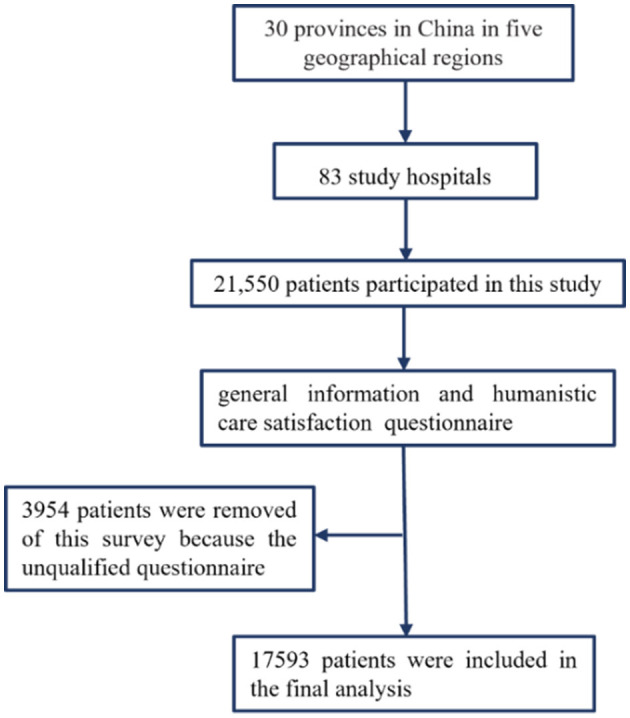
A multistage, stratified sampling method was employed to collect data from 8,263 patients aged 18 years or older in large public tertiary hospitals. Humanistic care satisfaction scores were measured using the Nurse Caring Instrument (NCI) questionnaire, a validated tool for assessing patient satisfaction with nursing care.
Satisfaction with nursing humanistic care among rural Chinese patients attending large tertiary public hospitals was low with the overall mean satisfaction score 81.62 ± 16.85. Significant differences in satisfaction were found based on age, marital status, number of children, educational attainment, occupation, monthly household income, department visited, type of medical insurance, and first-time visitor. A multivariate analysis revealed positive correlations with satisfaction for factors such as having children, higher education, higher family monthly income, and first-time visitor, and negative correlations for factors such as older age, being widowed, department visited, and region.
Older adults, widowed individuals, and first-time patients expressed lower levels of satisfaction, highlighting the need for tailored interventions. The findings provide insights into the impact of humanistic nursing care for rural patients and emphasize the importance of culturally sensitive approaches to improve patient satisfaction in rural China. This study has several limitations. The cross-sectional design restricts the ability to establish causal relationships, and there is a potential for selection bias, as participants who completed the survey may have higher educational and economic levels, possibly leading to an overestimation of satisfaction. Lastly, as this study focused on rural patients in large public tertiary hospitals in China, the findings may not be generalizable to other settings or patient groups. Future studies should address these limitations for broader applicability and insight.
提供高质量的医疗服务和患者满意度是现代医疗保健的基本目标。人文护理强调同理心、尊重个性和文化敏感性,旨在建立信任并改善患者的整体体验。这种方法对于中国农村患者尤为重要,他们在大型三级医院就医时往往面临更多挑战。
采用多阶段分层抽样方法,从大型公立三级医院的8263名18岁及以上患者中收集数据。使用护士关怀量表(NCI)问卷来测量人文关怀满意度得分,该问卷是评估患者对护理满意度的有效工具。
在中国大型公立三级医院就诊的农村患者对护理人文关怀的满意度较低,总体平均满意度得分为81.62±16.85。基于年龄、婚姻状况、子女数量、教育程度、职业、家庭月收入、就诊科室、医疗保险类型和首次就诊情况,满意度存在显著差异。多变量分析显示,有子女、高等教育、家庭月收入较高和首次就诊等因素与满意度呈正相关,而年龄较大、丧偶、就诊科室和地区等因素与满意度呈负相关。
老年人、丧偶者和首次就诊患者的满意度较低,这突出了采取针对性干预措施的必要性。研究结果揭示了人文护理对农村患者的影响,并强调了文化敏感方法对于提高中国农村患者满意度的重要性。本研究存在若干局限性。横断面设计限制了建立因果关系的能力,并且存在选择偏倚的可能性,因为完成调查的参与者可能具有较高的教育和经济水平,这可能导致对满意度的高估。最后,由于本研究聚焦于中国大型公立三级医院的农村患者,研究结果可能不适用于其他环境或患者群体。未来的研究应解决这些局限性,以实现更广泛的适用性和深入理解。