Zhao Bote, Zang Peixi, Quan Meina, Wang Qianqian, Guo Dongmei, Jia Jianping, Wang Wei
Innovation Center for Neurological Disorders and Department of Neurology, Xuanwu Hospital, Capital Medical University, Beijing, China.
National Center for Neurological Disorders and National Clinical Research Center for Geriatric Diseases, Beijing, China.
CNS Neurosci Ther. 2025 Jan;31(1):e70202. doi: 10.1111/cns.70202.
To analyze the effect of APOE ε4 on fluid biomarkers and the correlations between blood molecules and CSF biomarkers in AD patients.
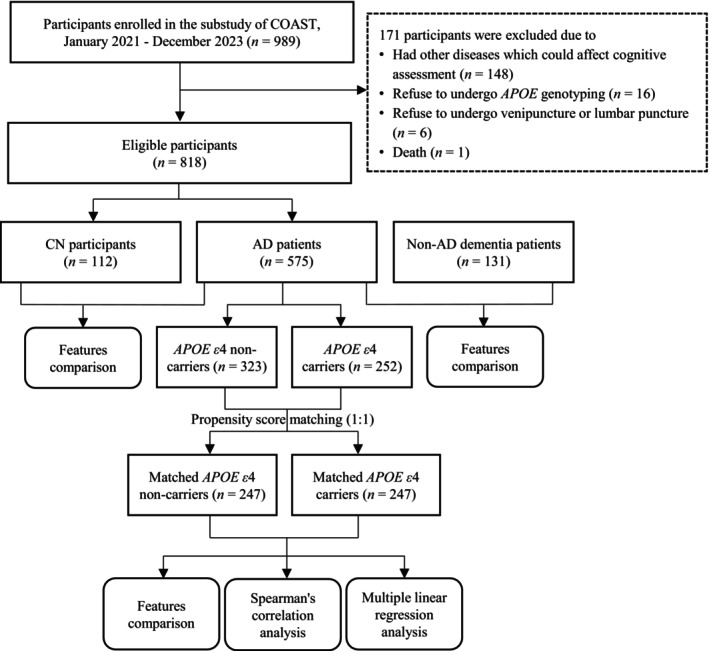
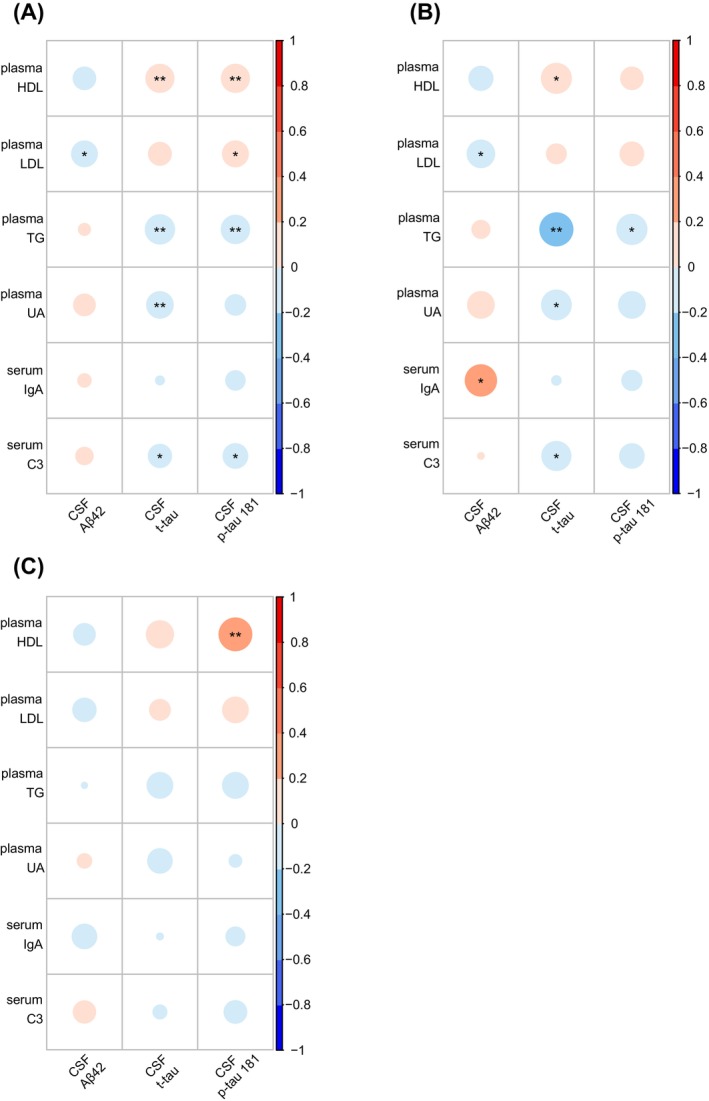
This study enrolled 575 AD patients, 131 patients with non-AD dementia, and 112 cognitively normal (CN) participants, and AD patients were divided into APOE ε4 carriers and non-carriers. Cerebrospinal fluid (CSF) biomarkers and blood-derived biomolecules were compared between AD and CN groups, between non-AD dementia and CN groups, as well as within APOE ε4 subgroups of AD patients. Utilizing Spearman's correlation analysis and quantile regression analysis, the relationships between blood-derived biomolecules and CSF biomarkers were analyzed in APOE ε4 carriers and non-carriers.
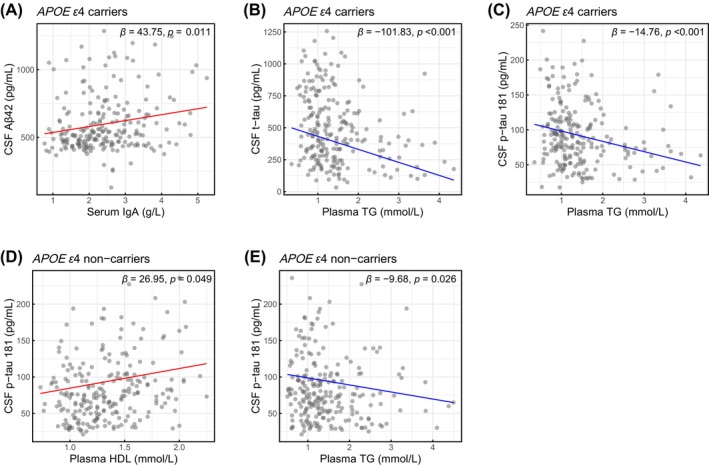
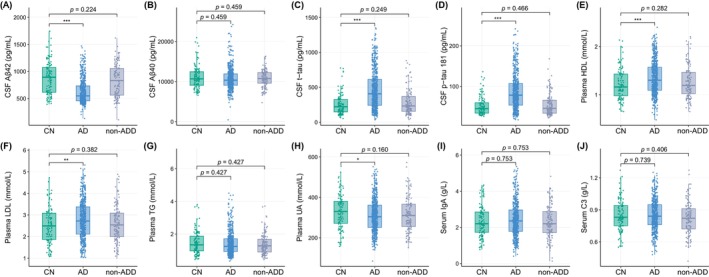
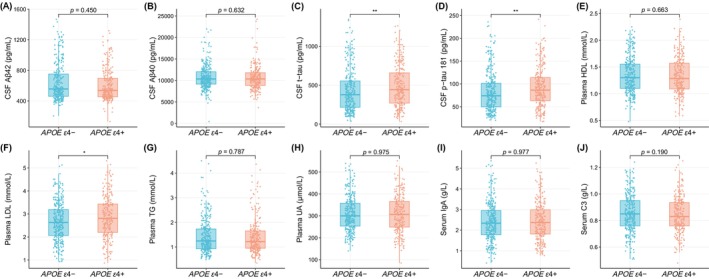
The levels of CSF biomarkers and blood molecules exhibited significant differences between the AD and CN groups, including Aβ42, t-tau, p-tau 181, high-density lipoprotein, low-density lipoprotein (LDL), and uric acid. In AD patients, APOE ε4 carriers had increased levels of CSF t-tau, p-tau 181, and plasma LDL. In the correlation and regression analyses, the negative relationships between plasma TG and t-tau, between plasma TG and p-tau 181 levels, as well as the positive relationship between serum IgA and CSF Aβ42, were observed significantly in APOE ε4+ AD groups, but not in APOE ε4- AD group.
APOE ε4 is associated with accelerated progression of AD pathology. The blood-derived biomolecules correlated with CSF biomarkers in APOE ε4 carriers are related to neuroinflammation and lipid metabolism, which may indicate the role of APOE ε4 in AD pathophysiology and offer insights for diagnostic and therapeutic strategies for AD.
ClinicalTrials.gov identifier: NCT03653156.
分析APOEε4对阿尔茨海默病(AD)患者脑脊液生物标志物的影响以及血液分子与脑脊液生物标志物之间的相关性。
本研究纳入了575例AD患者、131例非AD痴呆患者和112例认知正常(CN)参与者,AD患者被分为APOEε4携带者和非携带者。比较了AD组与CN组、非AD痴呆组与CN组之间以及AD患者的APOEε4亚组内的脑脊液(CSF)生物标志物和血液来源的生物分子。利用Spearman相关性分析和分位数回归分析,分析了APOEε4携带者和非携带者中血液来源的生物分子与脑脊液生物标志物之间的关系。
AD组与CN组之间脑脊液生物标志物和血液分子水平存在显著差异,包括Aβ42、总tau蛋白(t-tau)、磷酸化tau蛋白181(p-tau 181)、高密度脂蛋白、低密度脂蛋白(LDL)和尿酸。在AD患者中,APOEε4携带者的脑脊液t-tau、p-tau 181水平和血浆LDL水平升高。在相关性和回归分析中,APOEε4+ AD组中血浆甘油三酯(TG)与t-tau、血浆TG与p-tau 181水平之间的负相关关系以及血清免疫球蛋白A(IgA)与脑脊液Aβ42之间的正相关关系显著,但在APOEε4- AD组中未观察到。
APOEε4与AD病理进展加速有关。APOEε4携带者中与脑脊液生物标志物相关的血液来源生物分子与神经炎症和脂质代谢有关,这可能表明APOEε4在AD病理生理学中的作用,并为AD的诊断和治疗策略提供见解。
ClinicalTrials.gov标识符:NCT03653156。