Jauregi-Zinkunegi Ainara, Gleason Carey E, Bendlin Barbara, Okonkwo Ozioma, Hermann Bruce P, Blennow Kaj, Zetterberg Henrik, Hogervorst Eef, Johnson Sterling C, Langhough Rebecca, Mueller Kimberly D, Bruno Davide
School of Psychology, Liverpool John Moores University, Liverpool, UK.
Division of Geriatrics and Gerontology, Department of Medicine, University of Wisconsin, Madison, Wisconsin, USA.
Alzheimers Dement. 2025 Feb;21(2):e14456. doi: 10.1002/alz.14456. Epub 2025 Jan 9.
Menopausal hormone therapy (MHT), along with the apolipoprotein E (APOE) ε4 allele, has been suggested as a possible risk factor for Alzheimer's disease (AD). However, the relationship between MHT and cerebrospinal fluid (CSF) biomarkers is unknown: we investigated this association, and whether APOE ε4 carrier status moderates it.
In an observational study of 136 cognitively unimpaired female participants (M = 66.0; standard deviation = 6.3), we examined whether MHT use alone or in interaction with APOE ε4 carrier status was associated with CSF levels of phosphorylated tau (p-tau), amyloid beta (Aβ)40, Aβ42, p-tau/Aβ42, and Aβ42/40 ratios.
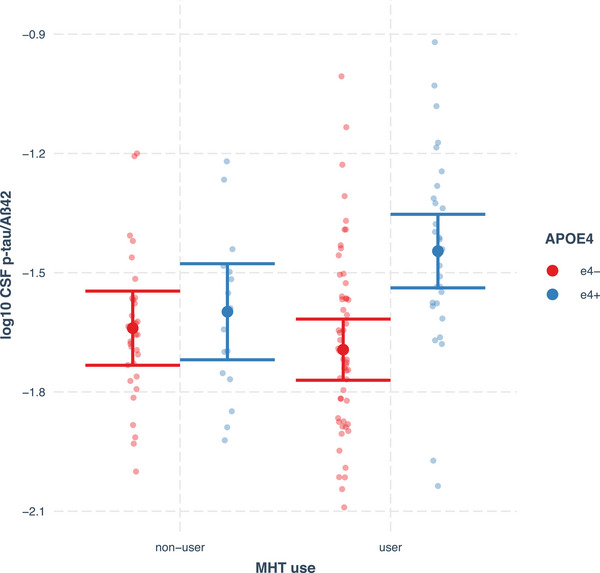
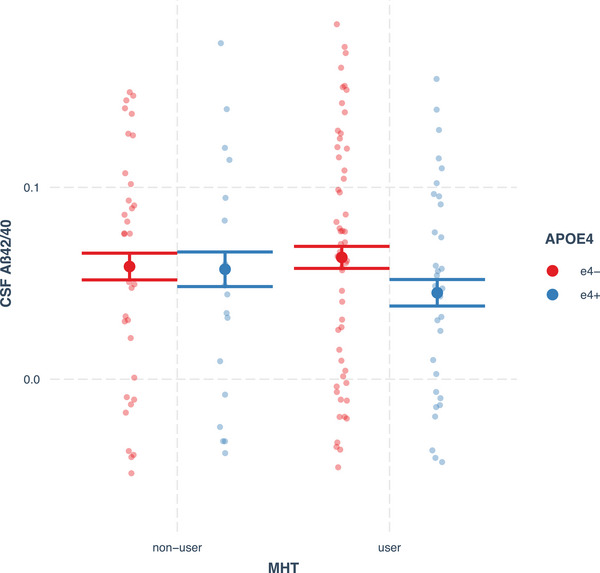
Significant interactions were found between APOE ε4 and MHT use for CSF biomarkers. APOE ε4 carriers who were MHT users showed worse levels of CSF p-tau/Aβ42 and Aβ42/40 ratios than all other users and non-users.
The presence of both APOE ε4 and MHT may be associated with elevated amyloid deposition and AD pathology in this sample of participants who demonstrated high familial AD risk.
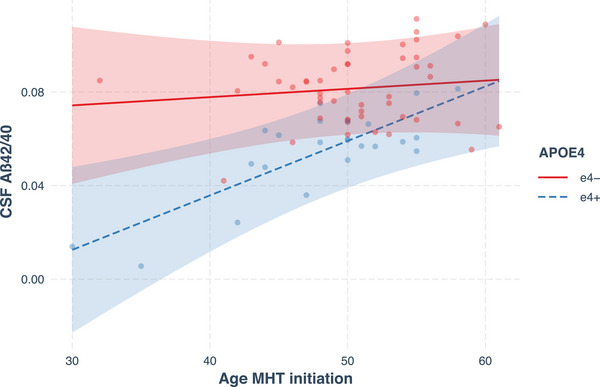
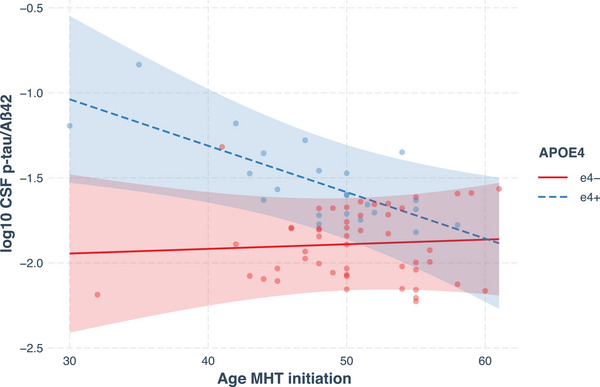
Significant interactions were found between apolipoprotein E (APOE) ε4 and menopausal hormone therapy (MHT) use for cerebrospinal fluid (CSF) phosphorylated tau (p-tau)/amyloid beta (Aβ)42 and Aβ42/40 ratios. APOE ε4 carriers who were MHT users showed worse levels of CSF biomarkers than non-users and non-carriers, both users and non-users. Younger age at MHT initiation was associated with worse levels of the p-tau/Aβ42 and Aβ42/40 ratios in carriers only. The presence of both APOE ε4 carriage and MHT use may be associated with elevated amyloid deposition and AD pathology. Further studies with larger sample sizes are necessary to confirm the differences observed in the current study.
绝经激素治疗(MHT)以及载脂蛋白E(APOE)ε4等位基因被认为是阿尔茨海默病(AD)的可能危险因素。然而,MHT与脑脊液(CSF)生物标志物之间的关系尚不清楚:我们研究了这种关联,以及APOE ε4携带者状态是否会对其产生调节作用。
在一项对136名认知未受损女性参与者(M = 66.0;标准差 = 6.3)的观察性研究中,我们研究了单独使用MHT或与APOE ε4携带者状态相互作用是否与CSF中磷酸化tau(p-tau)、淀粉样β蛋白(Aβ)40、Aβ42、p-tau/Aβ42以及Aβ42/40比值有关。
发现APOE ε4与MHT使用在CSF生物标志物方面存在显著相互作用。使用MHT的APOE ε4携带者的CSF p-tau/Aβ42和Aβ42/40比值水平比所有其他使用者和非使用者都要差。
在这个显示出高家族性AD风险的参与者样本中,APOE ε4和MHT的同时存在可能与淀粉样蛋白沉积增加和AD病理相关。
载脂蛋白E(APOE)ε4与绝经激素治疗(MHT)使用在脑脊液(CSF)磷酸化tau(p-tau)/淀粉样β蛋白(Aβ)42和Aβ42/40比值方面存在显著相互作用。使用MHT的APOE ε4携带者的CSF生物标志物水平比非使用者和非携带者(无论是否使用MHT)都要差。仅在携带者中,MHT开始时年龄较小与p-tau/Aβ42和Aβ42/40比值水平较差有关。APOE ε4携带和MHT使用的同时存在可能与淀粉样蛋白沉积增加和AD病理相关。需要进一步进行更大样本量的研究来确认本研究中观察到的差异。