Senjam Suraj Singh, Manna Souvik, Titiyal Jeewan Singh, Kumar Anil, Kishore Jugal
Dr. Rajendra Prasad Centre for Ophthalmic Sciences, All India Institute of Medical Sciences, Room no. 791, 7th Floor, New Delhi, India.
Directorate General Health Services, Ministry of Health and Family Welfare, Government of India, New Delhi, India.
Sci Rep. 2025 Jan 3;15(1):671. doi: 10.1038/s41598-024-82160-w.
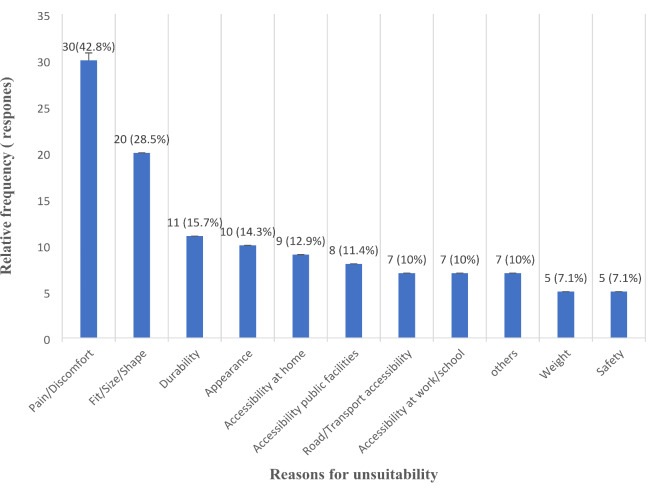
User satisfaction with Assistive Technology (AT) is one of the crucial factors in the success of any AT service. The current study aimed to estimate satisfaction with AT and the reasons for dissatisfaction and unsuitability among persons with functional difficulties in India. Using the WHO Rapid Assistive Technology Assessment tool, a cross-sectional study was conducted in eight districts, representing four zones of India. Multi-stage cluster random sampling and probability proportional to size techniques were used to select smaller administrative units from the larger ones. Satisfaction was reported in terms of assistive products and service delivery. In total, 8486 participants were surveyed out of which 8964 individuals were enumerated with a response rate of 94.6%. Around 22.2% (1888) of participants had functional difficulties and reported using AT, out of which 3.9% (74) were dissatisfied with their products. The assistive products, assessment and training, and repair and maintenance-related services were reported to be satisfied by approximately 92.2% (1740), 88.4% (1669), and 85.2% (1609) of respondents, respectively. Further, 3.2% (61) and 3.7% (70) of respondents reported that their AT was not suitable for home and public environments, respectively. According to 2.8% (53) respondents, their AT did not assist them in executing daily living activities. Discomfort (56.6%), poor fitting (37.7%), low quality of service (20.7%), and poor aesthetic values (18.9%) were identified as reasons for dissatisfaction. Satisfaction was good for AT received from friends and family but was poor for those received from the public sector. The study shows that overall satisfaction and suitability with AT were high among users with functional difficulties, but few have reported barriers to effective device use and facing challenges in accessing repair and follow-up services.
用户对辅助技术(AT)的满意度是任何AT服务成功的关键因素之一。当前的研究旨在评估印度功能障碍者对AT的满意度以及不满和不适用的原因。使用世界卫生组织快速辅助技术评估工具,在代表印度四个区域的八个地区进行了一项横断面研究。采用多阶段整群随机抽样和规模比例概率技术从较大的行政单位中选择较小的行政单位。从辅助产品和服务提供方面报告了满意度。总共调查了8486名参与者,其中8964人被统计,回复率为94.6%。约22.2%(1888名)参与者有功能障碍并报告使用了AT,其中3.9%(74名)对其产品不满意。分别约92.2%(1740名)、88.4%(1669名)和85.2%(1609名)的受访者对辅助产品、评估与培训以及维修和维护相关服务表示满意。此外,分别有3.2%(61名)和3.7%(70名)的受访者报告他们的AT不适合家庭和公共环境。根据2.8%(53名)受访者表示,他们的AT无助于他们进行日常生活活动。不适(56.6%)、贴合度差(37.7%)、服务质量低(20.7%)和审美价值差(18.9%)被确定为不满的原因。从朋友和家人那里获得的AT满意度良好,但从公共部门获得的AT满意度较差。该研究表明,功能障碍用户对AT的总体满意度和适用性较高,但很少有人报告在有效使用设备方面存在障碍以及在获得维修和后续服务方面面临挑战。