Wei CaiLv, Chen Chen, Li ShengLong, Ding YuXuan, Zhou YuWei, Mai FangYing, Hong ShiRan, Wu JiaXin, Yang Yang, Zhu Zhu, Xue DongDong, Ning XinPeng, Sheng LongXiang, Lu BingZheng, Cai Wei, Yuan MingJun, Liang HuaFeng, Lin SuiZhen, Yan GuangMei, Chen YuPin, Huang YiJun, Hu Cheng, Yin Wei
Department of Biochemistry and Molecular Biology, Zhongshan School of Medicine, Sun Yat-Sen University, Guangzhou, 510080, China; School of Medicine, Shenzhen Campus of Sun Yat-sen University, Sun Yat-sen University, Shenzhen, Guangdong, 518107, China.
Department of Biochemistry and Molecular Biology, Zhongshan School of Medicine, Sun Yat-Sen University, Guangzhou, 510080, China; Department of Pharmacology, Zhongshan School of Medicine, Sun Yat-Sen University, Guangzhou, 510080, China.
Redox Biol. 2025 Mar;80:103487. doi: 10.1016/j.redox.2024.103487. Epub 2024 Dec 31.
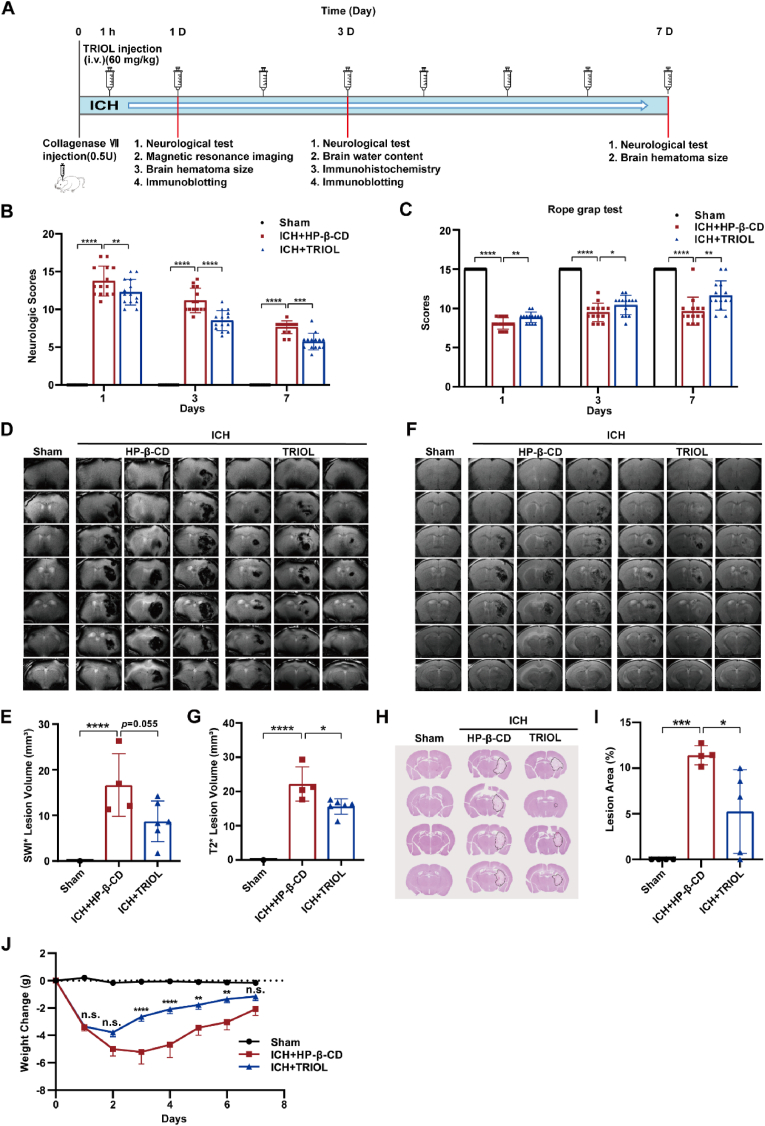
Intracerebral hemorrhage (ICH) represents the most severe subtype of stroke, and the lack of effective clinical pharmacotherapies poses a substantial threat to human health. Hematoma plays a crucial role in determining the prognosis of ICH patients by causing primary mechanical extrusion, followed by secondary brain injuries, such as cerebral edema, iron-mediated oxidative stress, and inflammation resulting from its degradation products. 5α-androst-3β,5α,6β-triol (TRIOL) is a neuroprotective steroid currently undergoing phase II clinical trial for acute ischemic stroke with anti-oxidative and anti-inflammatory properties. However, whether TRIOL can protect brain against ICH injury remains unclear. In this study, we found that TRIOL significantly improved neurological function while reducing hematoma volume, cerebral edema, and tissue damage after ICH. Moreover, TRIOL enhanced microglial hematoma clearance through promoting CD36-mediated erythrophagocytosis and CD163-associated hemoglobin scavenging, while simultaneously reducing the release of microglial inflammatory factors and activating the antioxidative transcription factor Nrf2. Additionally, TRIOL inhibited neuron mediated hematoma absorption by suppressing heme oxygenase 2 (HO-2) and protected neurons against ICH-induced damage in vitro and in vivo. TRIOL also mitigated neuronal iron-dependent oxidative damage by increasing ferritin levels but decreasing divalent metal transporter 1 (DMT1) expression. Overall, these findings highlight the promising potential of TRIOL as a drug candidate for treating ICH.
脑出血(ICH)是中风最严重的亚型,缺乏有效的临床药物治疗对人类健康构成了重大威胁。血肿在决定ICH患者的预后方面起着关键作用,它会导致原发性机械挤压,随后引发继发性脑损伤,如脑水肿、铁介导的氧化应激以及由其降解产物引起的炎症。5α-雄甾-3β,5α,6β-三醇(TRIOL)是一种具有神经保护作用的类固醇,目前正在进行急性缺血性中风的II期临床试验,具有抗氧化和抗炎特性。然而,TRIOL是否能保护大脑免受ICH损伤仍不清楚。在本研究中,我们发现TRIOL在脑出血后显著改善神经功能,同时减少血肿体积、脑水肿和组织损伤。此外,TRIOL通过促进CD36介导的红细胞吞噬作用和CD163相关的血红蛋白清除来增强小胶质细胞对血肿的清除,同时减少小胶质细胞炎症因子的释放并激活抗氧化转录因子Nrf2。此外,TRIOL通过抑制血红素加氧酶2(HO-2)抑制神经元介导的血肿吸收,并在体外和体内保护神经元免受ICH诱导的损伤。TRIOL还通过增加铁蛋白水平但降低二价金属转运蛋白1(DMT1)的表达来减轻神经元铁依赖性氧化损伤。总体而言,这些发现突出了TRIOL作为治疗ICH候选药物的潜在前景。