Park Gyeongwon, Kim Jichul, Lee Taeyeop, Kim Hyo-Won
Department of Psychiatry, Asan Medical Center, University of Ulsan College of Medicine, Seoul, Republic of Korea.
Psychiatry Investig. 2024 Dec;21(12):1407-1414. doi: 10.30773/pi.2024.0140. Epub 2024 Dec 23.
This study compared adaptive functioning measured by the Korean version of Vineland Adaptive Behavior Scales, Second Edition (K-VABS-II), in preschool children with developmental disabilities (DD) and those with typical development (TD). We also examined the correlation of K-VABS-II adaptive profiles with developmental and behavioral assessments.
Two hundred preschool children (73 females and 127 males, mean age 54.7±9.1 months) were recruited from special educational centers, community-based daycare centers, and kindergartens. Eighty-one with DD comprising 61 with autism spectrum disorder, 63 with intellectual disability, 12 with language disorder, and 119 with TD were included. Their developmental profiles were measured by the Psychoeducational Profile-Revised (PEP-R), Preschool Receptive-Expressive Language Scale (PRES), K-VABS-II, Social Responsiveness Scale (SRS), and the Korean version of the Childhood Autism Rating Scale (K-CARS). The parent completed the Child Behavior Checklist (CBCL), and Aberrant Behavior Checklist (ABC).
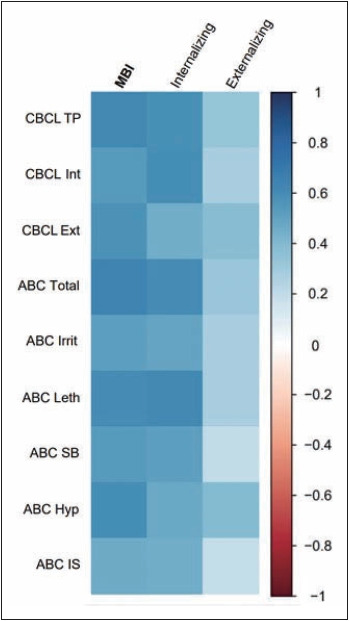
The K-VABS-II Adaptive Behavior Composite and all domain scores of K-VABS-II differed significantly between children with DD and TD (all p<0.001). In most domains, K-VABS-II had moderate-to-strong correlations with PEP-R, PRES, K-CARS, and SRS. The Maladaptive Behavior Index domain of K-VABS-II had moderate correlations with behavioral assessments, including CBCL and ABC.
These findings suggest that K-VABS-II is useful in evaluating developmental levels and adaptive and maladaptive behaviors of preschool children with DD. K-VABS-II also had significant correlations with cognitive, language, social, and behavioral assessments.
本研究比较了使用《文兰适应行为量表第二版韩国版》(K-VABS-II)对发育障碍(DD)学龄前儿童和发育正常(TD)学龄前儿童进行测量的适应功能。我们还研究了K-VABS-II适应特征与发育和行为评估之间的相关性。
从特殊教育中心、社区日托中心和幼儿园招募了200名学龄前儿童(73名女性和127名男性,平均年龄54.7±9.1个月)。其中包括81名发育障碍儿童,包括61名自闭症谱系障碍儿童、63名智力障碍儿童、12名语言障碍儿童,以及119名发育正常儿童。通过《心理教育量表修订版》(PEP-R)、《学龄前接受-表达语言量表》(PRES)、K-VABS-II、《社会反应量表》(SRS)和《韩国版儿童自闭症评定量表》(K-CARS)对他们的发育特征进行测量。家长完成了《儿童行为检查表》(CBCL)和《异常行为检查表》(ABC)。
发育障碍儿童和发育正常儿童在K-VABS-II适应行为综合得分和K-VABS-II所有领域得分上存在显著差异(所有p<0.001)。在大多数领域,K-VABS-II与PEP-R、PRES、K-CARS和SRS具有中度到高度的相关性。K-VABS-II的适应不良行为指数领域与包括CBCL和ABC在内的行为评估具有中度相关性。
这些结果表明,K-VABS-II有助于评估发育障碍学龄前儿童的发育水平以及适应和适应不良行为。K-VABS-II与认知、语言、社会和行为评估也具有显著相关性。