Lorenz-Meyer Lisa Antonia, Sziborra Clara, Henrich Wolfgang, David Matthias
Klinik für Geburtsmedizin, Campus Mitte, Charité - Universitätsmedizin Berlin, Berlin, Germany.
Klinik für Gynäkologie, Campus Virchow-Klinikum, Charité - Universitätsmedizin Berlin, Berlin, Germany.
Geburtshilfe Frauenheilkd. 2025 Jan 2;85(1):56-68. doi: 10.1055/a-2446-6504. eCollection 2025 Jan.
In Germany, 0.25% of the total population are persons with a Vietnamese migration background. There are almost no studies on this particular group of immigrants. We compared the perinatal data of women with a Vietnamese migration background with the pregnancy outcomes of non-Vietnamese women also living in Germany.
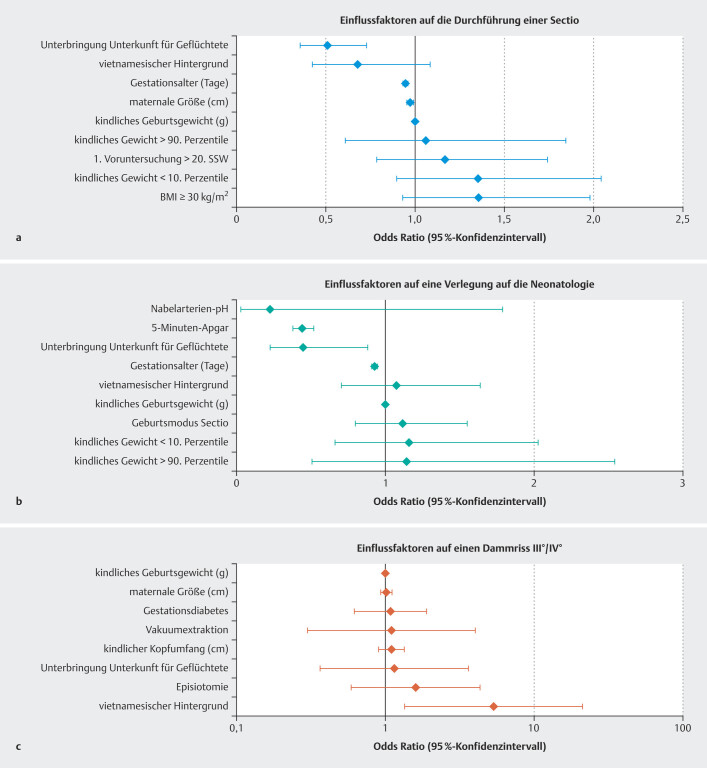
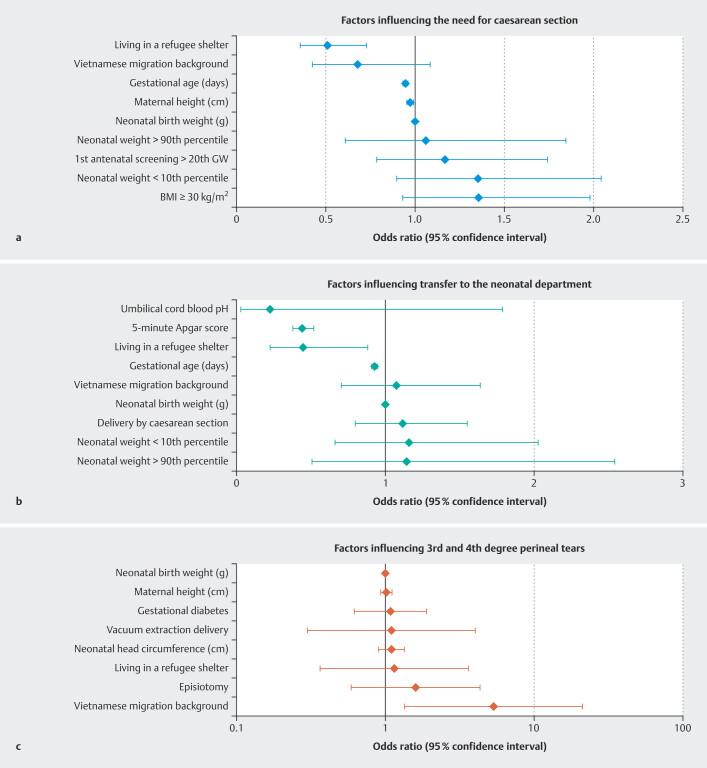
After using name analysis to allocate women into different groups, the perinatal data of women with a Vietnamese migration background who gave birth between 1.1.2016 and 31.12.2019 in Campus Charité Mitte in Berlin were retrospectively evaluated. These data were compared in a 3:1 ratio with the data of women of non-Vietnamese origin and the same age and parity. Multivariate regression analysis was used to determine factors which influenced caesarean section rates, the transfer rates of neonates to the neonatal department, and the rates of higher degree perineal tears.
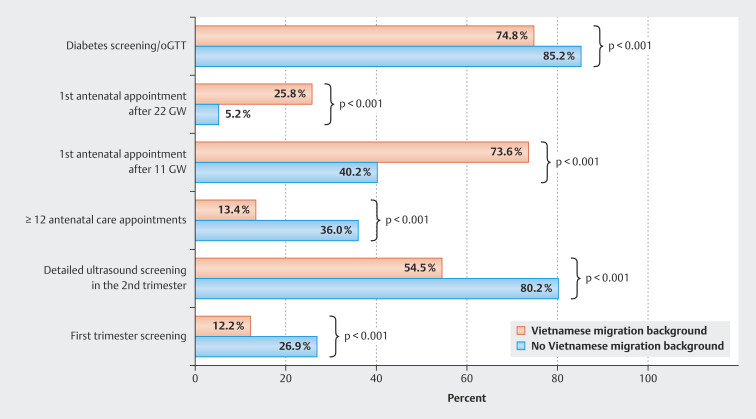
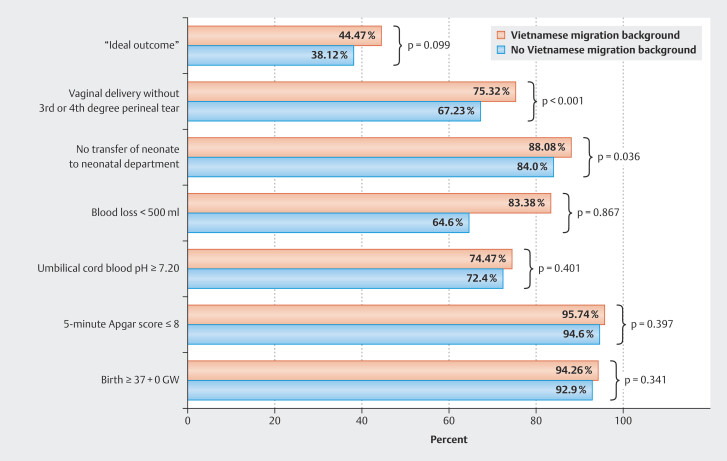
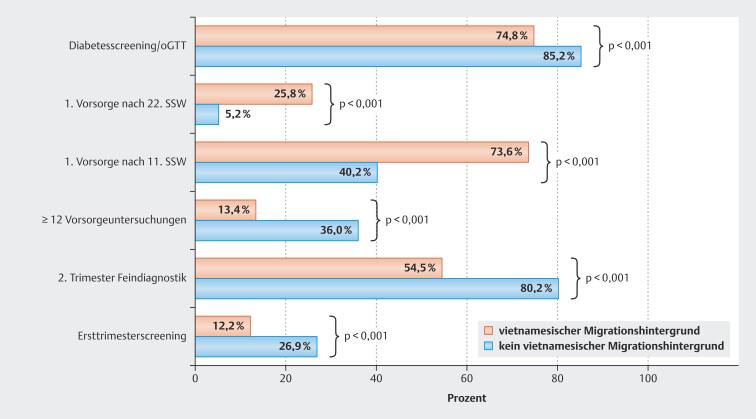
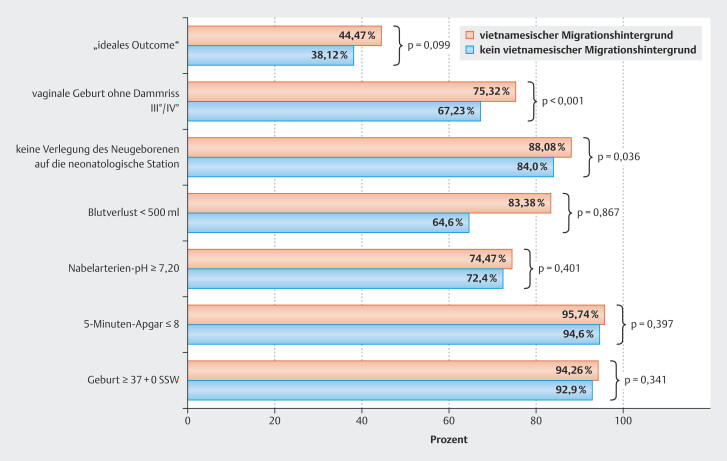
The perinatal data of 470 women with a Vietnamese migration background, 209 (44.5%) of whom were registered as living in a refugee shelter, were compared with those of 1410 controls. An "ideal pregnancy outcome," which included giving birth after 37 + 0 weeks of gestation, a 5-minute Apgar score ≥ 8, arterial cord blood pH ≥ 7.20, no transfer of the newborn to the neonatal department, and spontaneous birth or vacuum extraction without a higher degree perineal tear, was recorded for 44.5% of women with and 38.1% of women without a Vietnamese migration background (p = 0.1), despite the lower attendance rates at antenatal screening appointments of Vietnamese women. Accommodation in a shelter for refugees was a protective factor against caesarean section (OR 0.5, 95% CI: 0.36-0.73) and transfer of the newborn to the neonatal department (OR 0.45, 95% CI: 0.23-0.89). A Vietnamese migration background was a risk factor for a third-degree perineal tear (OR 5.4, 95% CI: 1.4-21.30).
Despite lower levels of antenatal care, women with a Vietnamese migration background did not have poorer pregnancy outcomes.
在德国,具有越南移民背景的人口占总人口的0.25%。针对这一特定移民群体的研究几乎没有。我们将具有越南移民背景的女性围产期数据与同样生活在德国的非越南裔女性的妊娠结局进行了比较。
通过姓名分析将女性分为不同组后,对2016年1月1日至2019年12月31日在柏林夏里特中心校区分娩的具有越南移民背景的女性围产期数据进行回顾性评估。这些数据与年龄和胎次相同的非越南裔女性数据按3:1的比例进行比较。采用多因素回归分析来确定影响剖宫产率、新生儿转入新生儿科的比例以及会阴三度裂伤发生率的因素。
将470名具有越南移民背景的女性围产期数据与1410名对照者的数据进行了比较,其中209名(44.5%)登记居住在难民收容所。“理想妊娠结局”包括妊娠37 + 0周后分娩、5分钟阿氏评分≥8、脐动脉血pH≥7.20、新生儿未转入新生儿科以及自然分娩或真空吸引且无会阴三度裂伤,具有越南移民背景的女性中有44.5%达到该标准,无越南移民背景的女性中有38.1%达到该标准(p = 0.1),尽管越南裔女性产前筛查预约的出勤率较低。居住在难民收容所是剖宫产(比值比0.5,95%可信区间:0.36 - 0.73)和新生儿转入新生儿科(比值比0.45,95%可信区间:0.23 - 0.89)的保护因素。越南移民背景是会阴三度裂伤的危险因素(比值比5.4,95%可信区间:1.4 - 21.30)。
尽管产前护理水平较低,但具有越南移民背景的女性妊娠结局并未更差。