Leng Qiaoli, Sun Yanan, Cao Jianan, Li Donghui, Geng Mingjian, Guo Zaihua, Cao Weidong, Zhu Qiang
Microelement Research Center of Huazhong Agricultural University, Key Laboratory of Arable Land Conservation (Middle and Lower Reaches of Yangtze River), Ministry of Agriculture and Rural Affairs, Wuhan, Hubei Province, 430070, China.
Institute of Agricultural Resources and Regional Planning, Chinese Academy of Agricultural Sciences, Beijing, 100081, China.
Heliyon. 2024 Dec 9;10(24):e41060. doi: 10.1016/j.heliyon.2024.e41060. eCollection 2024 Dec 30.
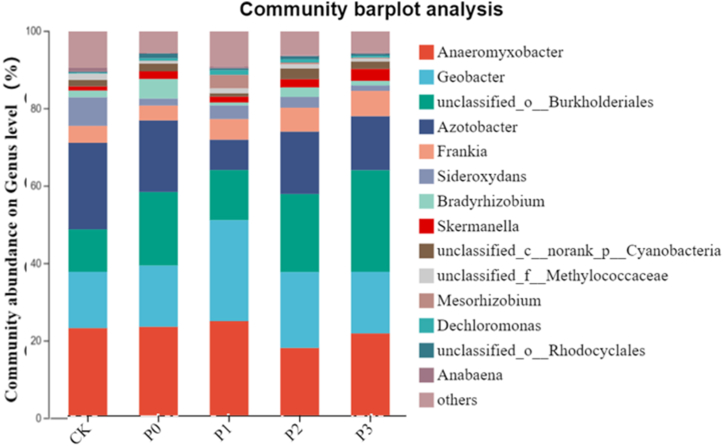
Chinese milk vetch (CMV) is widely recognized as the leading leguminous green manure utilized in the rice-green manure rotation system throughout southern China. While bacteria that form symbiotic relationships with CMV are responsible for fixing a significant portion of nitrogen (N) within agroecosystems. diazotrophic organisms play an essential role in the N cycle and enhance the pool of N readily accessible to plants. The goals of the current study were to investigate the effects of shifting partial phosphorus (P) fertilizer application from the rice season to the CMV season within a CMV-rice rotation system on soil nutrient levels, activity of soil enzymes and stoichiometric ratios, as well as diazotrophic community structure. The treatments consisted of a control group, a winter fallow-rice rotation without fertilizer application, and the treatments P0, P1, P2, and P3, representing 0, 1/3, 2/3, and the full dose, respectively, of phosphorus fertilizer (60 kg ha PO) added in a single rotation system during the CMV season, while combined with 60 % of regular N application rate during the rice season. In comparison to P0, the application of treatments P1, P2, and P3 resulted in higher CMV dry biomass and rice production across the seasons from 2018 to 2021 and the P2 treatment significantly increased the contents of total N (TN), soil organic matter (OM), and available P (AP) by 49 %, 48 %, and 110 %, respectively. The activities of alkaline phosphatase and L-leucine aminopeptidase showed a significant decrease when subjected to the P1 and P2 treatments. The P2 treatment enhanced the relative abundance of and by 2.6 % and 1.6 %, respectively, comparing with P0 treatment. Furthermore, correlation analysis revealed a positive relationship between and with the contents of TN, OM, AP, ammonium-N, and nitrate-N. In conclusion, the application of 1/3 to 2/3 of the full dose P fertilizer in CMV season reshaped soil diazotrophic community, improved soil N content, and thereby increased rice yield with 40 % N fertilizer reduction.
紫云英被广泛认为是中国南方稻-绿肥轮作系统中主要使用的豆科绿肥。与紫云英形成共生关系的细菌负责在农业生态系统中固定相当一部分的氮(N)。固氮生物在氮循环中起着至关重要的作用,并增加了植物易于获取的氮库。本研究的目的是调查在紫云英-水稻轮作系统中,将部分磷肥施用从水稻季转移到紫云英季对土壤养分水平、土壤酶活性和化学计量比以及固氮群落结构的影响。处理包括一个对照组、一个不施肥的冬闲-水稻轮作组,以及处理P0、P1、P2和P3,分别代表在紫云英季单一轮作系统中添加的磷肥(60 kg ha PO)的0、1/3、2/3和全剂量,同时在水稻季结合60%的常规氮肥施用量。与P0相比,2018年至2021年各季施用处理P1、P2和P3均使紫云英干生物量和水稻产量更高,且P2处理显著提高了全氮(TN)、土壤有机质(OM)和有效磷(AP)的含量,分别提高了49%、48%和110%。在P1和P2处理下,碱性磷酸酶和L-亮氨酸氨基肽酶的活性显著降低。与P0处理相比,P2处理使 和 的相对丰度分别提高了2.6%和1.6%。此外,相关性分析表明, 和 与TN、OM、AP、铵态氮和硝态氮的含量呈正相关。总之,在紫云英季施用1/3至2/3全剂量的磷肥重塑了土壤固氮群落,提高了土壤氮含量,从而在减少40%氮肥用量的情况下提高了水稻产量。