Woock Malin, Rossi Rosanna, Jabrah Duaa, Douglas Andrew, Redfors Petra, Nordanstig Annika, Tatlisumak Turgut, Ceder Erik, Dunker Dennis, Carlqvist Jeanette, Szikora István, Tsivgoulis Georgios, Psychogios Klearchos, Magoufis Georgios, Rentzos Alexandros, Doyle Karen M, Jood Katarina
Department of Neurology, Sahlgrenska University Hospital, Gothenburg, Sweden.
Department of Clinical Neuroscience, Institute of Neuroscience and Physiology, Sahlgrenska Academy at University of Gothenburg, Gothenburg, Sweden.
Eur J Neurol. 2025 Jan;32(1):e70037. doi: 10.1111/ene.70037.
Patients with active cancer face an increased risk of ischemic stroke. Also, stroke may be an initial indicator of cancer. In patients with large vessel occlusion (LVO) stroke treated with thrombectomy, analysis of the clot composition may contribute new insights into the pathological connections between these two conditions.
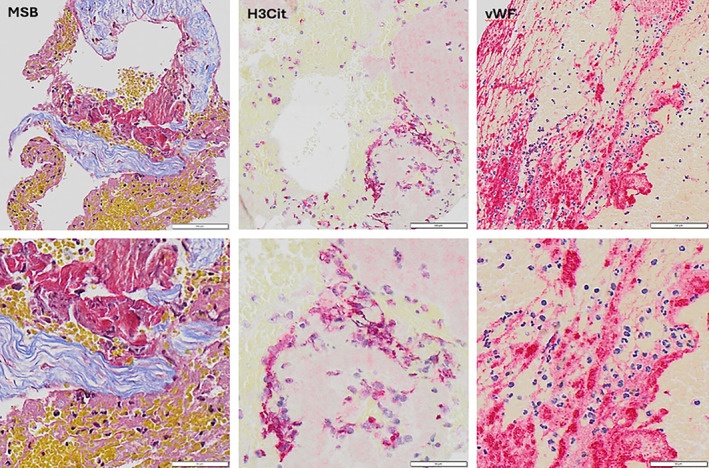
We compared the content of 64 consecutively retrieved clots from LVO stroke patients with concomitant active cancer and 64 clots from matched-control LVO stroke patients without a history of cancer. Clots were analyzed with respect to histological composition by Martius Scarlet Blue, von Willebrand factor (vWF), citrullinated histone H3 (H3Cit, a biomarker of NETS), CD42b, and CD3 expression by immunohistochemistry. Orbit Image Analysis was used for quantification. Differences between groups were tested using the Mann-Whitney U-test and Chi-square Test.
Clots from patients with concomitant cancer had a significantly higher content of vWF (median 26 [IQR13-38]% vs. 10 [4-18]%, p < 0.0001) and H3Cit (median 0.11 [IQR0.02-0.46]% vs. 0.05 [0.00-0.28]% p = 0.027) than controls. The presence of collagen >1% within the retrieved clots was highly indicative of cancer, occurring in 16/64 with active cancer and in 3/64 controls, p = 0.002. After correction for multiple comparisons, the statistical significance for H3Cit was lost. Red and white blood cells, platelets, fibrin, and expression of CD3 and CD42b did not differ between the groups.
Clots from LVO patients with concomitant active cancer possess distinct characteristics, indicating an influence of cancer on the innate immune system, fibroblasts, and the vascular endothelium in the formation of LVO clots.
患有活动性癌症的患者发生缺血性卒中的风险增加。此外,卒中可能是癌症的初始指标。在接受血栓切除术治疗的大血管闭塞(LVO)性卒中患者中,对血栓成分进行分析可能有助于深入了解这两种疾病之间的病理联系。
我们比较了64例伴有活动性癌症的LVO性卒中患者连续取出的血栓成分与64例匹配的无癌症病史的对照LVO性卒中患者的血栓成分。通过Martius Scarlet Blue、血管性血友病因子(vWF)、瓜氨酸化组蛋白H3(H3Cit,一种NETS的生物标志物)、CD42b以及通过免疫组织化学检测CD3表达来分析血栓的组织学组成。使用轨道图像分析进行定量。使用Mann-Whitney U检验和卡方检验对组间差异进行检验。
伴有癌症的患者的血栓中vWF含量(中位数26 [IQR13 - 38]% vs. 10 [4 - 18]%,p < 0.0001)和H3Cit含量(中位数0.11 [IQR0.02 - 0.46]% vs. 0.05 [0.00 - 0.28]%,p = 0.027)显著高于对照组。取出的血栓中胶原蛋白>1%的存在高度提示癌症,在64例活动性癌症患者中有16例出现,在64例对照中有3例出现,p = 0.002。在进行多重比较校正后,H3Cit的统计学显著性消失。两组之间红细胞、白细胞、血小板、纤维蛋白以及CD3和CD42b的表达没有差异。
伴有活动性癌症的LVO患者的血栓具有独特特征,表明癌症对LVO血栓形成过程中的固有免疫系统、成纤维细胞和血管内皮有影响。