Rossi Rosanna, Mereuta Oana Madalina, Barbachan E Silva Mariel, Molina Gil Sara, Douglas Andrew, Pandit Abhay, Gilvarry Michael, McCarthy Ray, O'Connell Shane, Tierney Ciara, Psychogios Klearchos, Tsivgoulis Georgios, Szikora István, Tatlisumak Turgut, Rentzos Alexandros, Thornton John, Ó Broin Pilib, Doyle Karen M
Department of Physiology and Galway Neuroscience Centre, School of Medicine, National University of Ireland, Galway, Ireland.
CÚRAM-SFI Research Centre for Medical Devices, National University of Ireland Galway, Galway, Ireland.
Front Neurol. 2022 Apr 19;13:854846. doi: 10.3389/fneur.2022.854846. eCollection 2022.
Besides the crucial role in the treatment of acute ischemic stroke (AIS), mechanical thrombectomy represents a unique opportunity for researchers to study the retrieved clots, with the possibility of unveiling biological patterns linked to stroke pathophysiology and etiology. We aimed to develop a shotgun proteomic approach to study and compare the proteome of formalin-fixed paraffin-embedded (FFPE) cardioembolic and large artery atherosclerotic (LAA) clots.
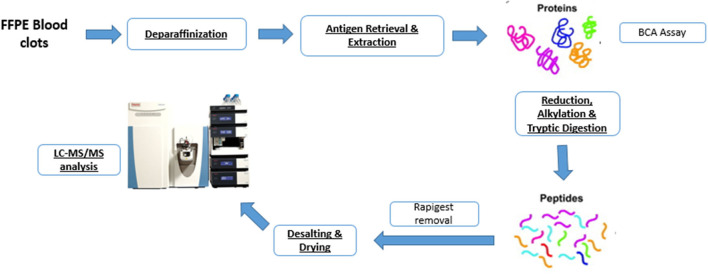
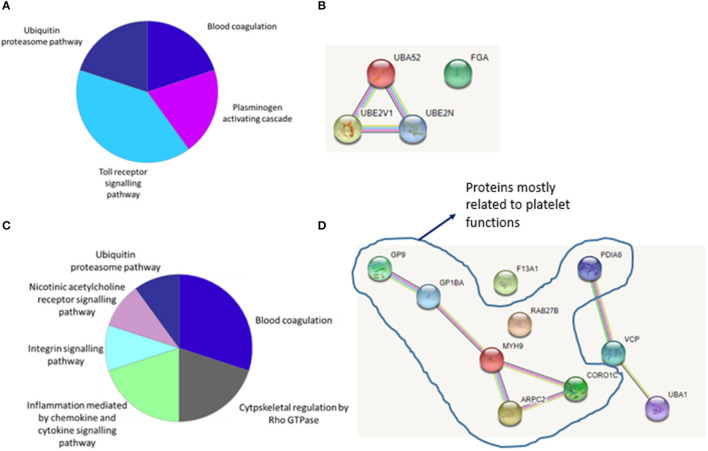
We used 16 cardioembolic and 15 LAA FFPE thrombi from 31 AIS patients. The thrombus proteome was analyzed by label-free quantitative liquid chromatography-tandem mass spectrometry (LC-MS/MS). MaxQuant v1.5.2.8 and Perseus v.1.6.15.0 were used for bioinformatics analysis. Protein classes were identified using the PANTHER database and the STRING database was used to predict protein interactions.
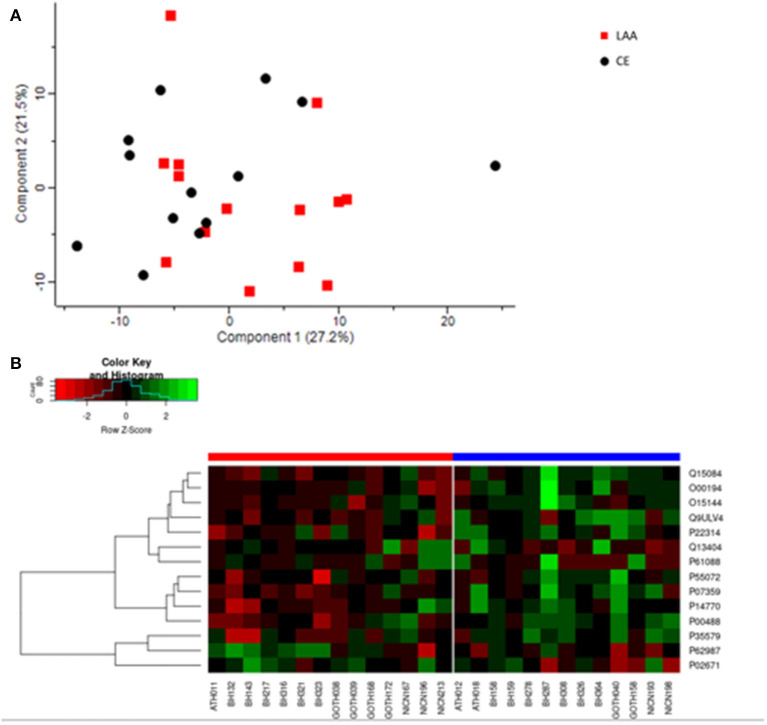
We identified 1,581 protein groups as part of the AIS thrombus proteome. Fourteen significantly differentially abundant proteins across the two etiologies were identified. Four proteins involved in the ubiquitin-proteasome pathway, blood coagulation or plasminogen activating cascade were identified as significantly abundant in LAA clots. Ten proteins involved in the ubiquitin proteasome-pathway, cytoskeletal remodeling of platelets, platelet adhesion or blood coagulation were identified as significantly abundant in cardioembolic clots.
Our results outlined a set of 14 proteins for a proof-of-principle characterization of cardioembolic and LAA FFPE clots, advancing the proteome profile of AIS human thrombi and understanding the pathophysiology of ischemic stroke.
机械取栓术除了在急性缺血性卒中(AIS)治疗中发挥关键作用外,还为研究人员提供了一个独特的机会来研究取出的血栓,有可能揭示与卒中病理生理学和病因学相关的生物学模式。我们旨在开发一种鸟枪法蛋白质组学方法,以研究和比较福尔马林固定石蜡包埋(FFPE)的心源性栓塞性和大动脉粥样硬化性(LAA)血栓的蛋白质组。
我们使用了来自31例AIS患者的16个心源性栓塞性和15个LAA FFPE血栓。通过无标记定量液相色谱-串联质谱(LC-MS/MS)分析血栓蛋白质组。使用MaxQuant v1.5.2.8和Perseus v.1.6.15.0进行生物信息学分析。使用PANTHER数据库识别蛋白质类别,并使用STRING数据库预测蛋白质相互作用。
我们鉴定出1581个蛋白质组作为AIS血栓蛋白质组的一部分。在两种病因中鉴定出14种差异显著丰富的蛋白质。在LAA血栓中,有4种参与泛素-蛋白酶体途径、血液凝固或纤溶酶原激活级联反应的蛋白质被鉴定为显著丰富。在心源性栓塞性血栓中,有10种参与泛素蛋白酶体途径、血小板细胞骨架重塑、血小板黏附或血液凝固的蛋白质被鉴定为显著丰富。
我们的结果概述了一组14种蛋白质,用于对心源性栓塞性和LAA FFPE血栓进行原理验证表征,推进了AIS人类血栓的蛋白质组概况,并有助于理解缺血性卒中的病理生理学。