Lewis Emma Grace, Hurst Christopher, Errington Linda, Sayer Avan A
AGE Research Group, Translational and Clinical Research Institute, Faculty of Medical Sciences, Newcastle University, Newcastle upon Tyne, UK.
NIHR Newcastle Biomedical Research Centre, Newcastle upon Tyne Hospitals NHS Foundation Trust, Cumbria Northumberland Tyne and Wear NHS Foundation Trust and Faculty of Medical Sciences Newcastle University, Newcastle upon Tyne, UK.
Eur Geriatr Med. 2025 Feb;16(1):99-113. doi: 10.1007/s41999-024-01132-5. Epub 2025 Jan 6.
Perceptions of sarcopenia have rarely been explored, yet understanding these will be key for successful translation of sarcopenia research findings into meaningful benefits for patients and the public. This scoping review aimed to explore how sarcopenia is perceived amongst patients, health and care professionals (HCP), and the public in different countries.
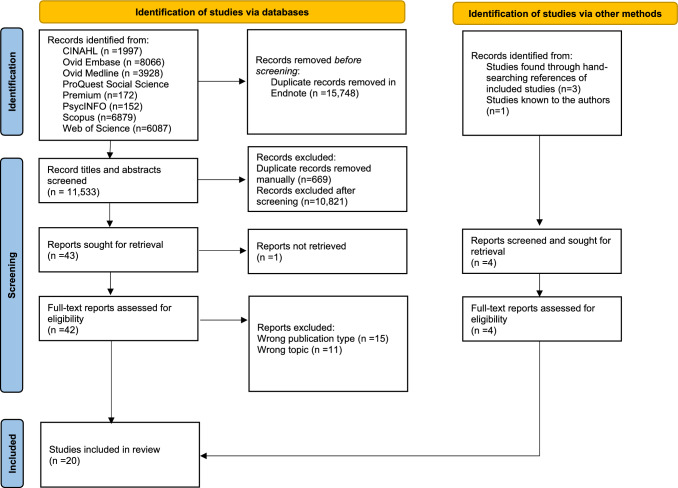
Seven electronic databases were searched from inception up to December 2023 with no geographical or language limitations. Studies were included if they were peer-reviewed research of any design where the focus related to perceptions of sarcopenia. Studies using alternative descriptors only, such as "skeletal muscle weakness/loss" were excluded. Study characteristics were charted, and thematic synthesis conducted.
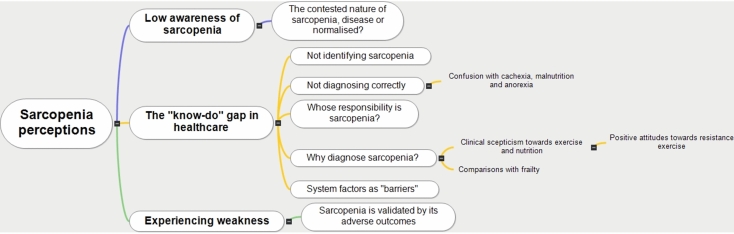
Following independent screening of 11,533 records, 20 articles were included in this review representing 19 countries. Five studies focused on patient perceptions, 11 investigated HCP, and four the public. Three key themes were identified: (1) Low awareness of sarcopenia-among all groups, its nature as a disease was contested. (2) The "know-do" gap in healthcare-even where knowledge among HCP existed, this had not translated into clinical practice, in part, due to perceptions of sarcopenia and its management. (3) Experiencing weakness-living with sarcopenia had physical and psychological sequalae.
These findings reveal perceptions that may be contributing to the slow adoption of sarcopenia prevention, screening, diagnosis, and management. Addressing these areas has the potential to aid translation of sarcopenia research findings into improved clinical care and benefits for patients and the public.
对肌肉减少症的认知很少被探讨,然而理解这些认知对于将肌肉减少症的研究成果成功转化为对患者和公众有意义的益处至关重要。本范围综述旨在探讨不同国家的患者、健康与护理专业人员(HCP)以及公众对肌肉减少症的认知情况。
检索了七个电子数据库,涵盖从建库至2023年12月的文献,无地理或语言限制。纳入的研究需为任何设计的同行评审研究,重点是与肌肉减少症认知相关的内容。仅使用替代描述词的研究,如“骨骼肌无力/丧失”,予以排除。记录研究特征并进行主题综合分析。
在对11,533条记录进行独立筛选后,本综述纳入了代表19个国家的20篇文章。五项研究聚焦于患者认知,11项调查了HCP,四项研究了公众。确定了三个关键主题:(1)对肌肉减少症的认知不足——在所有群体中,其作为一种疾病的性质存在争议。(2)医疗保健中的“知行”差距——即使HCP中有相关知识,但部分由于对肌肉减少症及其管理的认知,这些知识并未转化为临床实践。(3)经历虚弱——患有肌肉减少症会产生身体和心理后遗症。
这些发现揭示了可能导致肌肉减少症预防、筛查、诊断和管理采用缓慢的认知情况。解决这些领域的问题有可能有助于将肌肉减少症的研究成果转化为改善临床护理,并为患者和公众带来益处。