WHO Collaborating Center for Public Health Aspects of Musculo-skeletal Health and Ageing, Division of Public Health, Epidemiology and Health Economics, University of Liège, Liège, Belgium.
Department of Clinical Sciences and Community Health, University of Milan, Milan, Italy.
J Cachexia Sarcopenia Muscle. 2023 Jun;14(3):1228-1243. doi: 10.1002/jcsm.13243. Epub 2023 May 4.
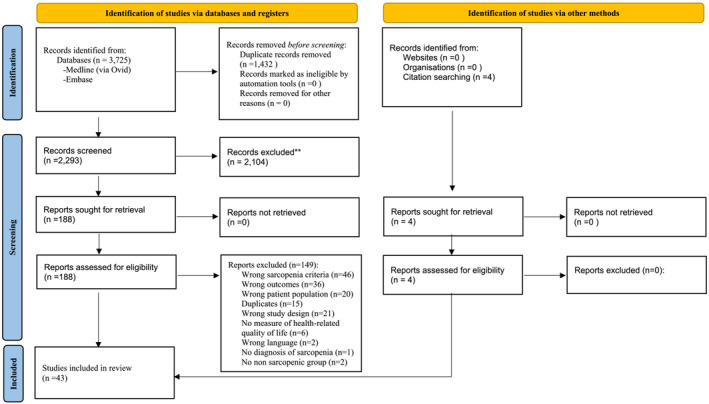
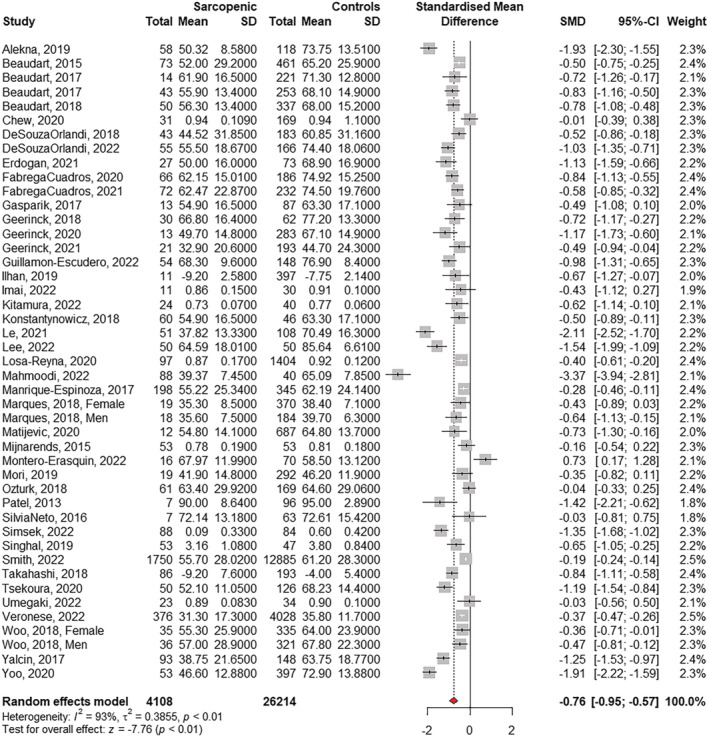
The decrease of physical abilities and functional decline that can be caused by musculoskeletal conditions such as sarcopenia, can lead to higher levels of dependency and disability. Therefore, it may influence patient reported outcome measures (PROM), such as the health-related quality of life (HRQoL). The purpose of this systematic review and meta-analysis is to provide a comprehensive overview of the relationship between sarcopenia and HRQoL. Preferred Reporting Items for Systematic Reviews and Meta-Analyses (PRISMA) were followed throughout the whole process of this work. A protocol was previously published on PROSPERO. The electronic databases MEDLINE, Scopus, Allied and Complementary Medicine (AMED), EMB Review - ACP Journal Club, EBM Review - Cochrane Central of Register of Controlled Trials and APA PsychInfo were searched until October 2022 for observational studies reporting a HRQoL assessment in both sarcopenic and non-sarcopenic individuals. Study selection and data extraction were carried out by two independent researchers. Meta-analysis was performed using a random effect model, reporting an overall standardized mean difference (SMD) and its 95% confidence interval (CI) between sarcopenic and non-sarcopenic individuals. Study quality was measured using the Newcastle-Ottawa Scale and the strength of evidence was assessed using the Grading of Recommendations Assessment, Development and Evaluation (GRADE) tool. The search strategy identified 3725 references from which 43 observational studies were eligible and included in this meta-synthesis study. A significantly lower HRQoL was observed for sarcopenic individuals compared with non-sarcopenic ones (SMD -0.76; 95% CI -0.95; -0.57). Significant heterogeneity was associated with the model (I = 93%, Q test P-value <0.01). Subgroup analysis showed a higher effect size when using the specific questionnaire SarQoL compared with generic questionnaires (SMD -1.09; 95% CI -1.44; -0.74 with the SarQoL versus -0.49; 95% CI -0.63; -0.36 with generic tools; P-value for interaction <0.01). A greater difference of HRQoL between sarcopenic and non-sarcopenic was found for individuals residing in care homes compared with community-dwelling individuals (P-value for interaction <0.001). No differences were found between age groups, diagnostic techniques, and continents/regions. The level of evidence was rated as moderate using the GRADE assessment. This systematic review and meta-analysis combining 43 observational studies shows that HRQoL is significantly reduced in sarcopenic patients. The use of disease-specific HRQoL instruments may better discriminate sarcopenic patients with respect to their quality of life.
肌肉减少症等肌肉骨骼疾病导致的身体机能下降和功能衰退,可能会导致更高的依赖程度和残疾水平。因此,它可能会影响患者报告的结果测量(PROM),如健康相关生活质量(HRQoL)。本系统评价和荟萃分析的目的是提供肌肉减少症与 HRQoL 之间关系的全面概述。整个工作过程都遵循了系统评价和荟萃分析的首选报告项目(PRISMA)。该方案先前已在 PROSPERO 上发布。从 2022 年 10 月之前,在 MEDLINE、Scopus、联合和补充医学(AMED)、EMB 评论-ACP 期刊俱乐部、EBM 评论-考科兰中心对照试验注册和 APA PsychInfo 等电子数据库中搜索了报告肌肉减少症和非肌肉减少症个体中 HRQoL 评估的观察性研究。研究选择和数据提取由两名独立研究人员进行。使用随机效应模型进行荟萃分析,报告肌肉减少症和非肌肉减少症个体之间的总体标准化均数差(SMD)及其 95%置信区间(CI)。使用纽卡斯尔-渥太华量表测量研究质量,使用推荐评估、制定和评估(GRADE)工具评估证据强度。搜索策略确定了 3725 条参考文献,其中 43 项观察性研究符合条件并纳入本荟萃分析研究。与非肌肉减少症个体相比,肌肉减少症个体的 HRQoL 明显较低(SMD-0.76;95%CI-0.95;-0.57)。模型存在显著的异质性(I=93%,Q 检验 P 值<0.01)。亚组分析表明,与通用问卷相比,使用特定问卷 SarQoL 时,效应量更高(SMD-1.09;95%CI-1.44;-0.74 与 SarQoL 相比,-0.49;95%CI-0.63;-0.36 与通用工具相比;交互检验 P 值<0.01)。与居住在养老院的个体相比,居住在养老院的个体与居住在社区的个体之间的 HRQoL 差异更大(交互检验 P 值<0.001)。在年龄组、诊断技术和大陆/地区之间没有发现差异。使用 GRADE 评估,证据水平被评为中等。本系统评价和荟萃分析结合了 43 项观察性研究,表明肌肉减少症患者的 HRQoL 明显降低。使用特定疾病的 HRQoL 工具可能会更好地区分肌肉减少症患者的生活质量。