Adly Aya Mohamed, Ibrahim Shereen Hafez, El-Zoghbi Amira Farid
Assistant lecturer at Conservative Dentistry, Faculty of Dentistry, Cairo University, Giza, Egypt.
Professor of Conservative Dentistry, Faculty of Dentistry, Cairo University, Giza, Egypt.
BDJ Open. 2025 Jan 6;11(1):2. doi: 10.1038/s41405-024-00284-7.
To assess the validity of light-induced and laser-induced fluorescence devices compared to the visual-tactile method for detecting secondary caries around resin composite restorations.
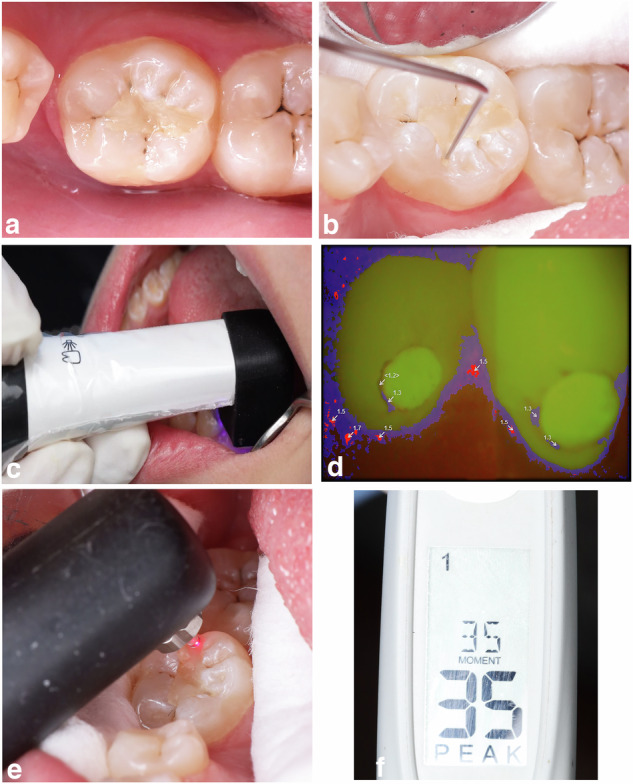
The study included 20 participants with 30 resin-composite restored teeth. Restorations' margins were examined using three diagnostic methods: the visual-tactile method (FDI criteria), the light-induced fluorescence camera (VistaCam iX), and the laser-induced fluorescence device (DIAGNOdent pen), and the reference was visual inspection after removal of defective restorations. The validity of each method was evaluated. Inter-examiner reliability was calculated using Cohen's kappa statistics. The level of significance was set at P = 0.05.
DIAGNOdent pen showed the highest sensitivity (100%) followed by VistaCam (98.82%) and the visual-tactile method (98.82%) at the enamel threshold. DIAGNOdent pen and VistaCam had lower specificity values than the visual-tactile method (81.69%, 76.06%, and 88.73% respectively). At the dentin threshold, DIAGNOdent pen yielded the highest sensitivity (89.36%), whereas VistaCam had the lowest (8.51%). The sensitivity of the visual-tactile method was low (57.45%) whereas all diagnostic methods had high specificity. There was perfect agreement in inter-examiner reliability for all assessment methods (Kappa 0.858-0.992).
Both fluorescence-based devices and the visual-tactile method are reliable for detecting secondary caries around resin composite restorations. DIAGNOdent pen is accurate in enamel and dentin, while VistaCam and the visual-tactile method can detect secondary caries in enamel only.
Fluorescence-based devices could be used as a valuable aid to supplement or as a second opinion after the visual-tactile method.
The study was listed on www.
gov with registration number (NCT04426604) on 11/06/2020.
评估光诱导荧光装置和激光诱导荧光装置与视觉触觉法相比,用于检测树脂复合材料修复体周围继发龋的有效性。
该研究纳入了20名参与者的30颗树脂复合材料修复牙。使用三种诊断方法检查修复体边缘:视觉触觉法(FDI标准)、光诱导荧光相机(VistaCam iX)和激光诱导荧光装置(DIAGNOdent笔),参考标准为去除有缺陷修复体后的目视检查。评估了每种方法的有效性。使用Cohen's kappa统计量计算检查者间可靠性。显著性水平设定为P = 0.05。
在釉质阈值时,DIAGNOdent笔显示出最高的灵敏度(100%),其次是VistaCam(98.82%)和视觉触觉法(98.82%)。DIAGNOdent笔和VistaCam的特异性值低于视觉触觉法(分别为81.69%、76.06%和88.73%)。在牙本质阈值时,DIAGNOdent笔的灵敏度最高(89.36%),而VistaCam最低(8.51%)。视觉触觉法的灵敏度较低(57.45%),而所有诊断方法的特异性都较高。所有评估方法的检查者间可靠性具有完美一致性(Kappa 0.858 - 0.992)。
基于荧光的装置和视觉触觉法在检测树脂复合材料修复体周围继发龋方面都是可靠的。DIAGNOdent笔在釉质和牙本质中都很准确,而VistaCam和视觉触觉法仅能检测釉质中的继发龋。
基于荧光的装置可作为一种有价值的辅助手段,在视觉触觉法之后补充使用或作为第二种意见。
该研究于2020年6月11日在www.CLINICALTRIALS.gov上列出,注册号为(NCT04426604)。