Park Su Hyun, Jeong Yu Jeong, Kim Soyoung, Lee Jiyoung, Kim Cha Young, Jeong Jae Cheol
Biological Resource Center, Korea Research Institute of Bioscience and Biotechnology (KRIBB), Jeongeup, 56212, Republic of Korea.
Sci Rep. 2025 Jan 6;15(1):978. doi: 10.1038/s41598-024-84860-9.
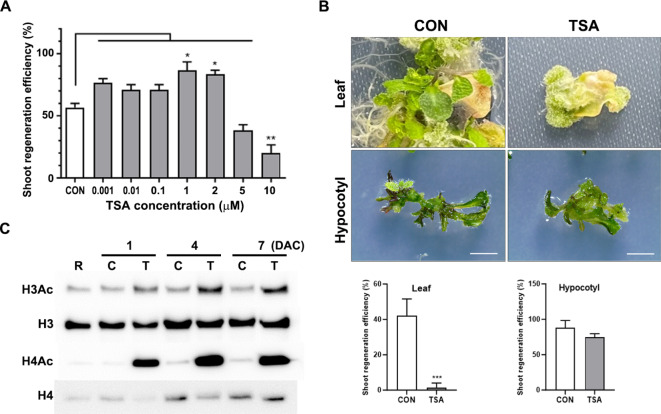
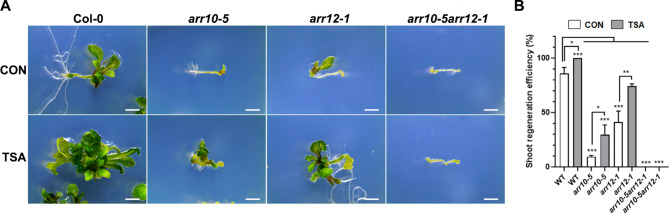
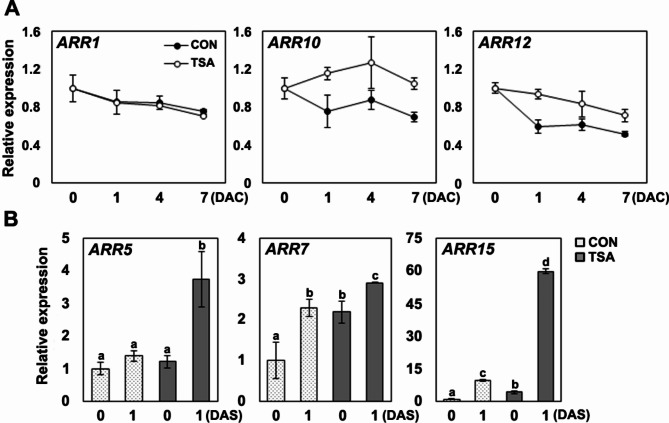
De novo shoot regeneration, characterized by the emergence of adventitious shoots from excised or damaged tissues or organs in vitro, is regulated by the complex interplay between genetic and epigenetic regulatory mechanisms. However, the specific effect of histone deacetylation on shoot regeneration remains poorly understood. This study investigated the effects of trichostatin A (TSA), a histone deacetylase inhibitor, on shoot regeneration in callus derived from root explants. TSA-treated root explants exhibited pronounced callus greening and substantially increasing in multiple shoot formations per callus compared with the control group. Additionally, TSA treatment upregulated shoot apical meristem-specific genes, including WUSCHELL (WUS), RELATED TO AP2.6 L (Rap2.6 L), SHOOT MERISTEMLESS (STM), CUP SHAPED COTYLEDON 2 (CUC2). Notably, TSA treatment enhanced the sensitivity to cytokinins, leading to increase expression of the cytokinin signaling reporter TCS::GFP in the callus. Concomitantly, type-B ARABIDOPSIS RESPONSE REGULATOR (ARR) 10 and 12, which are key regulators of cytokinin signaling, were upregulated in TSA-treated callus, whereas the downstream targets of type-B ARRs, such as ARR5, ARR7, and ARR15, were significantly upregulated during shoot regeneration. Furthermore, mutants deficient in ARR10 and ARR12 showed diminished responsiveness to shoot regenerative capacity, a phenotype that was enhanced by TSA treatment. Our findings underscore the crucial role of histone deacetylation in mediating cytokinin responses and controlling de novo shoot regeneration in plants.
从头再生是指在体外从切除或受损的组织或器官中产生不定芽,它受遗传和表观遗传调控机制之间复杂的相互作用所调节。然而,组蛋白去乙酰化对芽再生的具体影响仍知之甚少。本研究调查了组蛋白脱乙酰酶抑制剂曲古抑菌素A(TSA)对根外植体愈伤组织芽再生的影响。与对照组相比,经TSA处理的根外植体愈伤组织呈现出明显的绿化,且每个愈伤组织的多芽形成显著增加。此外,TSA处理上调了茎尖分生组织特异性基因,包括WUSCHELL(WUS)、RELATED TO AP2.6 L(Rap2.6 L)、SHOOT MERISTEMLESS(STM)、CUP SHAPED COTYLEDON 2(CUC2)。值得注意的是,TSA处理增强了对细胞分裂素的敏感性,导致愈伤组织中细胞分裂素信号报告基因TCS::GFP的表达增加。同时,细胞分裂素信号的关键调节因子拟南芥B型响应调节因子(ARR)10和12在经TSA处理的愈伤组织中上调,而B型ARR的下游靶标,如ARR5、ARR7和ARR15,在芽再生过程中显著上调。此外,ARR10和ARR12缺陷型突变体对芽再生能力的反应减弱,TSA处理增强了这种表型。我们的研究结果强调了组蛋白去乙酰化在介导细胞分裂素反应和控制植物从头芽再生中的关键作用。