Ding Lei, Xiao Xiao, Wang Haitao
Tianjin Chengjian University, Tianjin, China.
Sci Rep. 2025 Jan 6;15(1):914. doi: 10.1038/s41598-025-85146-4.
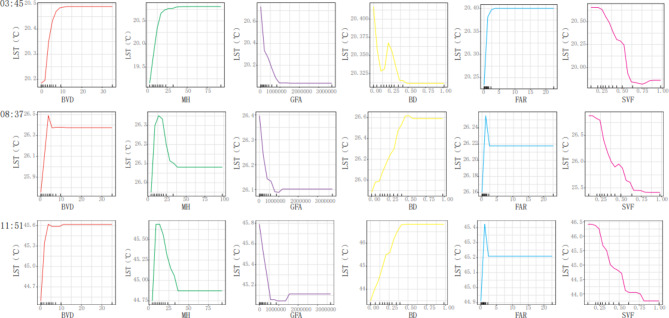
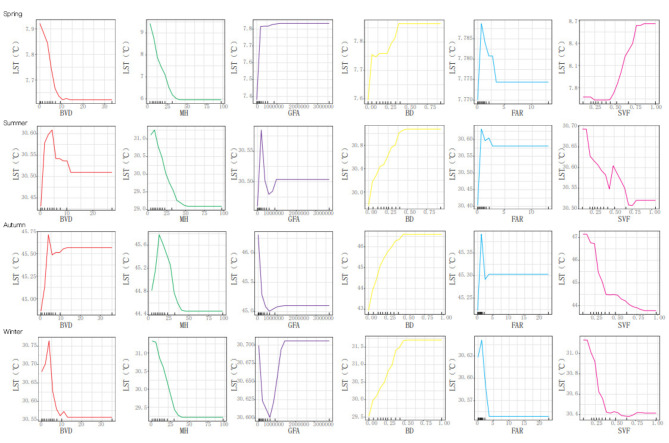
Urban overheating significantly affects thermal comfort and livability, making it essential to understand the relationship between urban form and land surface temperature (LST). While the horizontal dimensions of urban form have been widely studied, the vertical structures and their impact on LST remain underexplored. This study investigates the influence of three-dimensional urban form characteristics on LST, using ECOSTRESS sensor data and four machine learning models. Six urban morphology variables-building density (BD), mean building height (MH), building volume (BVD), gross floor area (GFA), floor area ratio (FAR), and sky view factor (SVF)-are analyzed across different seasons and times of day. The results reveal that MH, BD, and FAR are season-stable factors, with higher MH correlated with lower LST ((e.g., an observed reduction of approximately 3 °C in spring), while higher BD is associated with higher LST (e.g., an increase of about 3.5 °C in autumn). In contrast, BVD, GFA, and SVF are season-varying factors with variable impacts depending on the time of year. Higher BVD is generally associated with elevated LST, while GFA and SVF are linked to lower LST. These associations reflect absolute changes in LST, measured directly from ECOSTRESS data. These findings offer valuable insights into the complex interactions between urban morphology and LST, helping to inform strategies for urban heat mitigation and sustainable planning.
城市热岛效应显著影响热舒适度和宜居性,因此了解城市形态与地表温度(LST)之间的关系至关重要。虽然城市形态的水平维度已得到广泛研究,但垂直结构及其对地表温度的影响仍未得到充分探索。本研究利用ECOSTRESS传感器数据和四种机器学习模型,调查三维城市形态特征对地表温度的影响。分析了六个城市形态变量——建筑密度(BD)、平均建筑高度(MH)、建筑体积(BVD)、总建筑面积(GFA)、容积率(FAR)和天空开阔度因子(SVF)——在不同季节和一天中的不同时间的情况。结果表明,平均建筑高度、建筑密度和容积率是季节稳定因素,平均建筑高度越高,地表温度越低(例如,春季观测到约3°C的降幅),而建筑密度越高,地表温度越高(例如,秋季升高约3.5°C)。相比之下,建筑体积、总建筑面积和天空开阔度因子是随季节变化的因素,其影响因年份不同而变化。建筑体积越大,通常与地表温度升高相关,而总建筑面积和天空开阔度因子则与较低的地表温度相关。这些关联反映了直接从ECOSTRESS数据测量得到的地表温度的绝对变化。这些发现为城市形态与地表温度之间的复杂相互作用提供了有价值的见解,有助于为城市热缓解和可持续规划策略提供信息。