Tong Tong, Guo Yikun, Wang Qingqing, Sun Xiaoning, Sun Ziyi, Yang Yuhan, Zhang Xiaoxiao, Yao Kuiwu
Guang'anmen Hospital, China Academy of Chinese Medical Sciences, Beijing, China.
Beijing University of Chinese Medicine, Chao Yang District, Beijing, 100029, China.
Sci Rep. 2025 Jan 6;15(1):909. doi: 10.1038/s41598-025-85596-w.
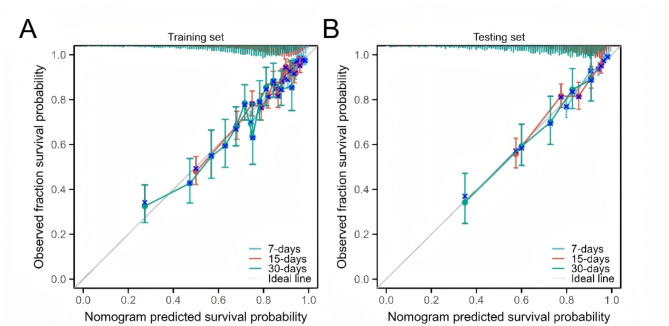
Heart failure is a common complication in patients with sepsis, and individuals who experience both sepsis and heart failure are at a heightened risk for adverse outcomes. This study aims to develop an effective nomogram model to predict the 7-day, 15-day, and 30-day survival probabilities of septic patients with heart failure in the intensive care unit (ICU). This study extracted the pertinent clinical data of septic patients with heart failure from the Critical Medical Information Mart for Intensive Care (MIMIC-IV) database. Patients were then randomly allocated into a training set and a test set at a ratio of 7:3. Cox proportional hazards regression analysis was used to determine independent risk factors influencing patient prognosis and to develop a nomogram model. The model's efficacy and clinical significance were assessed through metrics such as the concordance index (C-index), time-dependent receiver operating characteristic (ROC), calibration curve, and decision curve analysis (DCA). A total of 5,490 septic patients with heart failure were included in the study. A nomogram model was developed to predict short-term survival probabilities, using 13 variables: age, pneumonia, endotracheal intubation, mechanical ventilation, potassium (K), anion gap (AG), lactate (Lac), activated partial thromboplastin time (APTT), white blood cell count (WBC), red cell distribution width (RDW), hemoglobin-to-red cell distribution width ratio (HRR), Sequential Organ Failure Assessment (SOFA) score, and Charlson Comorbidity Index (CCI). The C-index was 0.730 (95% CI 0.719-0.742) for the training set and 0.761 (95% CI 0.745-0.776) for the test set, indicating strong model accuracy, indicating good model accuracy. Evaluations via the ROC curve, calibration curve, and decision curve analyses further confirmed the model's reliability and utility. This study effectively developed a straightforward and efficient nomogram model to predict the 7-day, 15-day, and 30-day survival probabilities of septic patients with heart failure in the ICU. The implementation of treatment strategies that address the risk factors identified in the model can enhance patient outcomes and increase survival rates.
心力衰竭是脓毒症患者的常见并发症,同时患有脓毒症和心力衰竭的个体出现不良结局的风险更高。本研究旨在开发一种有效的列线图模型,以预测重症监护病房(ICU)中合并心力衰竭的脓毒症患者的7天、15天和30天生存概率。本研究从重症医学信息集市(MIMIC-IV)数据库中提取了合并心力衰竭的脓毒症患者的相关临床数据。然后将患者按7:3的比例随机分为训练集和测试集。采用Cox比例风险回归分析来确定影响患者预后的独立危险因素,并开发列线图模型。通过一致性指数(C-index)、时间依赖性受试者工作特征(ROC)、校准曲线和决策曲线分析(DCA)等指标评估模型的有效性和临床意义。本研究共纳入5490例合并心力衰竭的脓毒症患者。利用13个变量开发了一个列线图模型来预测短期生存概率,这些变量包括:年龄、肺炎、气管插管、机械通气、钾(K)、阴离子间隙(AG)、乳酸(Lac)、活化部分凝血活酶时间(APTT)、白细胞计数(WBC)、红细胞分布宽度(RDW)、血红蛋白与红细胞分布宽度比值(HRR)、序贯器官衰竭评估(SOFA)评分和Charlson合并症指数(CCI)。训练集的C-index为0.730(95%CI 0.719 - 0.742),测试集的C-index为0.761(95%CI 0.745 - 0.776),表明模型准确性较高。通过ROC曲线、校准曲线和决策曲线分析进行的评估进一步证实了模型的可靠性和实用性。本研究有效地开发了一种简单有效的列线图模型,以预测ICU中合并心力衰竭的脓毒症患者的7天、15天和30天生存概率。实施针对模型中确定的危险因素的治疗策略可以改善患者预后并提高生存率。