Tang Juan, Zhao Peiling, Li Yi, Liu Shaowen, Chen Lu, Chen Yu, Chen Rui, Shen Yong, Liu Yongmei
Center for Clinical Laboratories, The Affiliated Hospital of Guizhou Medical University, 28, Guiyi Street, Guiyang, Guizhou, China.
School of Clinical Laboratory Science, Guizhou Medical University, 9 Beijing Road, Guiyang, Guizhou, China.
Heliyon. 2024 May 22;10(11):e31753. doi: 10.1016/j.heliyon.2024.e31753. eCollection 2024 Jun 15.
The goal of the research is to investigate the link between serum potassium levels and death after 28 days in sepsis patients, utilizing an extensive sample of patients from the multi-center Medical Information Mart for Intensive Care IV (MIMIC-IV) database. Current research on serum potassium levels and 28-day mortality in sepsis patients is questionable. This study adds to the growing body of evidence linking serum potassium levels to the 28-day possibility of death in patients with sepsis.
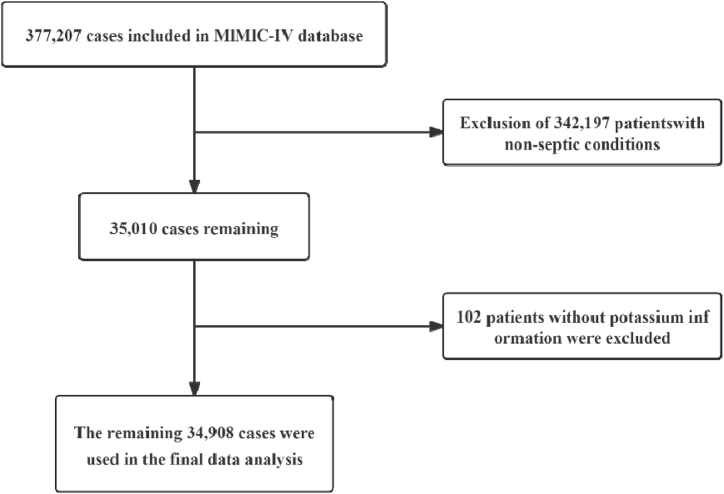
We collected 349,08 patients with sepsis from the retrospective cohort MIMIC-IV database, using serum potassium level on the first day of admission to the intensive care unit as the exposure variable and mortality at 28 days as the outcome variable. And controlled for confounding characteristics including gender, age, ethnicity, and vital signs during admission.
Serum potassium has a U-shaped connection with 28-day mortality in patients suffering from sepsis. The turning point was 4.10 mmol/L (95 % confidence interval: 4.03 to 4.22). Serum potassium and 28-day mortality were negatively linked on the inflection point's left side (OR: 0.72; 95 % CI: 0.63 to 0.83, P < 0.0001); on the opposing side of the point of inflexion, serum potassium was enthusiastically attached to 28-day mortality. (OR: 1.13; 95 % CI: 1.06 to 1.21, P < 0.0001).
The research conducted found that too high or too low potassium levels were linked to a 28-day risk of mortality in humans with sepsis.
本研究旨在利用多中心重症监护医学信息数据库IV(MIMIC-IV)中的大量患者样本,调查脓毒症患者血清钾水平与28天死亡率之间的联系。目前关于脓毒症患者血清钾水平与28天死亡率的研究存在疑问。本研究为血清钾水平与脓毒症患者28天死亡可能性之间的联系提供了越来越多的证据。
我们从回顾性队列MIMIC-IV数据库中收集了34908例脓毒症患者,将重症监护病房入院第一天的血清钾水平作为暴露变量,28天死亡率作为结局变量。并对包括性别、年龄、种族和入院时生命体征等混杂特征进行了控制。
脓毒症患者血清钾与28天死亡率呈U型关系。转折点为4.10mmol/L(95%置信区间:4.03至4.22)。在转折点左侧,血清钾与28天死亡率呈负相关(OR:0.72;95%CI:0.63至0.83,P<0.0001);在转折点的另一侧,血清钾与28天死亡率呈正相关。(OR:1.13;95%CI:1.06至1.21,P<0.0001)。
本研究发现,过高或过低的钾水平与脓毒症患者28天的死亡风险相关。