Tamaki Mizuna, Chiku Tsutomu, Suzuki Shunya, Misaki Aya, Funakubo Asuka, Matsushima Yoshitaka, Yokota Kenji, Igimi Shizunobu, Kajikawa Akinobu
Department of Agricultural Chemistry, Graduate School of Tokyo University of Agriculture, 1-1-1 Sakuragaoka, Setagaya-ku, Tokyo 156-8502, Japan.
Bioproduction Research Institute, National Institute of Advanced Industrial Science and Technology, 1-1-1 Higashi, Tsukuba, Ibaraki 305-8566, Japan.
Biosci Microbiota Food Health. 2025;44(1):70-79. doi: 10.12938/bmfh.2024-009. Epub 2024 Sep 6.
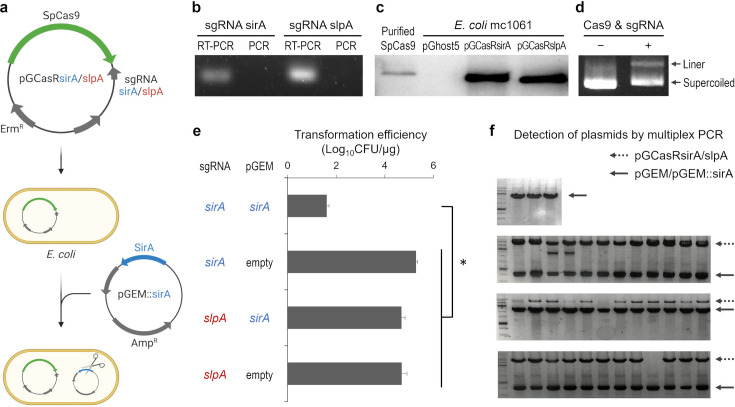
Although the clustered regularly interspaced short palindromic repeat (CRISPR)-Cas system has been extensively developed since its discovery for eukaryotic and prokaryotic genome editing and other genetic manipulations, there are still areas warranting improvement, especially regarding bacteria. In this study, BRD0539, a small-molecule inhibitor of Cas9 (SpCas9), was used to suppress the activity of the nuclease during genetic modification of , as well as to regulate CRISPR interference (CRISPRi). First, we developed and validated a CRISPR-SpCas9 system targeting the gene of . Then BRD0539 was used for CRISPR-dependent DNA cleavage . Our results suggested that the inhibitor worked partially in both and . Next, we designed a CRISPRi system in a strain by inserting an inactive SpCas9 gene into the chromosome and introducing a plasmid encoding for a single guide RNA (sgRNA) targeting the gene. Expression of was successfully inhibited in the recombinant strains, and CRISPRi was abolished in an inhibitor-dependent manner. Our findings may help expand the CRISPR toolbox for research on lactic acid bacteria and other microbes.
尽管成簇规律间隔短回文重复序列(CRISPR)-Cas系统自发现以来已被广泛开发用于真核生物和原核生物的基因组编辑及其他基因操作,但仍有需要改进的地方,尤其是在细菌方面。在本研究中,BRD0539,一种Cas9(SpCas9)的小分子抑制剂,被用于在对[具体细菌名称]进行基因改造期间抑制核酸酶的活性,以及调节CRISPR干扰(CRISPRi)。首先,我们开发并验证了一个靶向[具体细菌名称]的[具体基因名称]基因的CRISPR-SpCas9系统。然后将BRD0539用于依赖CRISPR的DNA切割。我们的结果表明该抑制剂在[具体细菌名称1]和[具体细菌名称2]中均部分起作用。接下来,我们通过将一个无活性的SpCas9基因插入染色体并引入一个编码靶向[具体基因名称]的单向导RNA(sgRNA)的质粒,在[具体细菌名称3]菌株中设计了一个CRISPRi系统。在重组菌株中[具体基因名称]的表达被成功抑制,并且CRISPRi以依赖抑制剂的方式被消除。我们的发现可能有助于扩展用于乳酸菌和其他微生物研究的CRISPR工具箱。