Chavas Christos, Sapanidou Vasiliki G, Feidantsis Konstantinos, Lavrentiadou Sophia N, Mavrogianni Despoina, Zarogoulidou Ioanna, Fletouris Dimitrios J, Tsantarliotou Maria P
Laboratory of Animal Physiology, School of Veterinary Medicine, Faculty of Health Sciences, Aristotle University of Thessaloniki, GR-54124 Thessaloniki, Greece.
Department of Fisheries & Aquaculture, School of Agricultural Sciences, University of Patras, GR-26504 Mesolonghi, Greece.
Antioxidants (Basel). 2024 Nov 22;13(12):1437. doi: 10.3390/antiox13121437.
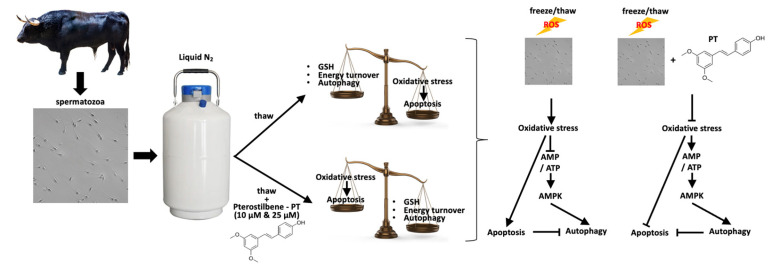
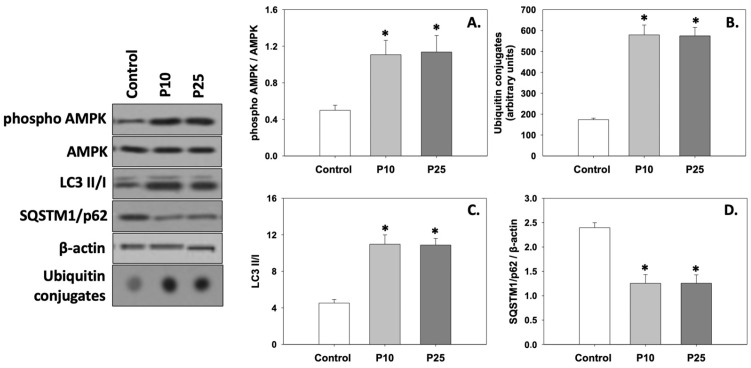
Reactive Oxygen Species (ROS) play an important role in sperm physiology. They are required in processes such as capacitation and fertilization. However, the exposure of spermatozoa to ROS generated from internal or external sources may create a potentially detrimental redox imbalance. Antioxidant supplementation in semen is now a rather common approach to protect spermatozoa from oxidative stress (OS) during their handling and/or cryopreservation. Supplementation with pterostilbene, a potent antioxidant, protects spermatozoa from OS and ameliorates their post-thawing characteristics and viability. In the present study, we used freezing/thawing as a model of natural ROS overproduction and investigated the molecular mechanisms modulated by pterostilbene. Specifically, bovine frozen/thawed spermatozoa were incubated with 10 or 25 μM pterostilbene for 60 min. Results have shown that in a dose-independent manner, pterostilbene decreased lipid peroxidation and increased intracellular GSH levels. Moreover, pterostilbene ameliorated energy production, as ATP and AMP/ATP levels were restored, and increased autophagy levels through AMP-activated protein kinase (AMPK) activation, which finally resulted in the inhibition of apoptotic cell death in bovine spermatozoa when exposed to OS. This study sheds light on spermatozoa redox state, the crosstalk between apoptotic and autophagic pathways, and its role in determining the beneficial or detrimental effect of ROS in spermatozoa.
活性氧(ROS)在精子生理过程中发挥着重要作用。它们在精子获能和受精等过程中是必需的。然而,精子暴露于内源性或外源性产生的ROS可能会造成潜在有害的氧化还原失衡。精液中添加抗氧化剂如今是一种相当常见的方法,用于在精子处理和/或冷冻保存期间保护精子免受氧化应激(OS)的影响。补充紫檀芪,一种强效抗氧化剂,可保护精子免受OS的影响,并改善其解冻后的特性和活力。在本研究中,我们将冷冻/解冻作为自然ROS过量产生的模型,并研究了紫檀芪调节的分子机制。具体而言,将牛冷冻/解冻精子与10或25μM紫檀芪孵育60分钟。结果表明,紫檀芪以剂量非依赖性方式降低了脂质过氧化,并提高了细胞内谷胱甘肽水平。此外,紫檀芪改善了能量产生,因为ATP和AMP/ATP水平得以恢复,并通过激活AMP活化蛋白激酶(AMPK)提高了自噬水平,最终在牛精子暴露于OS时抑制了细胞凋亡性细胞死亡。这项研究揭示了精子的氧化还原状态、凋亡和自噬途径之间的相互作用,以及其在确定ROS对精子有益或有害作用方面的作用。