Czajkowski Mateusz, Falis Michał, Żawrocki Anton, Sternau Magdalena, Lubiewski Andrzej, Rytlewska Magdalena, Matuszewski Marcin
Department of Urology, Medical University of Gdańsk, 80-214 Gdańsk, Poland.
Faculty of Medicine, Medical University of Gdańsk, 80-214 Gdańsk, Poland.
Cancers (Basel). 2024 Dec 12;16(24):4139. doi: 10.3390/cancers16244139.
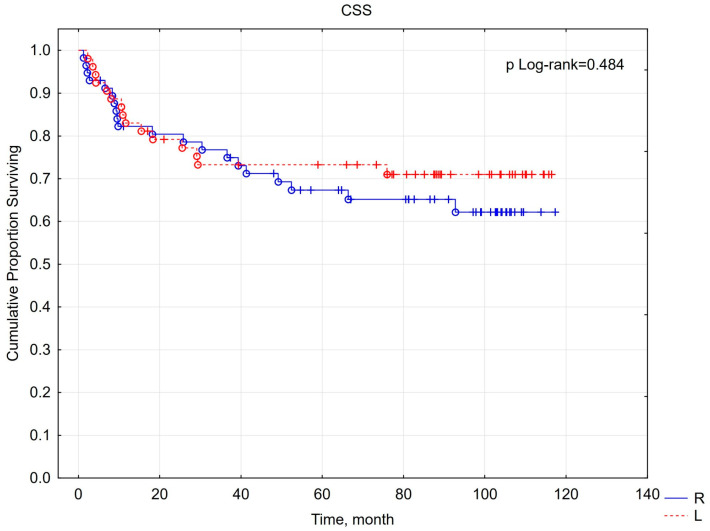
: Kidney cancer accounts for approximately 2% of all diagnosed cancers and fatalities worldwide, and a notable increase in its incidence has been observed in recent years. Previous studies have identified various risk factors for renal cell carcinoma (RCC), including age, gender, smoking, hypertension, overweight, and obesity. However, limited information is available regarding the correlation between RCC risk factors and tumor lateralization. : To investigate the relationship between body mass index (BMI) and the lateralization of kidney tumors in patients undergoing surgery for renal cell carcinoma. Moreover, we aim to evaluate the impact of lateralization of malignant kidney tumors on overall survival (OS) and cancer-specific survival (CSS). : This single-center study included 287 patients who underwent surgical treatment for kidney tumors between January 2016 and December 2019. The patients were allocated into the following groups based on their BMI: normal (18.5-24.99 kg/m), overweight (25-29.99 kg/m), or obese (≥30 kg/m). The study collected demographic and histopathological data, as well as patient history, including risk factors such as smoking and hypertension. : Right-sided kidney tumors occurred more frequently (55.05%, n = 158) than left-sided ones (44.95%, n = 129). A statistically significant relationship ( = 0.04731) was observed between BMI and the frequency of right-sided kidney tumors in the overweight group (70 vs. 43 cases). There was no correlation between BMI and the occurrence of kidney tumors in the normal BMI and obesity groups. Furthermore, the analysis revealed no association between the lateralization of kidney tumors, smoking, and hypertension. The 5-year survival rate was 62%, with a mean follow-up duration of 104 months (approximately 8.5 years). No statistically significant difference was observed between the right- and left-sided cancer groups, with survival rates of 58% and 66%, respectively ( = 0.652). : This study highlighted that right-sided kidney tumors occurred significantly more frequently in overweight individuals in our cohort of patients. No association was observed between lateralization of kidney cancer and overall survival (OS) or cancer-specific survival (CSS).
肾癌约占全球所有确诊癌症及死亡病例的2%,近年来其发病率显著上升。既往研究已确定肾细胞癌(RCC)的多种风险因素,包括年龄、性别、吸烟、高血压、超重和肥胖。然而,关于RCC风险因素与肿瘤定位之间的相关性信息有限。
为了研究体重指数(BMI)与接受肾细胞癌手术患者肾肿瘤定位之间的关系。此外,我们旨在评估恶性肾肿瘤定位对总生存期(OS)和癌症特异性生存期(CSS)的影响。
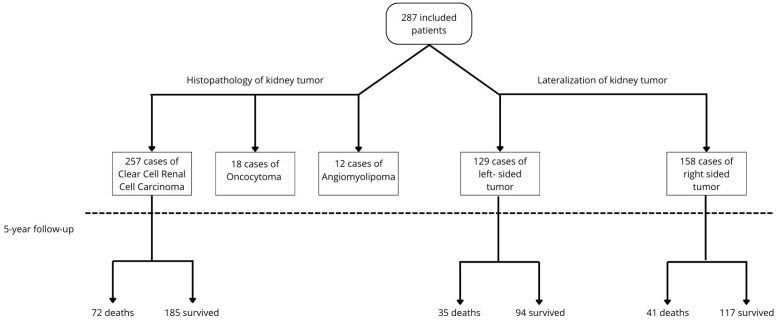
这项单中心研究纳入了2016年1月至2019年12月期间接受肾肿瘤手术治疗的287例患者。根据BMI将患者分为以下几组:正常(18.5 - 24.99 kg/m)、超重(25 - 29.99 kg/m)或肥胖(≥30 kg/m)。该研究收集了人口统计学和组织病理学数据,以及患者病史,包括吸烟和高血压等风险因素。
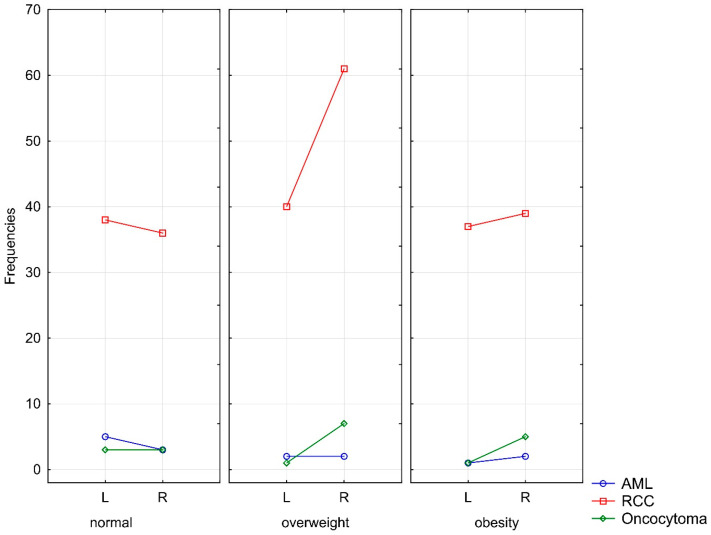
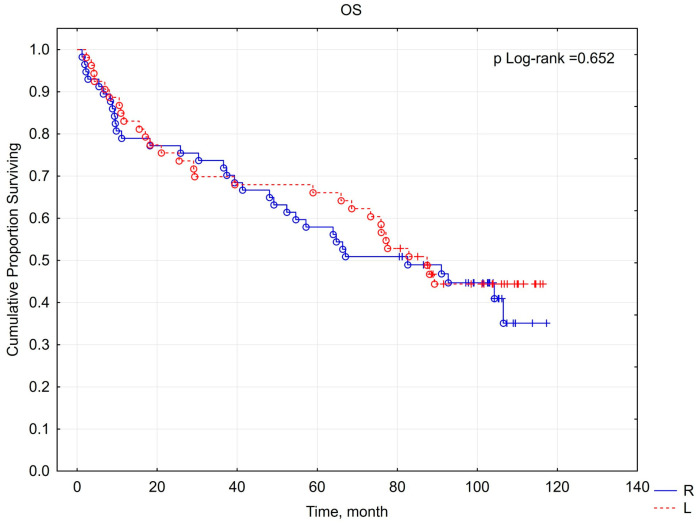
右侧肾肿瘤的发生频率(55.05%,n = 158)高于左侧(44.95%,n = 129)。在超重组中,观察到BMI与右侧肾肿瘤发生频率之间存在统计学显著关系(= 0.04731)(70例对43例)。正常BMI组和肥胖组中,BMI与肾肿瘤的发生无相关性。此外,分析显示肾肿瘤定位、吸烟和高血压之间无关联。5年生存率为62%,平均随访时间为104个月(约8.5年)。右侧和左侧癌症组之间未观察到统计学显著差异,生存率分别为58%和66%(= 0.652)。
本研究强调,在我们的患者队列中,超重个体右侧肾肿瘤的发生频率显著更高。未观察到肾癌定位与总生存期(OS)或癌症特异性生存期(CSS)之间存在关联。