Middlezong William, Stinnett Victoria, Phan Michael, Phan Brian, Morsberger Laura, Klausner Melanie, Ghabrial Jen, DeMetrick Natalie, Zhu Jing, James Trisha, Pallavajjala Aparna, Gocke Christopher D, Baer Maria R, Zou Ying S
Krieger School of Arts and Sciences, Johns Hopkins University, Baltimore, MD 21218, USA.
Department of Pathology, Johns Hopkins University School of Medicine, Baltimore, MD 21287, USA.
Biomolecules. 2024 Dec 13;14(12):1595. doi: 10.3390/biom14121595.
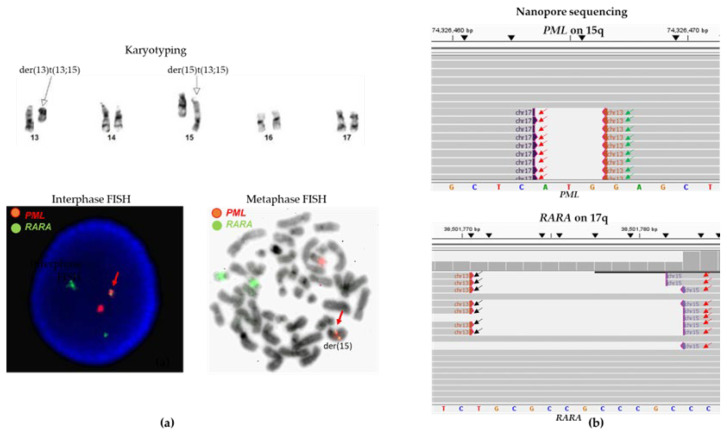
Acute promyelocytic leukemia (APL) accounts for approximately 10-15% of newly diagnosed acute myeloid leukemia cases and presents with coagulopathy and bleeding. Prompt diagnosis and treatment are required to minimize early mortality in APL as initiation of all-trans retinoic acid therapy rapidly reverses coagulopathy. The fusion is a hallmark of APL and its rapid identification is essential for rapid initiation of specific treatment to prevent early deaths from coagulopathy and bleeding and optimize patient outcomes. Given limitations and long turnaround time of current gene fusion diagnostic strategies, we have developed a novel amplification-free nanopore sequencing-based approach with low cost, easy setup, and fast turnaround time. We termed the approach CRISPR/Cas9-enriched nanopore sequencing with adaptive sampling (CENAS). Using CENAS, we successfully sequenced breakpoints of typical and atypical fusions in APL patients. Compared with the standard-of-care genetic diagnostic tests, CENAS achieved good concordance in detecting fusions in this study. CENAS allowed for the identification of sequence information of fusion breakpoints involved in typical and atypical fusions and identified additional genes ( and ) and genomic regions (13q14.13) involving the atypical fusions. To the best of our knowledge, involvements of the gene, the gene, and the 13q14.13 genomic region flanking with the and genes have not been reported in the atypical fusions. CENAS has great potential to develop as a point-of-care test enabling immediate, low-cost bedside diagnosis of APL patients with a fusion. Given the early death rate in APL patients still reaches 15%, and ~10% of APL patients are resistant to initial therapy or prone to relapse, further sequencing studies of typical and atypical fusion might shed light on the pathophysiology of the disease and its responsiveness to treatment. Understanding the involvement of additional genes and positional effects related to the and genes could shed light on their role in APL and may aid in the development of novel targeted therapies.
急性早幼粒细胞白血病(APL)约占新诊断急性髓系白血病病例的10%-15%,常伴有凝血功能障碍和出血症状。由于全反式维甲酸治疗可迅速逆转凝血功能障碍,因此需要及时诊断和治疗以降低APL患者的早期死亡率。PML-RARA融合基因是APL的标志性特征,快速识别该融合基因对于迅速启动特异性治疗、预防因凝血功能障碍和出血导致的早期死亡以及优化患者治疗结局至关重要。鉴于当前基因融合诊断策略存在局限性且周转时间长,我们开发了一种基于无扩增纳米孔测序的新型方法,该方法成本低、设置简便且周转时间短。我们将该方法称为具有适应性采样的CRISPR/Cas9富集纳米孔测序(CENAS)。使用CENAS,我们成功对APL患者典型和非典型PML-RARA融合基因的断点进行了测序。与标准的基因诊断测试相比,CENAS在本研究中检测PML-RARA融合基因时具有良好的一致性。CENAS能够识别典型和非典型PML-RARA融合基因中涉及的融合断点的序列信息,并鉴定出与非典型融合相关的其他基因(BCR和IGH)以及基因组区域(13q14.13)。据我们所知,非典型PML-RARA融合基因中尚未报道BCR基因、IGH基因以及与BCR和IGH基因侧翼的13q14.13基因组区域的相关性。CENAS具有很大的潜力发展成为一种即时检测方法,能够对携带PML-RARA融合基因的APL患者进行即时、低成本的床边诊断。鉴于APL患者的早期死亡率仍达15%,且约10%的APL患者对初始治疗耐药或易于复发,对典型和非典型PML-RARA融合基因进行进一步的测序研究可能有助于揭示该疾病的病理生理学及其对治疗的反应。了解与BCR和IGH基因相关的其他基因的参与情况和位置效应,可能有助于揭示它们在APL中的作用,并可能有助于开发新的靶向治疗方法。