Jiang Zipeng, Mei Liang, Li Yuqi, Guo Yuguang, Yang Bo, Huang Zhiyi, Li Yangyuan
Guangdong VTR Bio-Tech Co,. Ltd., Zhuhai 519060, China.
School of Biology and Biological Engineering, South China University of Technology, Guangzhou 510641, China.
Biomolecules. 2024 Dec 20;14(12):1638. doi: 10.3390/biom14121638.
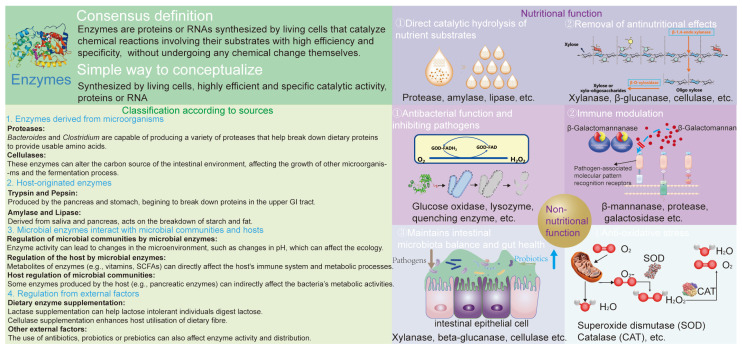
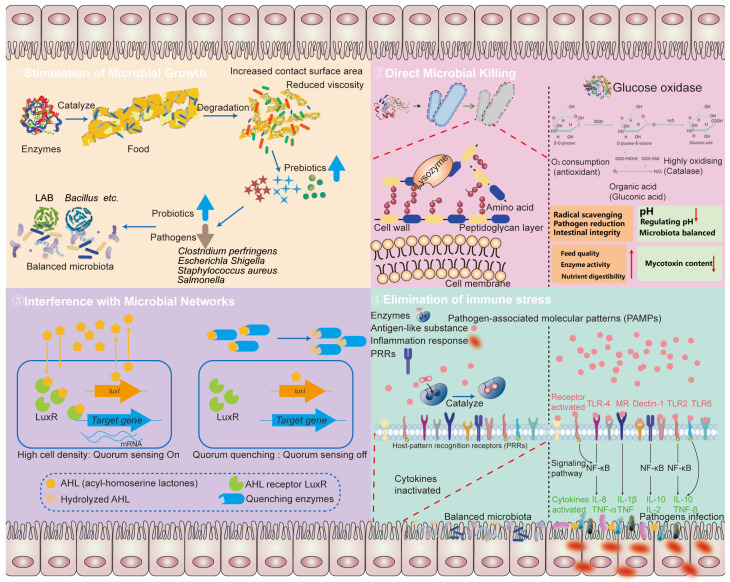
The gut microbiota, a complex ecosystem, is vital to host health as it aids digestion, modulates the immune system, influences metabolism, and interacts with the brain-gut axis. Various factors influence the composition of this microbiota. Enzymes, as essential catalysts, actively participate in biochemical reactions that have an impact on the gut microbial community, affecting both the microorganisms and the gut environment. Enzymes play an important role in the regulation of the intestinal microbiota, but the interactions between enzymes and microbial communities, as well as the precise mechanisms of enzymes, remain a challenge in scientific research. Enzymes serve both traditional nutritional functions, such as the breakdown of complex substrates into absorbable small molecules, and non-nutritional roles, which encompass antibacterial function, immunomodulation, intestinal health maintenance, and stress reduction, among others. This study categorizes enzymes according to their source and explores the mechanistic principles by which enzymes drive gut microbial activity, including the promotion of microbial proliferation, the direct elimination of harmful microbes, the modulation of bacterial interaction networks, and the reduction in immune stress. A systematic understanding of enzymes in regulating the gut microbiota and the study of their associated molecular mechanisms will facilitate the application of enzymes to precisely regulate the gut microbiota in the future and suggest new therapeutic strategies and dietary recommendations. In conclusion, this review provides a comprehensive overview of the role of enzymes in modulating the gut microbiota. It explores the underlying molecular and cellular mechanisms and discusses the potential applications of enzyme-mediated microbiota regulation for host gut health.
肠道微生物群是一个复杂的生态系统,对宿主健康至关重要,因为它有助于消化、调节免疫系统、影响新陈代谢,并与脑-肠轴相互作用。多种因素影响这种微生物群的组成。酶作为重要的催化剂,积极参与对肠道微生物群落有影响的生化反应,影响微生物和肠道环境。酶在调节肠道微生物群方面发挥着重要作用,但酶与微生物群落之间的相互作用以及酶的精确机制仍是科学研究中的一个挑战。酶既具有传统的营养功能,如将复杂底物分解为可吸收的小分子,也具有非营养功能,包括抗菌功能、免疫调节、维持肠道健康和减轻压力等。本研究根据酶的来源对其进行分类,并探讨酶驱动肠道微生物活性的作用机制,包括促进微生物增殖、直接清除有害微生物、调节细菌相互作用网络以及减轻免疫应激。系统了解酶在调节肠道微生物群中的作用及其相关分子机制,将有助于未来酶在精确调节肠道微生物群方面的应用,并提出新的治疗策略和饮食建议。总之,本综述全面概述了酶在调节肠道微生物群中的作用。它探讨了潜在的分子和细胞机制,并讨论了酶介导的微生物群调节对宿主肠道健康的潜在应用。